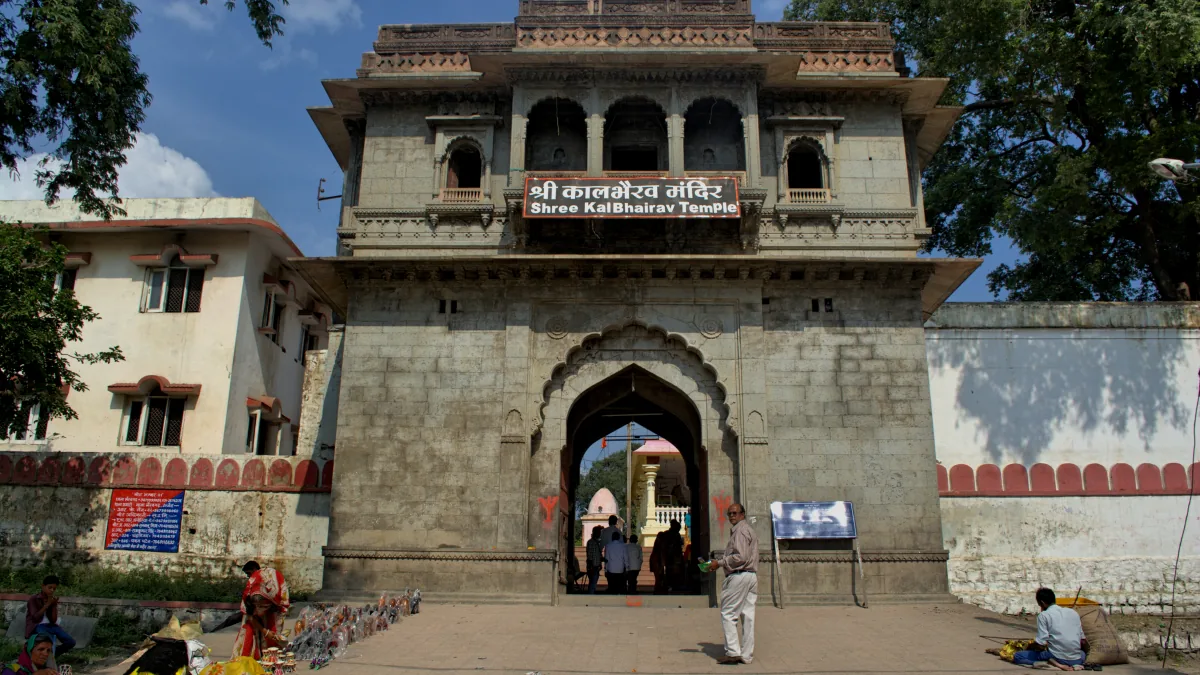
The Bhairav Chalisa is a Hindi hymn of praise to Lord Bhairav, the fierce form of Lord Shiva, and this page gives its full Roman text with a plain meaning for each of its couplets. One word in it carries most of the meaning, and that word is kotwal.
Platts’ dictionary gives kotwal as the keeper or porter of a castle, and also as the chief police officer of a city or town. So when the chalisa hails Bhairav as the Kotwal of Kashi, it is naming him the officer who keeps watch over Shiva’s own city.
Read every other line with that picture in mind.
Why this chalisa has 36 couplets and not forty
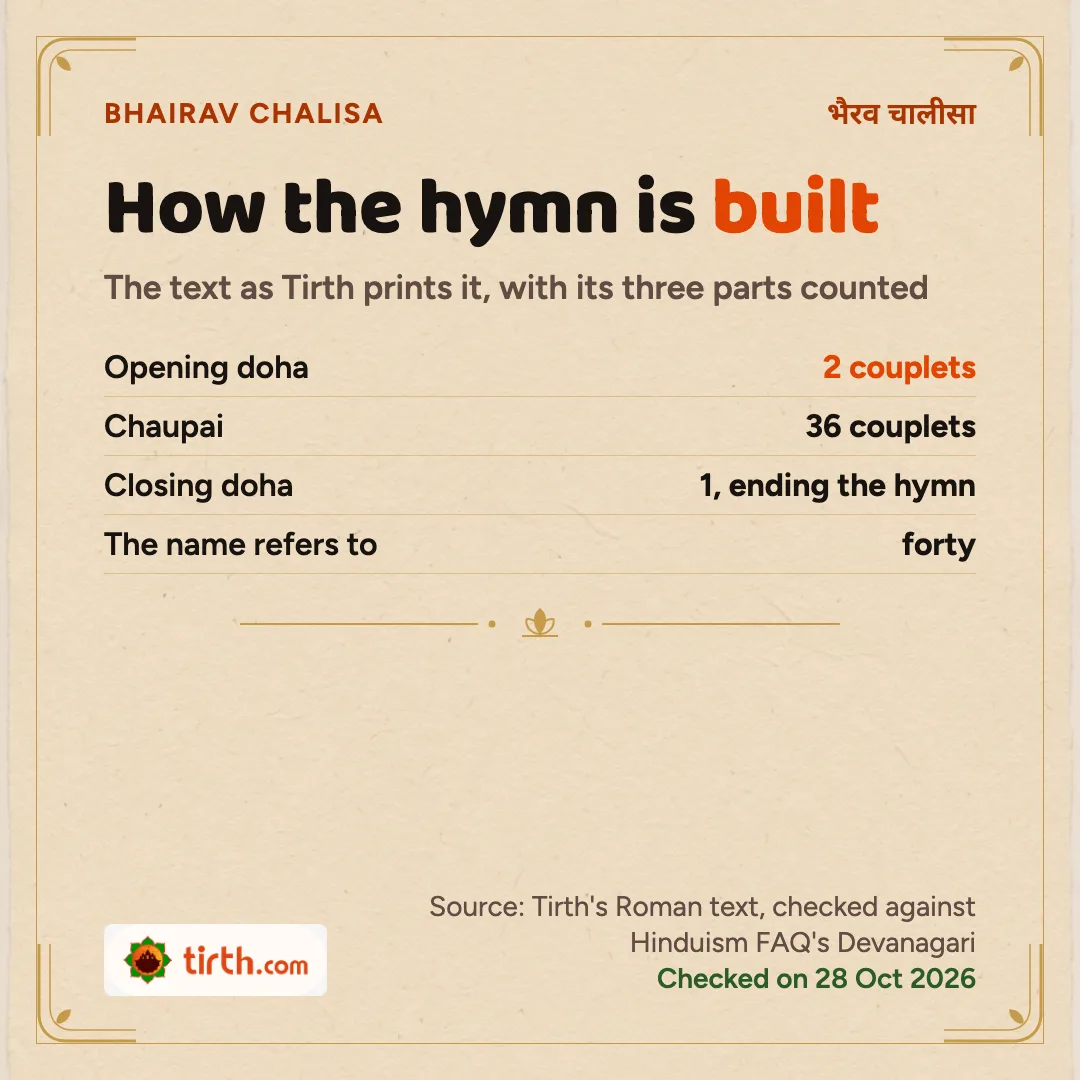
A chalisa is named for the number forty. This one does not have forty verses, and nobody should worry about that. In the Roman text on Tirth, checked line by line against the Devanagari of Hinduism FAQ, the hymn opens with a doha of two couplets, runs through 36 chaupai couplets, and closes with one more doha and the line that says the Shri Bhairav Chalisa is complete.
Printings differ.
Hinduism FAQ’s text has the same 36 couplets. Gita Insight prints a different Bhairav Chalisa altogether, with another opening and 37 couplets of its own, so a booklet that does not match the table line for line may simply be that other hymn. Pocket editions of the Shri Bhairav Chalisa are sold by Brajadham Prakashan of Mathura (32 pages). We have not yet compared that booklet with our text line by line, and until we do, the table below claims to be nothing more than the text as Tirth prints it.
Two couplets near the end name people. Couplet 34 speaks of Elaadi, and couplet 35 of Sundardas, near Shri Durvasa at Prayag. The hymn says nothing more about either of them, and so neither do we.
Bhairav Chalisa lyrics with a plain meaning for each couplet
The Roman text is set out exactly as Tirth has printed it, spellings and all, which is why the first chaupai writes KaashiKutwaala for the same Kotwal. The meaning column is Tirth’s own plain English and not a dictionary gloss. Where a line’s sense is unclear in this printing, the column says so instead of guessing (on a phone, turn the screen sideways, because the table is wide).
| Couplet | In English letters | Plain meaning (Tirth’s rendering) |
|---|---|---|
| Opening doha 1 | Shri Ganpati, Guru Gauri pad, prem sahit dhari maath. Chalisa vandan karo, Shri Shiv Bhairavnath. | With love I bow my head at the feet of Shri Ganpati, the Guru and Gauri, and offer this chalisa in praise of Shri Shiv Bhairavnath. |
| Opening doha 2 | Shri Bhairav sankat haran, mangal karan kripal. Shyam varan vikalal vapu, lochan laal vishal. | Shri Bhairav takes trouble away and brings what is good, the kind one. Dark in colour and fearsome in form, with large red eyes. |
| 1 | Jay Jay Shri Kaali ke Laala. Jayati Jayati KaashiKutwaala. | Victory, victory to the son of Shri Kali. Victory to the Kotwal (guardian) of Kashi. |
| 2 | Jayati Batuk Bhairav Bhay Haari. Jayati Kaal Bhairav Balkaari. | Victory to Batuk Bhairav, remover of fear. Victory to Kaal Bhairav, the mighty one. |
| 3 | Jayati Sarv Bhairav Vikhyaata. Jayati Naath Bhairav Sukhdaata. | Victory to Bhairav, famed in every form. Victory to Bhairav the Lord, giver of happiness. |
| 4 | Bhairav roop kiyo Shiv dhaaran. Bhav ke bhaar utaaran kaaran. | Shiva took the form of Bhairav to lift the burden of worldly life. |
| 5 | Bhairav rav sun hai bhay doori. Sab vidhi hoy kaamana poori. | The text says that on hearing Bhairav’s roar, fear goes far away and every wish is fulfilled. |
| 6 | Shesh Mahesh aadi gun gaayo. KaashiKotwal kehlayo. | Shesh, Mahesh and others sang his qualities, and he came to be called the Kotwal of Kashi. |
| 7 | Jataajoot sir chandra viraajat. Baala, mukut, bijayath saajat. | Matted hair on his head with the moon shining in it, and a crown adorning him (the words before mukut are unclear in this printing). |
| 8 | Kati karadhani ghunghru baajat. Darshan karat sakal bhay bhaajat. | Bells ring on the girdle at his waist. The text says his darshan breaks every fear. |
| 9 | Jeevan daan daas ko deenhyo. Keenhyo kripa Naath tab cheenhyo. | He gave the gift of life to his servant. When the Lord showed grace, the servant came to know him. |
| 10 | Vasi rasna bani SaradKaali. Deenyo var rakhyo mam laali. | Sense unclear in this printing. The line speaks of Sharada and Kali dwelling in the poet’s speech, and of a boon that kept his honour. |
| 11 | Dhanya dhanya Bhairav bhay bhanjan. Jay manranjan khal dal bhanjan. | Blessed, blessed is Bhairav, breaker of fear. Victory to the one who delights the mind and scatters the ranks of the wicked. |
| 12 | Kar Trishul Damru Shuchi Koda. Kripa kataaksh suyash nahin thoda. | In his hands are the trident, the damru and the koda. His glance of grace and his good name are no small thing. |
| 13 | Jo Bhairav nirbhay gun gaavat. Ashtasiddhi navnidhi fal paavat. | Whoever sings the qualities of Bhairav without fear gains the fruit of the eight siddhis and nine treasures, the text says. |
| 14 | Roop vishaal kathin dukh mochan. Krodh karaal laal duhun lochan. | His form is vast, and the text calls him the one who frees people from hard sorrow. In anger he is terrible, both eyes red. |
| 15 | Aganit bhoot pret sang dolat. Bam Bam Bam Shiv Bam Bam bolat. | Countless ghosts and spirits move with him, calling Bam Bam Bam Shiv Bam Bam. |
| 16 | Rudrakay Kaali ke laala. Mahakaalhu ke ho kaala. | Rudra in form, son of Kali. You are death even to Mahakaal. |
| 17 | Batuk Naath ho Kaal Gambheera. Shwet, rakt aru Shyaam shareera. | You are Batuk Nath and the deep Kaal, with bodies white, red and dark. |
| 18 | Karat teenhu roop prakaasha. Bharat subhaktan kah shubh aasha. | You make these three forms shine and fill your true devotees with good hope. |
| 19 | Ratnajalit kanchan singhasan. Vyaghra charm shuchi narm suvaanan. | A golden throne set with jewels, and a pure, soft tiger skin (the last word is unclear in this printing). |
| 20 | Tumhi jaai Kaashihin jan dhyaavahin. Vishwanath kah darshan paavahin. | The text says that people who come to Kashi and meditate on him receive darshan of Vishwanath. |
| 21 | Jay Prabhu Sanhaarak Sunand Jay. Jay Unnat Har Umanand Jay. | Victory to the Lord, the destroyer, Sunand. Victory to the exalted Har, Uma’s joy. |
| 22 | Bhim Trilokan Swaan Saath Jay. Baijnath Shri Jagatnaath Jay. | Victory to Bhim, the three-eyed, with a dog at his side. Victory to Baijnath, Shri Jagatnath. |
| 23 | Mahabhim Bhishan Shareer Jay. Rudra Tryambak Dheer Veer Jay. | Victory to the very fearsome one, terrible in body. Victory to Rudra, Tryambak, steady and brave. |
| 24 | Ashwanaath Jay Pretnath Jay. Swanaarudh Saychandra Naath Jay. | Victory to Ashwanath and Pretnath. Victory to the Lord who rides a dog, Saychandra Nath (name as printed). |
| 25 | Nimish Digambar Chakranaath Jay. Gahat Anaathan Naath Haath Jay. | Victory to Nimish, Digambar and Chakranath. Victory to the Lord who takes the hand of the helpless. |
| 26 | Treshlesh Bhootesh Chandra Jay. Krodh Vats Amaresh Nand Jay. | A run of names, each hailed with victory, among them Bhootesh and Amaresh (several names are unclear in this printing). |
| 27 | Shri Vaaman Nakulesh Chand Jay. Krityaau Keerati Prachand Jay. | More names hailed with victory, Shri Vaaman, Nakulesh and Chand, and the fierce one of great fame (Krityaau is unclear). |
| 28 | Rudra Batuk Krodhesh Kaal Dhar. Chakra Tund Dash Paanivyaal Dhar. | Rudra, Batuk, Krodhesh, bearer of Kaal. The second half lists what he holds in his hands (sense unclear in this printing). |
| 29 | Kari Mad Paan Shambhu Gungavat. Chausath Yogini Sang Nachavat. | He makes the sixty-four Yoginis dance with him (the first half of the line is unclear in this printing). |
| 30 | Karat Kripa Jan Par Bahu Dhanga. Kaashi Kotwaal Adbanga. | He shows people grace in many ways, the Kotwal of Kashi, like no other. |
| 31 | Deyam Kaal Bhairav Jab Sota. Nasai Paap Mota se Mota. | The first half is unclear in this printing. In the second, the text says even the heaviest sin is destroyed. |
| 32 | Jaakar Nirmal Hoy Shareera. Mitei Sakal Sankat Bhav Peera. | The text says the body becomes pure, and every trouble and pain of worldly life is wiped away. |
| 33 | Shri Bhairav Bhooton ke Raaja. Baadha Harat Karat Shubh Kaaja. | Shri Bhairav is king of the spirits. The text says he removes obstacles and brings good work to completion. |
| 34 | Elaadi ke dukh nivaryo. Sada Kripa Kari Kaaj Samhaaryo. | He took away the sorrow of Elaadi, and always showed grace and set his work right. |
| 35 | Sundardas sahit anuraaga. Shri Durvaasa nikat Prayaaga. | Sundardas, with love, near Shri Durvasa at Prayag (the sense runs on into the next couplet)… |
| 36 | Shri Bhairav ji ki Jay lekhyo. Sakal Kaamana Pooran Dekhyo. | …wrote out the praise of Shri Bhairav ji, and the text says he saw every wish fulfilled. |
| Closing doha | Jay Jay Jay Bhairav Batuk, Swami Sankat Taar. Kripa Daas Par Kijiye, Shankar Ke Avtaar. Jo Yah Chaalisa Padhe, Prem Sahit Sat Baar. Us Ghar Sarvaanand Hon, Vaibhav Bade Apaar. || Iti Shri Bhairav Chaalisa Samaapt || | Victory, victory, victory to Bhairav Batuk, the Lord who carries us across trouble. Show grace to your servant, you who came as Shankar. The text says that whoever reads this chalisa with love, sat baar, that house has every joy and great prosperity. Here the Shri Bhairav Chalisa ends. |
Bhairav, kotwal and sankat in Platts’ dictionary
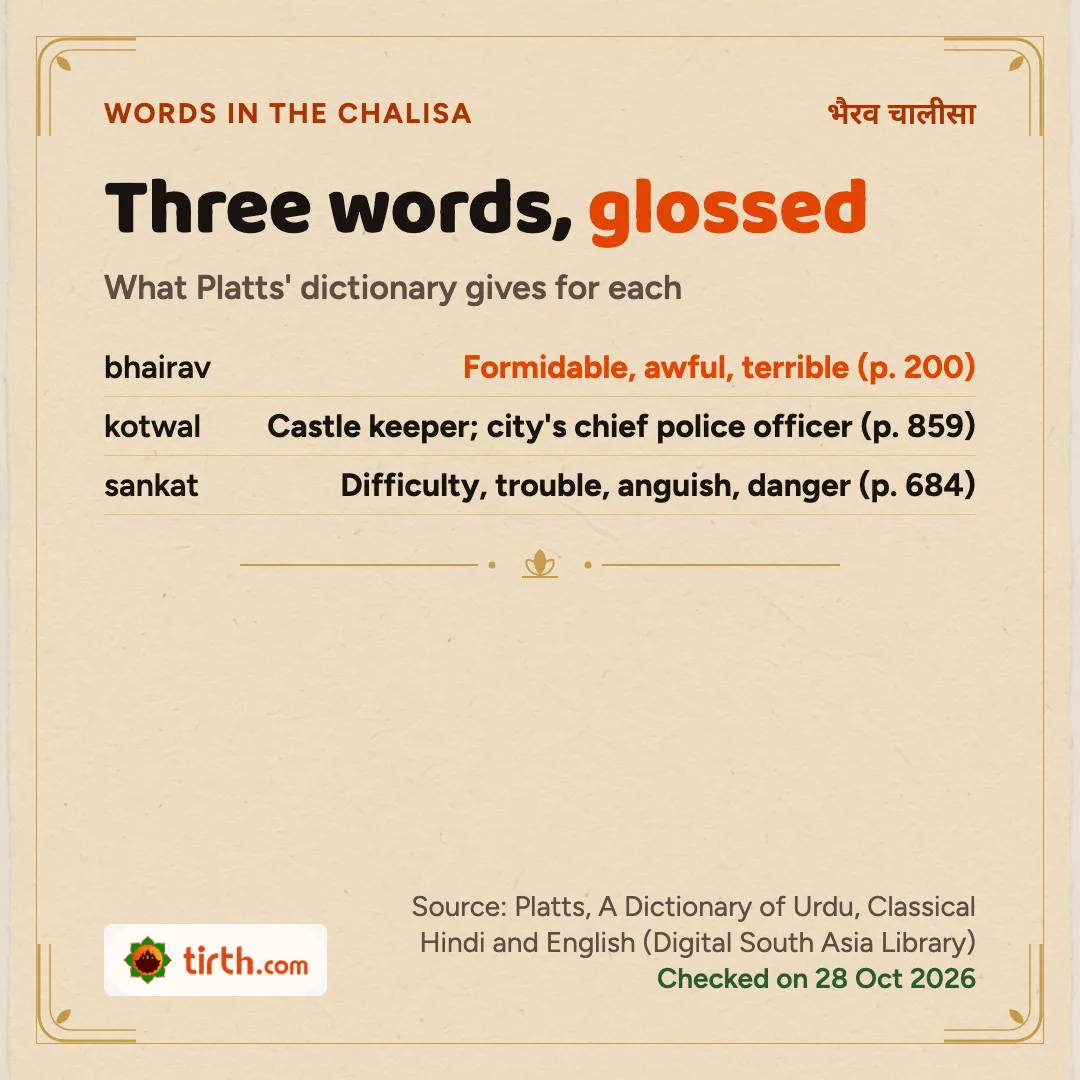
Three words hold the hymn together.
Each has an entry in Platts’ A Dictionary of Urdu, Classical Hindi and English, and the page numbers are below so you can look them up yourself.
| Word | What Platts gives | Page |
|---|---|---|
| bhairav (भैरव) | Formidable, awful, terrible; a form of Shiva; also the name of a raag | 200 |
| kotwal (कोतवाल) | The keeper or porter of a castle; the chief police officer of a city or town | 859 |
| sankat (संकट) | Difficulty, trouble, anguish, affliction, danger; also a narrow passage | 684 |
So the name Bhairav already says what the chalisa goes on to describe in couplet 14, the vast form and the red eyes. Sankat is trouble. Platts gives it first as difficulty and anguish, and also as a narrow passage, which is about the best picture of trouble there is. Sankat haran in the second opening doha names Bhairav as the one who takes that trouble away.
Other words in the text, jataajoot, damru, koda, vikalal etc., have no sourced gloss in this post, so the meaning column renders them in plain English.
Kaal Bhairav, Batuk Bhairav and the Kotwal of Kashi
The chalisa praises one Lord under many names. Its very first chaupai hails him as the son of Shri Kali, so it sits naturally beside the Kali Chalisa. Couplet 2 names Batuk Bhairav and Kaal Bhairav together. Couplet 4 then says it outright, that Shiva took the form of Bhairav.
Anyone who knows the Shiv Chalisa will hear the same Lord here in his fierce form, with matted hair, the moon on his head, and the trident and the damru in his hands.
Kashi is named in four couplets: 1, 6, 20 and 30.
Couplet 1 hails him as KaashiKutwaala, couplet 6 says he came to be called the Kotwal of Kashi, couplet 30 calls him Kaashi Kotwaal again, and couplet 20 says that people who come to Kashi and meditate on him receive darshan of Vishwanath. If you are planning a trip to the city yourself, our Kashi Vishwanath darshan guide covers the temple side of that trip.
Batuk Bhairav needs a word of caution. Gita Press prints a Shri Batuk Bhairav Chalisa (32 pages, 2016), which is a different text about the child form of Bhairav, and we found no Gita Press edition of the Shri Bhairav Chalisa itself. If you are buying a booklet for a parent who reads only from print, check the title on the cover before you pay.
Kalashtami, Kalabhairav Jayanti and reading it at home
Kalashtami, the Ashtami of the waning fortnight, is the monthly day for Bhairav worship. The date moves. Look up the next one in the monthly Kalashtami list on Tirth when you need it, and there is no date you have to keep in your head from one month to the next.
Kalabhairav Jayanti falls on Margashirsha Krishna Ashtami (Kartika, if your calendar counts months the amanta way). In 2026 that is Tuesday, 1 December; some panchangs may show another day, so check your local panchang for the tithi hours. The Tirth Spiritual Calendar has it.
On how often to read it, the closing doha speaks for itself. It says that in the house where this chalisa is read with love, sat baar, there will be every joy and great prosperity. One page explains sat baar as a hundred times, and the hymn itself gives no number, so we give no count. Those are the hymn’s own words, a hope set before Bhairav. If you are new to it, read it once, slowly, with the meaning column open beside you. The run of names in couplets 21 to 28 goes by fast, and the words are easier to mean when you know whom they call.
To go on from here, the Bhairav Baba aarti and the Kaal Bhairav beej mantra are both on the blog. Tirth also has a page for the Kaal Bhairav puja in Ujjain and one for the Kal Bhairav temple in Ujjain. More hymns of this kind sit in the chalisa collection.
Frequently asked questions
What is the Bhairav Chalisa?
A Hindi hymn to Lord Bhairav, Lord Shiva’s fierce form. In the version Tirth prints, it has an opening doha of two couplets, 36 chaupai couplets and a closing doha.
Why is Bhairav called the Kotwal of Kashi?
Platts’ dictionary (p. 859) gives kotwal as the keeper of a castle or the chief police officer of a city, and the chalisa itself calls Bhairav Kashi’s Kotwal in couplets 6 and 30, the guardian of Shiva’s city.
How many verses does the Bhairav Chalisa have?
The version on Tirth has 36 chaupai couplets, though a chalisa is named for forty, between an opening doha of two couplets and a closing doha. Gita Insight prints another Bhairav Chalisa, 37 couplets long. Check which hymn your booklet holds.
Is the Bhairav Chalisa the same as the Batuk Bhairav Chalisa?
No. Gita Press prints a Shri Batuk Bhairav Chalisa, a separate text about the child form of Bhairav. The chalisa on this page names Batuk Bhairav in its second couplet, but it is a different hymn.
What does sankat haran mean?
Remover of trouble. Platts (p. 684) gives sankat as difficulty, trouble, anguish, affliction or danger, and the second opening doha uses the phrase for Shri Bhairav.
When should the Bhairav Chalisa be read?
The hymn names no day. Its closing doha says that the house where it is read with love, sat baar, has every joy and great prosperity. Kalashtami, the Ashtami of the waning fortnight, is the monthly day for Bhairav worship, and Kalabhairav Jayanti falls on Tuesday, 1 December in 2026, though some panchangs may show another day, so check your local panchang for the tithi hours.
Leave a Reply