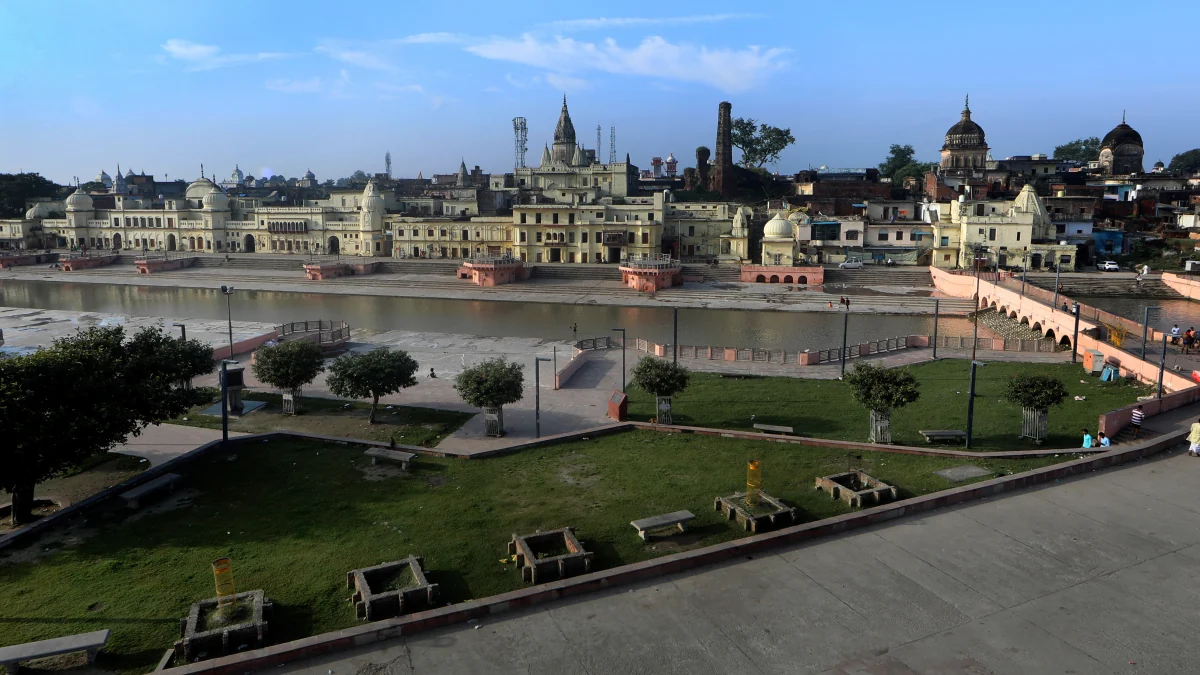
Ram Mandir opens its gates at 4:00 AM, but the regular darshan line doesn’t move until 7:00 AM.
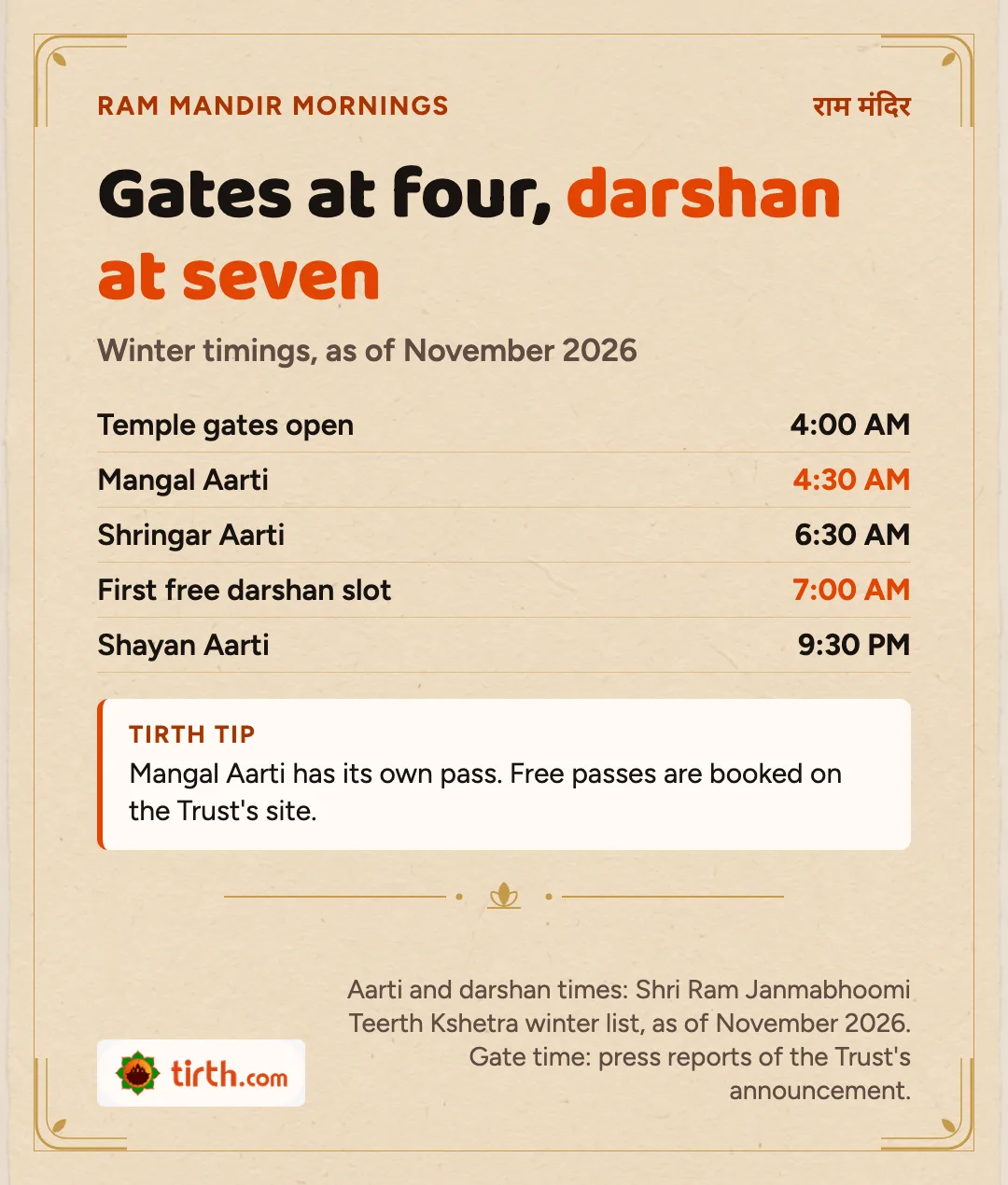
The Ayodhya morning spiritual experience sits in between. Going by the Trust’s own list as of November 2026, Mangal Aarti is at 4:30 AM, Shringar Aarti at 6:30 AM and free darshan from 7:00 AM. That list has no gate time on it, mind. The 4:00 AM figure is from press reports of what the Trust announced.
So if you reach the gate at four expecting to stand before Bhagwan Ram a few minutes later, that’s not how the morning goes here. What four o’clock gets you is the aarti. And only with a pass.
In Ayodhya the temple clock is fixed, while sunrise over the Saryu slides by more than an hour and a half between mid-January and mid-June, so what counts as an early start here changes with the month you come in.
What happens at Ram Mandir between 4 AM and 7 AM?
A Trust runs the temple, the Shri Ram Janmabhoomi Teerth Kshetra. Its winter list came in from the start of November 2026, and the morning end of it looks like this, with the 4:00 AM gate taken from press reports of the Trust’s announcement.
| Time (as of November 2026) | What happens |
|---|---|
| 4:00 AM | Temple gates open |
| 4:30 AM | Mangal Aarti (free aarti darshan, with a pass) |
| 6:30 AM | Shringar Aarti |
| 7:00 AM | First free darshan slot begins |
Press reports of the Trust’s announcement say the hours between the aartis go to rituals, with the doors shut for darshan through that stretch. So 4:00 AM gets you as far as the gate and the aarti, and darshan itself waits for 7:00 AM.
No fee is charged for aarti or darshan passes, the Trust says. Booking is on its own site, and whatever is printed on your pass, go by that.
Where people slip up, I think, is treating Mangal Aarti as an extra-early darshan slot. It has its own pass. Getting up early doesn’t move the darshan line forward, and that line opens at 7:00 AM same as on any morning.
The temple’s list sits in one place on the Ram Mandir page on Tirth. Look at it again the week you travel.
When does Brahma Muhurta start in Ayodhya?
No temple notice prints it. It’s a tradition thing, Brahma Muhurta, and it hangs off sunrise. So it moves.
A muhurta is 48 minutes. Brahma Muhurta, as per the usual reckoning, is the one that ends 48 minutes before sunrise, so it starts about 96 minutes before the sun is up.
Panchangs don’t all agree on the count, and families differ too. So read the times below as approx.
| Month (middle of the month) | Sunrise in Ayodhya, about |
|---|---|
| December 2026 | 6:41 AM |
| January 2027 | 6:51 AM |
| February 2027 | 6:37 AM |
| March 2027 | 6:11 AM |
| April 2027 | 5:37 AM |
| May 2027 | 5:13 AM |
| June 2027 | 5:06 AM |
| July 2027 | 5:16 AM |
| August 2027 | 5:32 AM |
| September 2027 | 5:46 AM |
| October 2027 | 6:00 AM |
| November 2027 | 6:20 AM |
Subtract the 96 minutes and the start lands at about 5:05 AM in mid-December. In mid-March it’s about 4:35 AM, in mid-June about 3:30 AM and in mid-September about 4:10 AM.
In December, Mangal Aarti is at 4:30 AM, and Brahma Muhurta doesn’t begin till a good half hour and more after that. June would turn it around, with Brahma Muhurta starting an hour ahead of the aarti and the sun up at 5:06 AM, well before Shringar Aarti at 6:30 AM. All of that assumes the winter list still holds in June, though, and it may not, since the Trust changes its timings with the season.
(Half past three in June is a hard wake-up with older parents along. Clothes and passes laid out the night before.)
For the exact sunrise on your travel date, the Tirth panchang works it out day by day.
Is a dawn dip at Ram ki Paidi part of the morning?
Then there’s the Saryu. Ram ki Paidi, going by the Ayodhya district website, is a row of ghats along the bank of the Saryu. Devotees go into the water there. A dip at Ram ki Paidi, the page says, is believed to wash away sins.
Dawn doesn’t come up on that page at all. If anything it praises the ghats most when they are floodlit at night. So the idea that the dip has to happen before sunrise isn’t from any official page that I know of.
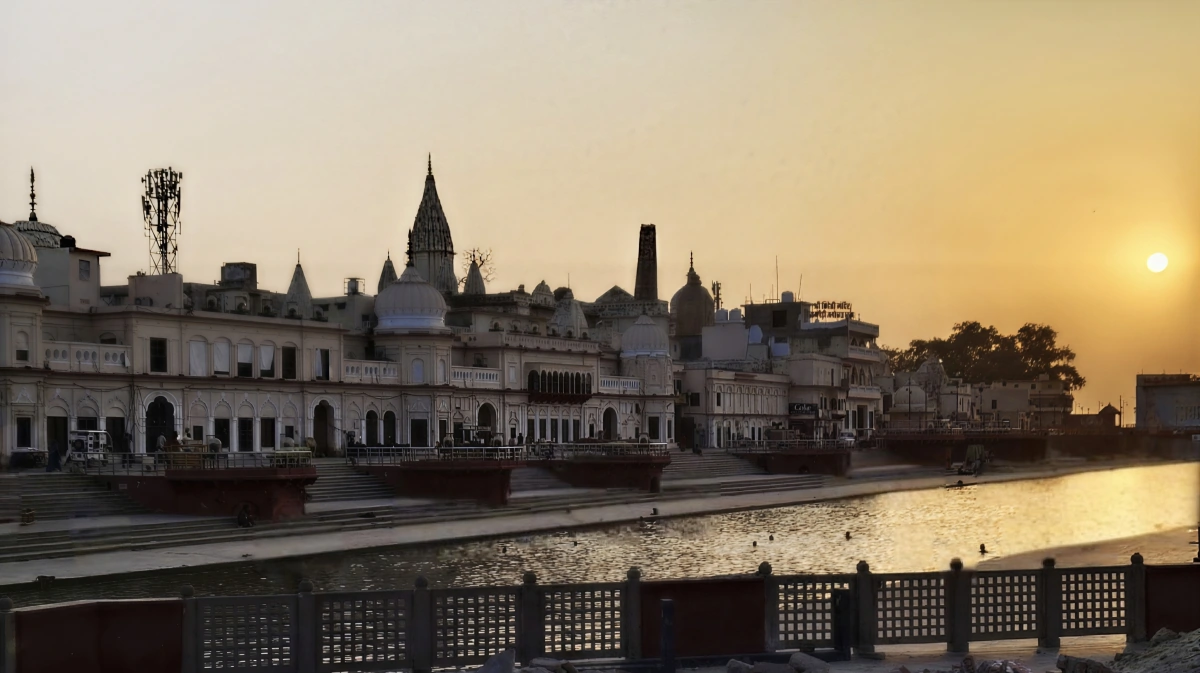
Same story with a Saryu aarti in the morning. Nothing official puts a time on one. One private guide talks of an aarti as the day starts and another as it ends, but that’s a private site, so ask at the ghat the evening before and plan around whatever they tell you there.
What this river means to the city is its own long story, told in why the Saryu matters to Ayodhya.
The Valmiki Ramayana, Bala Kanda, sarga 5, shloka 8, describes Ayodhya’s broad royal highway strewn with flowers and regularly sprinkled with water.
Can you fit Hanumangarhi into the same morning?
Yes. Just don’t look for an official time for it. Hanumangarhi is 1 km from Ayodhya railway station, as per the district website.
That same page says Hanuman ji is believed to have lived here, guarding Ayodhya, and it credits Vikramaditya with having the temple built. Inside, the main temple’s murti shows the young Hanuman ji sitting on Maa Anjani’s lap.
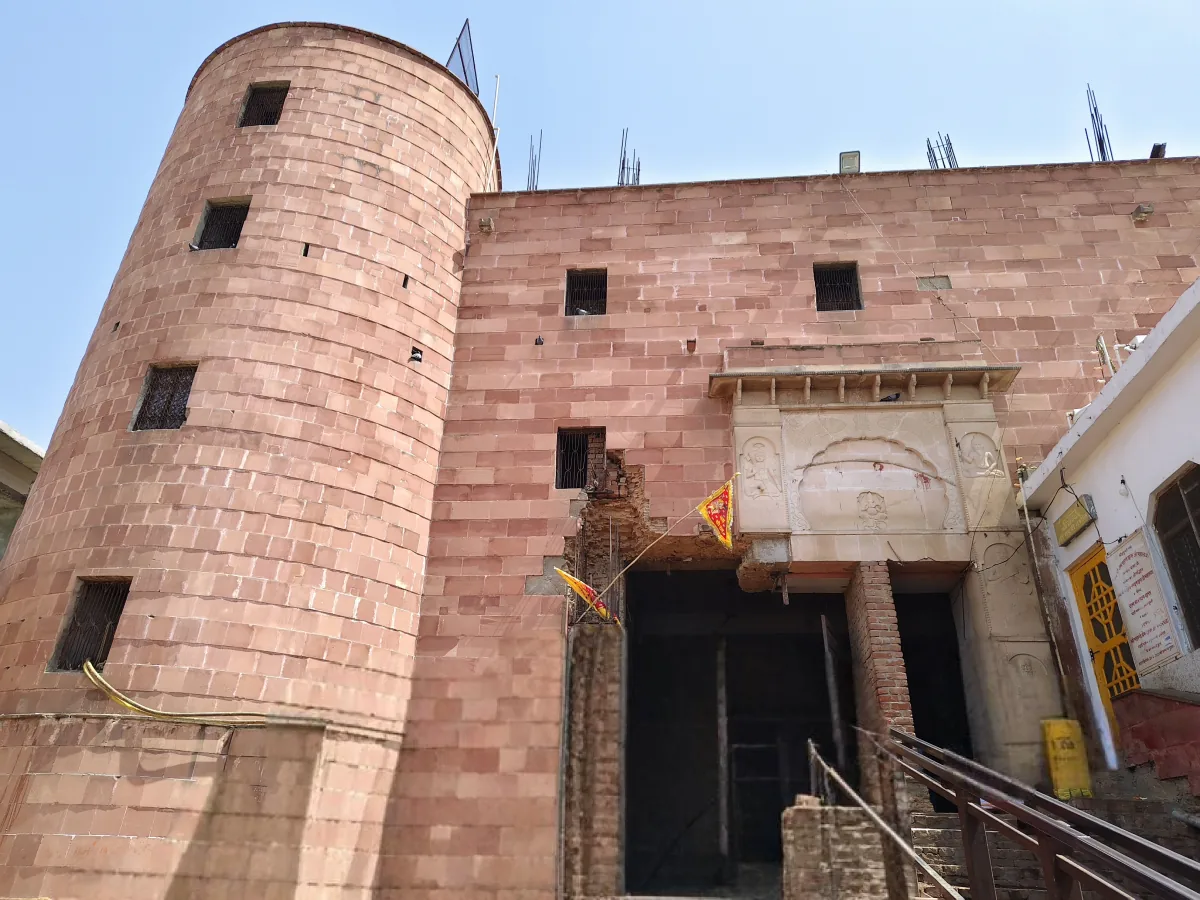
No opening hours on that page, though. I won’t guess them for you.
Ask at your hotel or the temple the evening before. Then slot it on whichever side of the Ram Mandir darshan suits you, once you know the hours. Before or after, your call.
A December morning vs a June morning in Ayodhya
Put the pieces together and a mid-December morning goes roughly like this.
- 4:00 AM at the Ram Mandir gates, Mangal Aarti pass booked ahead on the Trust’s site.
- Mangal Aarti, at 4:30 AM.
- From about 5:05 AM, Brahma Muhurta, while, by press reports, the temple stays shut for its rituals.
- Shringar Aarti at 6:30 AM. Sunrise over the Saryu follows at about 6:41 AM.
- From 7:00 AM, the first free darshan slot.
Sunrise in December falls in the gap between Shringar Aarti and darshan, so you can’t be at the river for it and in the temple too.
My pick would be the 7:00 AM darshan, and a walk down to Ram ki Paidi after it. The darshan slot runs to a clock, while the ghat has no published one.
June turns it around. Sunrise is about 5:06 AM then, which leaves time for the Saryu at first light and a return well before 6:30 AM, provided the Trust’s summer list sits close to the winter one. Check its notice for that before you book a single thing.
From mid-December to mid-March, Brahma Muhurta starts after the 4:30 AM aarti, at about 5:05 AM at one end of that stretch and 4:35 AM at the other. How each season feels on the ground is in best time to visit Ayodhya.
Rather not sort out passes and an early ride to the gate on your own? Tirth’s senior-friendly Ayodhya yatra is worth a look. Finding an auto in the dark is its own small headache.
If you are staying into the evening as well, read how Ayodhya slows after sunset, which picks up where this morning leaves off.
Frequently asked questions
What time is Mangal Aarti at Ram Mandir?
On the Trust’s list as of November 2026 Mangal Aarti is at 4:30 AM. Press reports of the Trust’s announcement give the gates opening at 4:00 AM. The Trust changes these with the season. Check its latest notice.
What time does darshan start at Ram Mandir in the morning?
7:00 AM, when the first free darshan slot begins. Before that it’s Mangal Aarti, then rituals, then Shringar Aarti at 6:30 AM, one after the other.
Can I get darshan if I reach at 4 AM?
For Mangal Aarti, yes, if you have a pass. Turning up early won’t get you regular darshan, though. That begins at 7:00 AM.
Do I have to pay for the aarti pass?
No. As per the Trust, aarti and darshan passes carry no fee. Booking is on its site, and the instructions on the pass are what you follow.
What time is Brahma Muhurta in Ayodhya?
By the common reckoning it starts about 96 minutes before sunrise. For Ayodhya, about 5:05 AM in mid-December and about 3:30 AM in mid-June. Reckonings differ a little.
Is there a morning aarti at the Saryu?
Nothing official gives a time for one. Ask the evening before, at Ram ki Paidi itself, and plan around what you hear.
Continue on Tirth
- The Ayodhya family trip guide, for temples, aarti and the rest of the visit around the morning.
- A whole day in Ayodhya, if you are staying on past the morning.
- Living Ayodhya, on how the city keeps its faith.
- Ram Mandir on Tirth, for the temple’s current darshan list.
Leave a Reply