Navratri: Meaning, Customs and Celebrations
Navratri is a major festival in the Hindu calendar. It is dedicated to the worship of Maa Durga and her nine forms. The nine nights honour Maa Durga as Shakti, and the tenth day, Vijayadashami, marks the victory of good over evil. Devotees across India observe fasts, perform daily puja, and engage in various activities.
Like most major Hindu festivals in India such as Durga Puja, Dussehra, and Diwali, Navratri is also a time of devotion and worship. The festival combines ritual worship and expression of culture. It brings faith, custom and community together.
More on festivals and traditions: Devotional Lifestyle and Culture.
Navratri date and Ghatasthapana timing
Sharad Navratri in 2027 (New Delhi): begins on Thursday, 30 September. Hindu month: Ashwin. Pratipada begins at 8:04 AM on 30 September and ends at 5:34 AM on 1 October. No sunrise falls within it. The Tirth Spiritual Calendar marks this start as a close call, because the Pratipada is kshaya this year (it begins and ends between two sunrises), so check the timings for your city on the calendar page.
Ghatasthapana on 30 September: 8:04 AM to 10:11 AM. Abhijit muhurat, the alternative: 11:47 AM to 12:34 PM.
Durga Ashtami: Thursday, 7 October 2027. Vijayadashami (Dussehra): Saturday, 9 October 2027. Navratri lasts 9 nights, and the 10th day is Vijayadashami.
Dates and timings for New Delhi from the Tirth Spiritual Calendar. Checked on 27 Nov 2026. Timings for your city in the Tirth Spiritual Calendar
What is the meaning of Navratri?
The Navratri festival has its origins in the Sanskrit language. The word ‘Nava’ means nine in Sanskrit and ‘Ratri’ means ‘nights’.
Each of the nine nights is dedicated to a different form of Maa Durga. The tenth day is considered Vijayadashami or Dussehra and it is a celebration of the victory of good over evil.
There are four Navratri festivals each year, but the most important and most celebrated of the four is Sharad Navratri and it is celebrated in the month of Ashwin, according to the Hindu calendar.
What is the Cultural and Spiritual Importance of Navratri?
Navratri is a time for celebration and also for discipline. Many people use the nine days to:
- Fast to practice self-restraint
- Take the time to reflect and focus on inner values and strength
- Offer prayer or meditation and ask for guidance
Navadurga
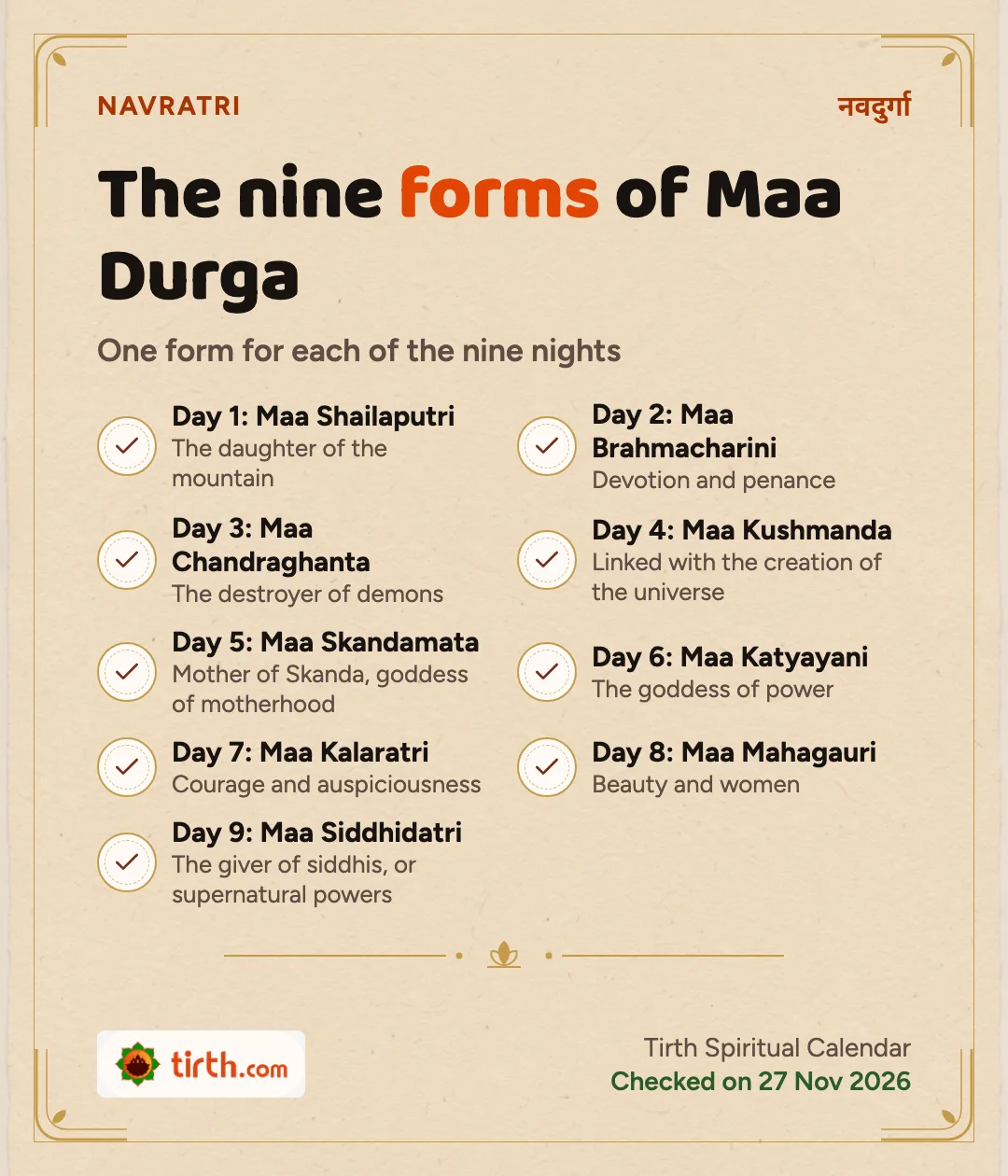
The nine forms of Maa Durga correlate to the nine days of the Navratri festival:
- Maa Shailaputri: the daughter of the mountain
- Maa Brahmacharini: devotion and penance
- Maa Chandraghanta: the destroyer of demons
- Maa Kushmanda: linked in tradition with the creation of the universe
- Maa Skandamata: the mother of Skanda (Kartikeya), the goddess of motherhood
- Maa Katyayani: the goddess of power
- Maa Kalaratri: the goddess of courage and auspiciousness
- Maa Mahagauri: the goddess of beauty and women
- Maa Siddhidatri: the goddess of siddhis, or supernatural powers
Navratri Practices and their Significance
Ghatasthapana
On the first day, Maa Durga is invoked in a kalash. A kalash filled with water is set up with mango leaves and a coconut on top.
Puja and Fasting
Many devotees fast for the nine days; what they eat differs by family and region.
Daily Bhajan and Aarti
Many homes sing bhajans and do aarti during the nine days.
The Celebration of Navratri in Different Parts of India
The festival of Navratri is celebrated in various manners all over the country:
- Gujarat: Garba and Dandiya Raas
- West Bengal: Durga Puja
- Northern India: Ram Leela, the dramatic retelling of Bhagwan Ram’s story, which ends with Dussehra
- Southern India: Golu, the doll display; in Karnataka, Ayudha Puja on the ninth day
Customs vary by community and region, and many families keep their own.
Navratri Celebration Rituals and Food
Fasting customs differ by family and region. In many households, a Navratri fast allows foods such as these:
- Sabudana khichdi
- Dishes made from flour of kuttu and singhara
- Makhana and dry fruits
Many households leave out onion and garlic during the fast. Each family follows its own custom.
Relevance of Navratri Today
Navratri is kept both in community gatherings, such as Garba nights, and in puja at home.
Celebrating Faith and Strength with Navratri
Navratri is the celebration of devotion, discipline, strength and Shakti. For many it means prayer, fasting and dance, and for many a community gathering.
Navratri Frequently Asked Questions
1. Why is Navratri celebrated?
Navratri is celebrated to honour and pay tribute to Maa Durga, and in doing so, it celebrates the triumph of good over evil.
2. How many Navratris are there in a year?
There are four Navratris in a year, and among the four, Sharad Navratri is the most popular.
3. Is fasting a must during Navratris?
No. Fasting is a personal choice, and families follow their own custom.
4. What is Ghatasthapana?
Ghatasthapana is the first ritual of Navratri in which Maa Durga is invoked and welcomed.
5. When is Navratri?
Sharad Navratri falls in the month of Ashwin. The dates and the Ghatasthapana timing for New Delhi are in the date card near the top of this page.
6. What comes after Navratri?
The festival of Navratri ends with the celebration of Vijayadashami (Dussehra).
Continue on Tirth
- Sharad Navratri in the Tirth Spiritual Calendar: the dates and Ghatasthapana timing for your city.
- Maa Durga on Tirth: her chalisa, mantras and stotram.
- Durga Puja guide: Mahalaya, Sandhi Puja and the Visarjan.
Leave a Reply