A boy born from Bhagwan Shiva’s fury, raised by the ocean, and hard to beat while one woman stayed faithful to him. That is where the Tulsi Vivah story begins, long before anyone thought of a wedding.
Mark Saturday, 21 November 2026 for Tulsi Vivah. Devutthana Ekadashi sits just before it on Friday, 20 November. Regional calendars may also differ by a day, so look up your own city on the Tirth Spiritual Calendar.
Where did Jalandhar come from?
The story opens on Kailasa. Indra Dev comes to see Bhagwan Shiva, who bars his way dressed as an ascetic, and Indra Dev raises his thunderbolt. Bhagwan Shiva’s third eye opens. The fire from it goes into the sea. That is at the meeting of the Ganga and the ocean, as the Shiva Purana tells it.
It becomes a crying boy. His cry shakes the worlds.
The gods, Indra Dev among them, go to Brahma Dev, and the ocean says he does not know whose child this is. Brahma Dev hands the boy over to be raised as the ocean’s own son. He names him Jalandhar, because the child made Brahma Dev’s eyes water. He also foretells that the boy will be emperor of the Asuras and able to conquer even Bhagwan Vishnu. Only Bhagwan Shiva can slay him.
The ocean arranges his marriage to Vrinda, the daughter of the Asura Kalanemi.
What kept Jalandhar unbeaten?
In time the war reached Kailasa.
The texts treat Vrinda’s faithfulness as what his strength rested on. While she stayed true to her husband, no god could beat him. Her faithfulness is the point the texts keep returning to.
I find that hard to read. A war should not be won by breaking a woman’s faithfulness.
How was Vrinda deceived?
In the Shiva Purana, Bhagwan Vishnu goes to Jalandhar’s city and, by illusion, gives Vrinda a dream. Her husband is naked, smeared with oil, riding a buffalo towards the south, and the omens drive her out into a forest.
In the forest two lion-faced demons close in on her. An ascetic scares them away with a single shout, and he is Bhagwan Vishnu in disguise.
Two monkeys then bring her husband’s head and limbs. She begs the ascetic for help, and out of pity he revives the man.
The Padma Purana, narrated by Narada, varies the scene. Here Bhagwan Vishnu appears as the husband she has just got back, and they live in the forest together.
After many days Vrinda realises who has been beside her.
In both texts she rebukes him and speaks a shraap, a spoken word of ruin, saying that the two who stood before her will become Rakshasas and carry off his wife. He will know separation, and monkeys will help him.
Anyone who knows the Ramayan hears it in those lines, and the footnotes to the Shiva Purana translation say as much.
Vrinda goes into the fire, and Bhagwan Vishnu tries and fails to prevent it.
Her radiance merges into Maa Parvati in the Shiva Purana. The Padma Purana has Bhagwan Vishnu cover himself with her ashes, and he finds no peace.
Once the vow is gone, Bhagwan Shiva brings the war to an end. Jalandhar makes an illusory Maa Parvati to deceive him. Bhagwan Shiva forms a discus from his toe and cuts off the Asura’s head, and Jalandhar’s splendour merges into Bhagwan Shiva. The Padma Purana gives the same ending. There Bhagwan Vishnu tells Bhagwan Shiva the truth first, and the weapon is the Sudarshana discus.
Where does the Tulsi plant come from in the Padma Purana?
The plant has its own account. It is in the Padma Purana, Uttara Khanda, chapters 104 and 105. Maa Gauri, Maa Lakshmi and other forms of Maya hand seeds to the gods. They sow them where Bhagwan Vishnu stays.
Three plants sprout, Dhatri from the earth and Malati from Maa Lakshmi. Tulsi comes from Maa Gauri.
Bhagwan Vishnu sees the plants in the form of women and is drawn to Tulsi and to Dhatri. He goes to Vaikuntha with both. The chapter ends by saying why worship at the root of the Tulsi closes the Kartik vow, and more of that month is in the Kartik Mahatmya stories.
Who curses Bhagwan Vishnu into a stone?
In the popular telling, Vrinda tells Bhagwan Vishnu he will become a stone, and then she burns. He promises that she will be born as Tulsi and that he will wed her as the Shaligram.
Retellings often credit this to the Padma Purana. We read the Padma chapters 103 to 105 and the Shiva Purana chapters that tell this story. The stone and the marriage promise are not in them. Another chapter could. These do not.
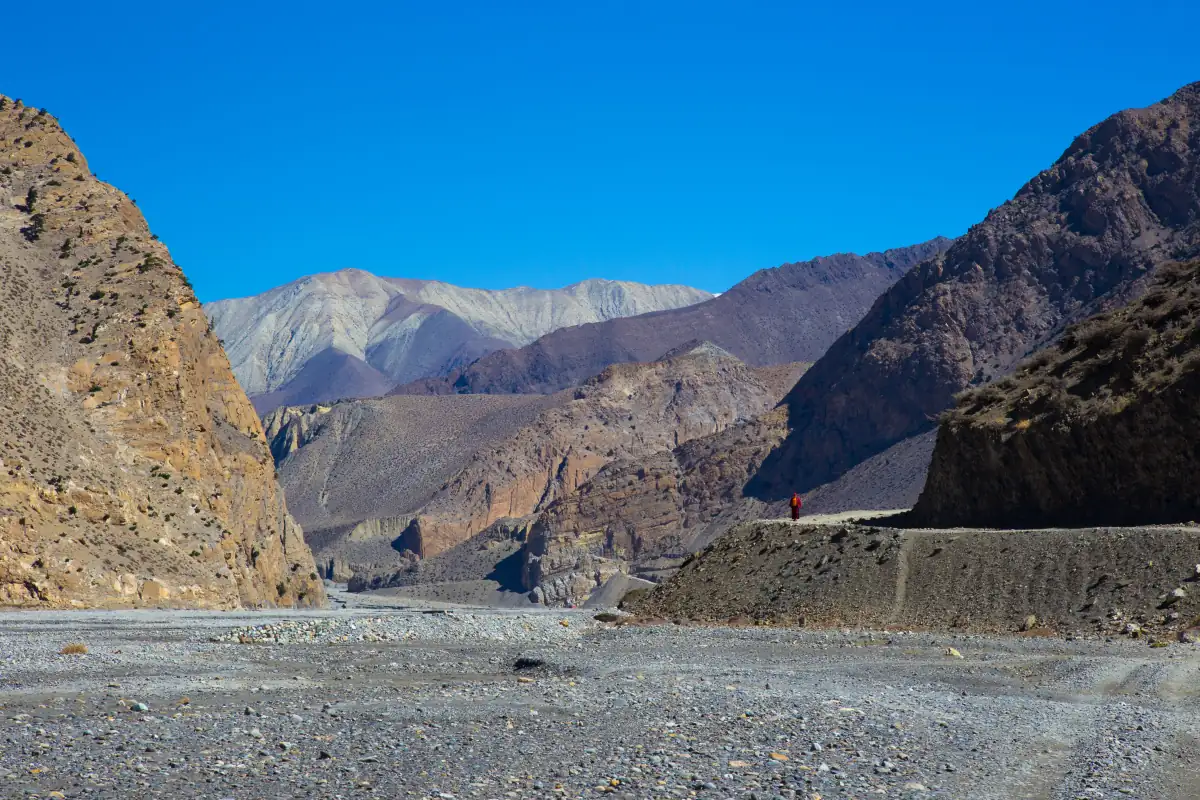
The stone is tied to the Brahma Vaivarta Purana, in the Prakriti Khanda, and the husband there is Shankhachuda, not Jalandhar. That section explains how she became the Gandaki river and the Tulsi plant, and how Bhagwan Vishnu took the form of the shalagrama stones. Some regional tellings keep a stone-curse and the Gandaki bank. As for the stones themselves, Shaligram stones are found in the Kali Gandaki river in Nepal.
The wedding, then, is a living part of the festival. Its written source is harder to pin down.
The tellings side by side
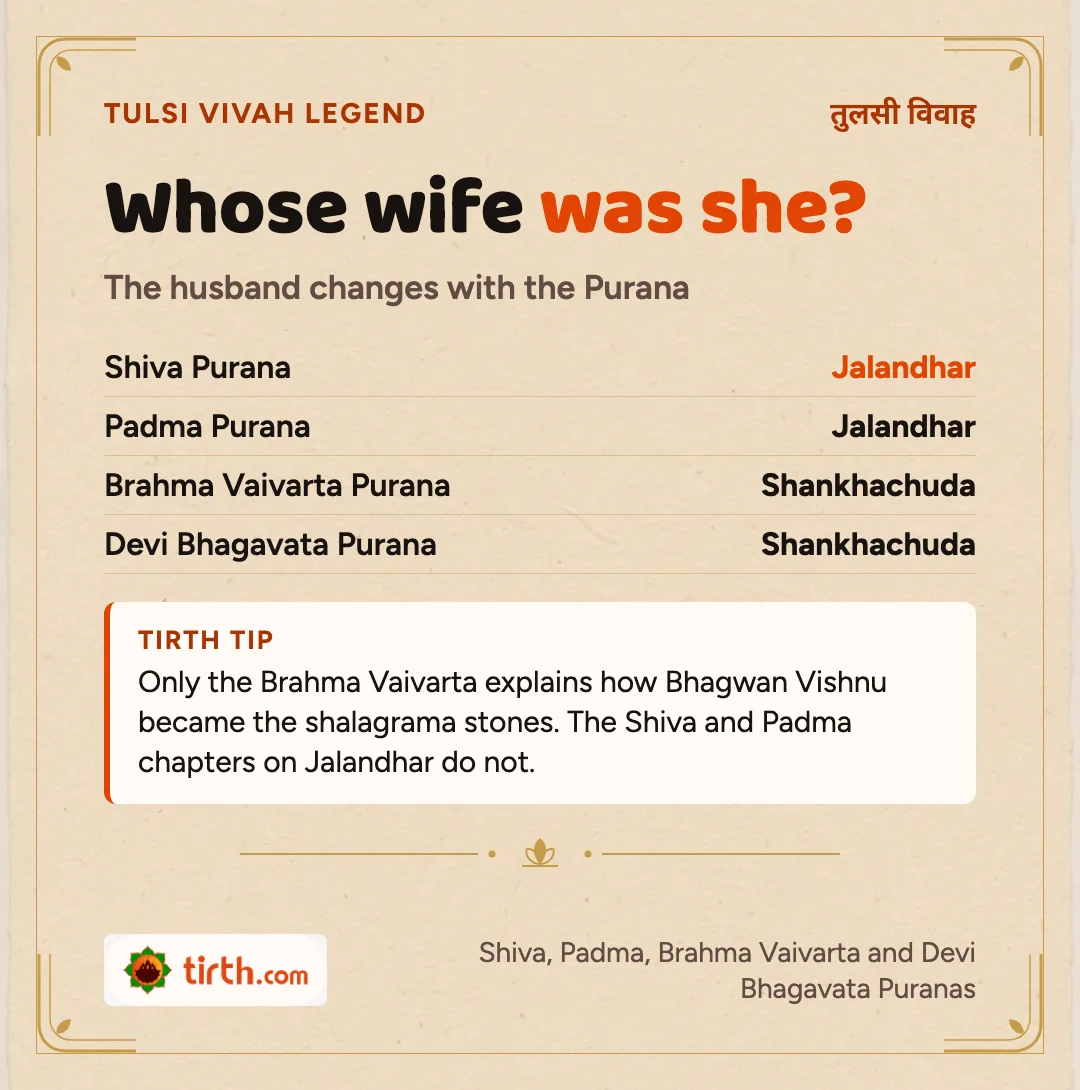
These legends do not agree on the husband, so here is each telling in one place.
| Text | Husband | Who deceives her | Her end | The stone | Tulsi |
|---|---|---|---|---|---|
| Shiva Purana | Jalandhar | Bhagwan Vishnu, as an ascetic who revives her husband | Fire; radiance merges into Maa Parvati | Not in these chapters | Not named |
| Padma Purana | Jalandhar | Bhagwan Vishnu, as the revived husband | Fire; Bhagwan Vishnu covers himself in her ashes | Not in chapters 103 to 105 | Grows from Maa Gauri’s seed (chapter 105) |
| Brahma Vaivarta Purana | Shankhachuda | Bhagwan Vishnu, in Shankhachuda’s form | Becomes the Gandaki river and the Tulsi plant | Explains how Bhagwan Vishnu took the form of the shalagrama stones | Born on Kartika Purnima to Madhavi, wife of Dharmadhvaja; the section explains how she became the Tulsi plant |
| Devi Bhagavata Purana | Shankhachuda | Bhagwan Vishnu, in his form | Body becomes the Gandaki, hair the Tulsi | Some regional tellings add a stone-curse | Maa Lakshmi’s manifestation |
| Popular retelling | Jalandhar | Bhagwan Vishnu, as Jalandhar | Burns after speaking her shraap | Bhagwan Vishnu becomes the Shaligram | Bhagwan Vishnu promises she will be Tulsi and he will marry her |
Chapter numbers for the Brahma Vaivarta differ from edition to edition, so none are quoted here.
Why a plant weds a stone each Kartik
The wedding is held the morning after Devutthana Ekadashi, in the stretch before Kartika Purnima on Tuesday, 24 November 2026. Tirth lists the Ekadashi dates too.
She dies betrayed. The festival says she returned as a plant, and each year she is married to Bhagwan Vishnu, the very god who deceived her, in the form of the Shaligram. That is how the families who keep the festival tell it.
I would rather people knew the chapters before they retell the wedding, because the tellings differ even on the husband.
For Tulsi herself, start with the Tulsi mantra or the Tulsi Chalisa. For the plant in the home and what it means, read the Tulsi plant in the Hindu home.
Frequently asked questions
Why is Tulsi married to the Shaligram?
The popular retelling has Vrinda telling Bhagwan Vishnu to become a stone, and Bhagwan Vishnu promising that she will be born as Tulsi and he will marry her as the Shaligram. We checked the Padma chapters 103 to 105, and they do not carry it.
Who was Vrinda?
Vrinda is the wife of Jalandhar, the Asura the ocean raised. The Shiva Purana calls her the daughter of the Asura Kalanemi, and the festival remembers her as Tulsi.
Who was Jalandhar, and why could nobody kill him?
Bhagwan Shiva’s fury gave birth to Jalandhar, and the ocean raised him. In the texts his strength rests on Vrinda’s faithfulness to him, and Brahma Dev had said that only Bhagwan Shiva could kill him.
Which Purana tells the Tulsi Vivah story?
No one Purana tells all of it. The Shiva Purana and the Padma Purana give the story of Jalandhar and Vrinda as the texts hold it, while the Brahma Vaivarta and the Devi Bhagavata give her a different husband, Shankhachuda.
Continue on Tirth
- The Tirth Spiritual Calendar: Tulsi Vivah and Devutthana Ekadashi for your city.
- The Kartik Mahatmya stories: where the month ends.
- The Tulsi mantra: for the plant at the centre of it.
- The Vat Savitri vrat katha: another story where a wife’s vow decides a husband’s fate.
- Tirth pujas: if you want a Pandit to do a puja for you.
Leave a Reply