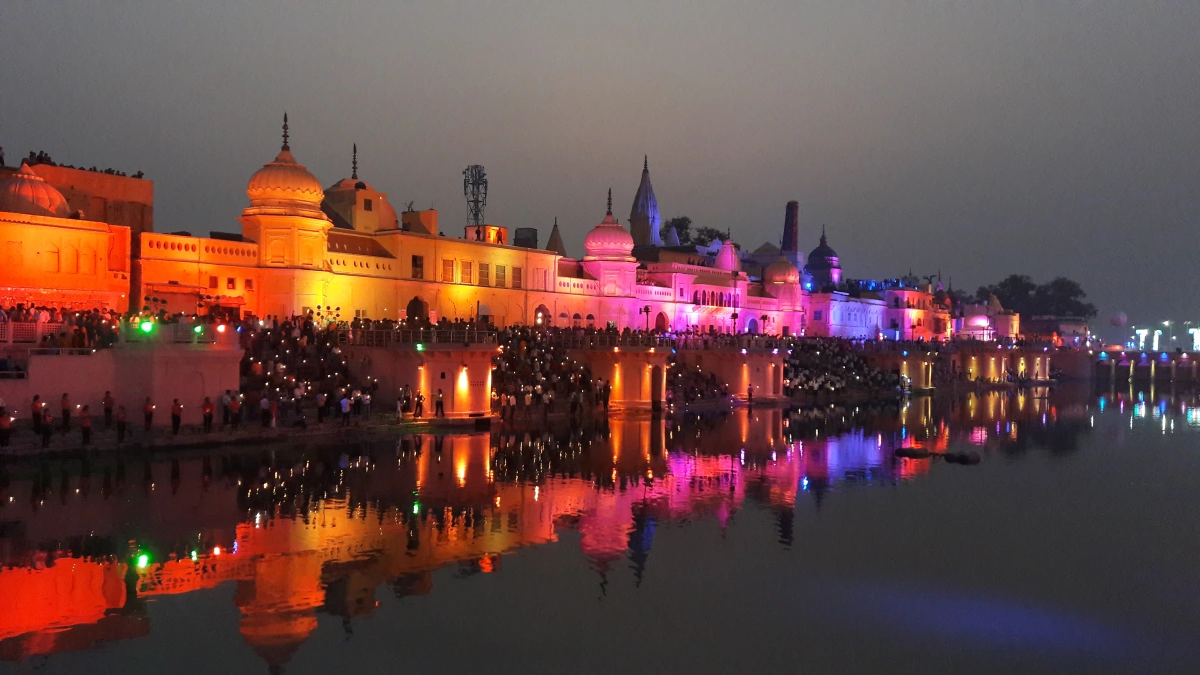
If you’re planning evening bhakti in Ayodhya, there are two times to keep in your head. Shayan Aarti at Ram Mandir is at 9:30 PM.
And on 15 December the sun is down over Ayodhya by 5:10 PM.
The first of those comes from the Trust’s notice. The Shri Ram Janmabhoomi Teerth Kshetra is the Trust that runs Ram Mandir, and its aarti times are written there. The second one moves each and every month, and it is the one that decides when dusk reaches the river, so an evening in June starts almost two hours after an evening in December.
What time is Shayan Aarti at Ram Mandir?
These times come straight from the Trust’s notice. I’ve put three of them in the table, from the winter list that came into effect on 1 November 2026, as checked on 26 November 2026.
| What | Time (Trust winter schedule, from 1 November 2026) |
|---|---|
| Mangal Aarti | 4:30 AM |
| Shringar Aarti | 6:30 AM |
| Shayan Aarti | 9:30 PM |
You don’t pay for the passes. The Trust says there is no fee for aarti or darshan passes. All it asks is that you follow the instructions on the pass.
Darshan slots are another matter. The Trust’s list has been in effect since 1 November 2026, and its current notice is where the slots and the door closing times are. I wouldn’t plan an evening around any list without reading it first. This one included.
For the whole list as it stands, there’s the Ram Mandir page on Tirth, and there’s the Trust’s own notice.
What time does the sun set in Ayodhya each month?
The river half of the evening runs on the sun. And in Ayodhya the sun keeps very different hours in different months.
I’ve taken the sunset on the 15th of every month from the Tirth panchang.
| Date (December 2026 to November 2027) | Sunset in Ayodhya |
|---|---|
| January 15 | 5:29 PM |
| February 15 | 5:53 PM |
| March 15 | 6:09 PM |
| April 15 | 6:25 PM |
| May 15 | 6:41 PM |
| June 15 | 6:56 PM |
| July 15 | 6:57 PM |
| August 15 | 6:38 PM |
| September 15 | 6:06 PM |
| October 15 | 5:33 PM |
| November 15 | 5:11 PM |
| December 15 | 5:10 PM |
Mid-December is the early end. The sun has set by 5:10 PM. Come in June and it hangs on till 6:56 PM on the 15th, a much later dusk to plan the ghats around.
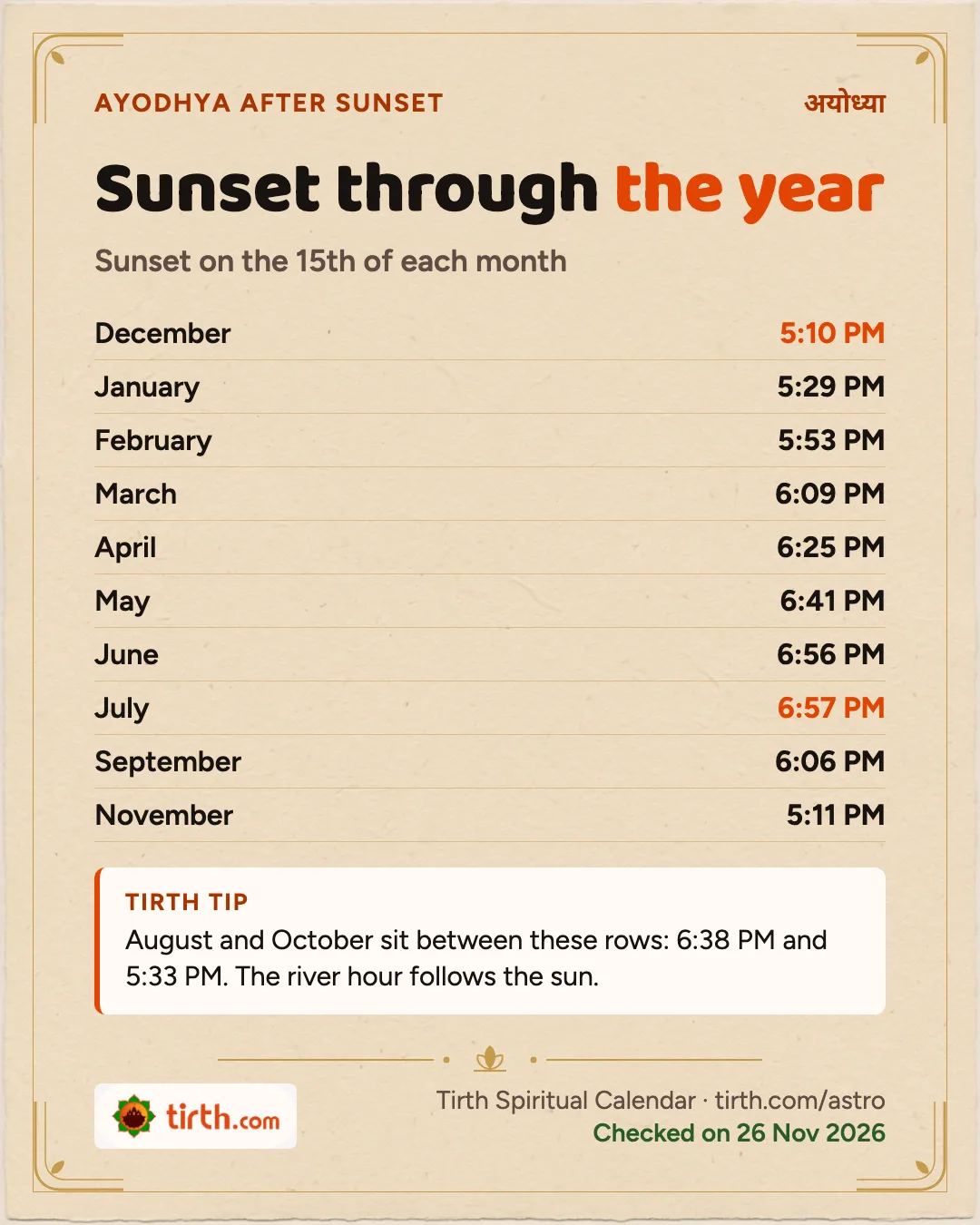
So whatever you plan for the river has to shift with the calendar.
If you haven’t settled on a month yet, there’s a separate piece on when to visit Ayodhya that goes season by season.
Ram ki Paidi at dusk & the Saryu aarti
For the river, you go to Ram ki Paidi.
The Ayodhya district administration’s website calls it a series of ghats on the bank of the Saryu, and says the view is at its finest at night, once the ghats are floodlit. People come here to bathe as well. To wash away their sins, as the same site puts it.
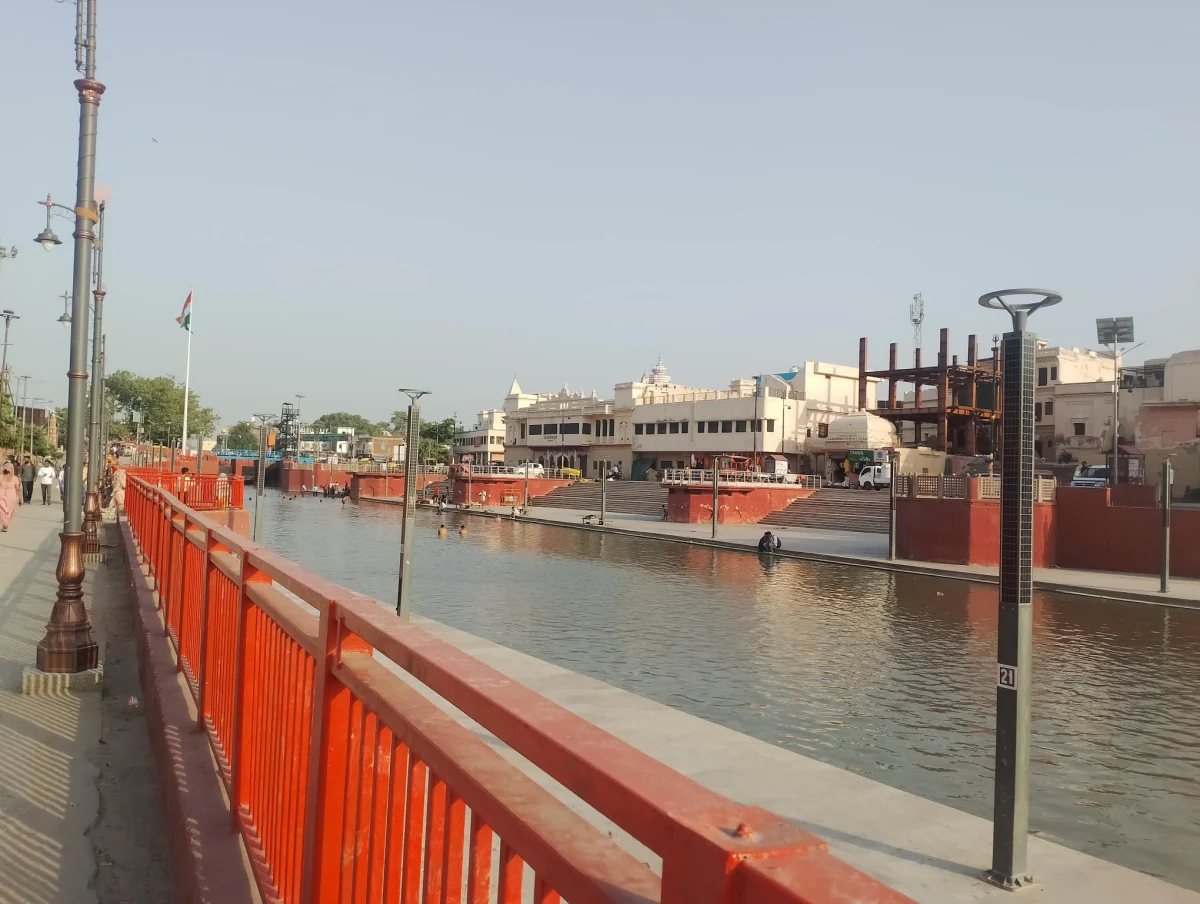
I’d get there at dusk and stay on till the floodlights come up, since that is when the district site says the place looks its best.
The Valmiki Ramayana has its own picture of these streets. In Bala Kanda, sarga 5, Ayodhya’s royal highway is described as broad and well laid out, strewn with flowers and regularly sprinkled with water.
Then in Ayodhya Kanda, sarga 6, the city is being decorated for Bhagwan Ram’s coronation. Flowers go down on the roads. Lamps are placed here and there in case the royal procession passes through at night. One commentary reads them as lamp stands shaped like trees.
Keep that picture somewhere in mind when the ghats light up.
The Saryu aarti is trickier. There is no official time at Ram ki Paidi, and none at Naya Ghat either. Both ghats are on the district list. Neither has an aarti time next to it. The private websites that do mention the aarti only say it happens around dusk. So ask at the ghat on the day.
(Do look at the sunset table before you step out of your room. Mid-December it is 5:10 PM and mid-July it is 6:57 PM, and that gap is what decides whether you reach the ghat in daylight or after dark.)
If there’s still time after the ghats, ask the way to Deokaali. The district site places it near Naya Ghat.
Its story is Maa Sita’s. After her wedding she is said to have come to Ayodhya with a murti of Girija Devi. King Dashrath had a temple built for it, and that is where she worshipped, according to the same site.
And if the evening runs long and you want one more darshan, there’s Nageshwarnath. It is a temple of Bhagwan Shiva. Going by the district site, it is said to have been established by Kush, Bhagwan Ram’s son. Shivratri is celebrated there in a big way, with a Shiv Barat procession.
The district site gives no timings for Nageshwarnath, so check locally before setting off.
If you’d prefer the river evening arranged for you, Tirth runs a Maa Saryu aarti experience in Ayodhya Dham. For the river’s own story before you go, read why the Saryu matters to Ayodhya.
An evening in Ayodhya from Hanumangarhi to Shayan Aarti
Start sooner than feels right, at Hanumangarhi, while there’s still daylight.
Going by the district site, it is 1 km from Ayodhya railway station. Vikramaditya was the one who had the temple built. The same page says Hanuman ji is believed to have lived here guarding Ayodhya. In the main temple the murti is of young Hanuman ji, sitting on Maa Anjani’s lap.
Kanak Bhawan belongs in the daylight part of the evening as well. You’ll find it in Ramkot, north-east of Ram Janmabhoomi, the district site says.
That page also records the belief that Kaikei gifted it to Maa Sita right after her marriage to Bhagwan Ram, and that Vikramaditya had it renovated, with Vrish Bhanu Kunwari renovating it again later. In the sanctum the main murtis are Bhagwan Ram & Maa Sita.
Timings are the awkward bit.
Neither temple has an official opening time, closing time or aarti time. The district pages for both list none. So see them while it’s light. Don’t build the rest of the evening on the hope that one of them stays open late.
After that it comes down to the month you’re in.
| Step | Mid-December (sunset 5:10 PM) | Mid-June (sunset 6:56 PM) |
|---|---|---|
| Before dusk | Hanumangarhi and Kanak Bhawan in daylight | Hanumangarhi and Kanak Bhawan in daylight |
| Next | Ram ki Paidi and the Saryu ghats at sunset | Ram Mandir darshan (check the Trust’s current slots) |
| Then | Ram Mandir darshan (check the Trust’s current slots) | Ram ki Paidi and the Saryu ghats at sunset |
| Last | Shayan Aarti, 9:30 PM | Shayan Aarti, 9:30 PM on the winter list |
The June column is built on the winter list too, because the winter list is the only one that has been checked, so read the Trust’s current notice before you fix any of it.
Frequently asked questions
What time is the evening aarti at Ram Mandir?
On the Trust’s winter schedule, in effect from 1 November 2026, Shayan Aarti is at 9:30 PM, as checked on 26 November 2026. Before you go, look at the Trust’s current notice for the full list of aartis.
Until what time is Ram Mandir darshan open in the evening?
The Trust’s list has been in effect since 1 November 2026. Its current notice is where to check evening darshan slots and door closing times before you go.
Is there a fee for the aarti pass?
No. The Trust says aarti and darshan passes carry no fee, and it asks you to follow the instructions on the pass.
What time is the Saryu aarti at Ram ki Paidi?
There’s no official time for it. Private websites only say it is around dusk, so look up your month’s sunset in the table above and then ask at the ghat that day.
What time does it get dark in Ayodhya?
Mid-December is the earliest, with sunset at 5:10 PM on the 15th. Mid-July is the latest, at 6:57 PM. The Tirth panchang for Ayodhya is where both of those times come from.
Can I visit Hanumangarhi in the evening?
No official timing for Hanumangarhi turned up, morning or evening. So go in daylight, before Ram Mandir, and count a late visit as unconfirmed. Kanak Bhawan is no different. Its district page lists no hours either.
Continue on Tirth
- Ayodhya’s mornings, for the other end of the day.
- Planning a trip to Ayodhya, for the rest of the trip.
- Daily life in Ayodhya from dawn to night, for the whole day around this evening.
Leave a Reply