Ask who cut Surpanakha’s nose and you will hear Lakshmana ji. His sword, yes. But in Aranya Kanda 18 of the Valmiki Ramayana the order is Bhagwan Rama’s. He holds her back from Maa Sita, warns his brother not to joke with wicked people and tells him to disfigure her, and Lakshmana ji cuts off her ears and nose.
Everything in the role of Surpanakha in Ramayana swings on that order. She is Ravana’s sister. After the cut she goes to her brother Khara first, and gets to Lanka only later, where what she says pushes Ravana towards taking Maa Sita.
Most of us grew up on a different version. In that one Lakshmana ji does the cutting of his own accord, and she then flies straight to Ravana, face cut, story ready.
Valmiki doesn’t tell it like that. So I’ll go sarga by sarga. For any unfamiliar name, who is who in the Ramayana has the whole cast.
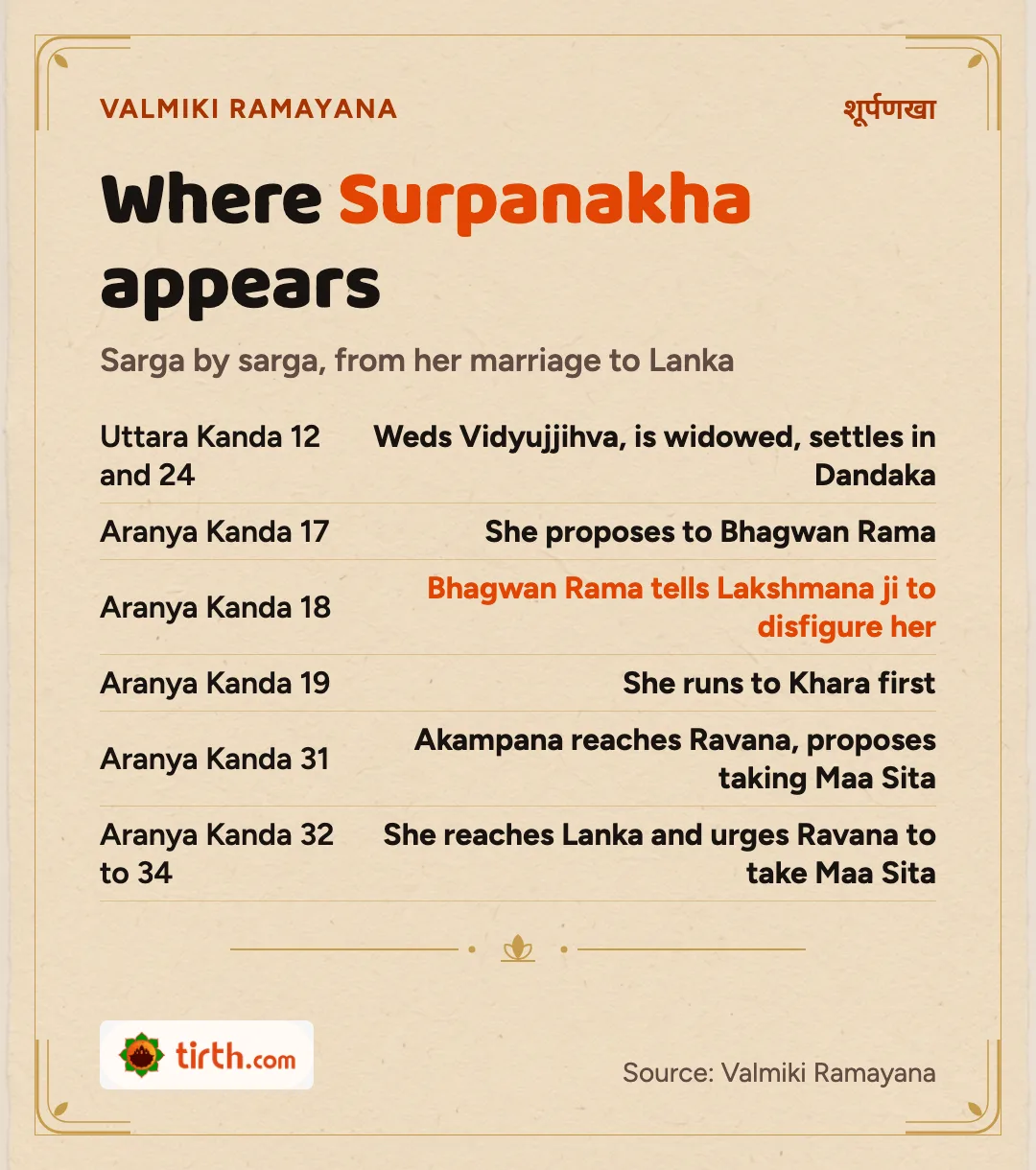
| Where in Valmiki | What happens |
|---|---|
| Uttara Kanda 12 and 24 | Ravana marries her to Vidyujjihva, later kills him in battle, and sends Khara and Dushana to Dandaka, where she settles |
| Aranya Kanda 17 | She proposes to Bhagwan Rama |
| Aranya Kanda 18 | Bhagwan Rama tells Lakshmana ji to disfigure her |
| Aranya Kanda 19 | She goes to Khara, whose fourteen rakshasas fail |
| Aranya Kanda 31 | Akampana reaches Ravana first and proposes carrying off Maa Sita |
| Aranya Kanda 32 to 34 | She reaches Lanka, rebukes Ravana and urges him to take Maa Sita |
Whose sister was Surpanakha, and whose widow?
Her parents, as Uttara Kanda 9 has it, are Vishrava and Kaikasi. Her brothers are Ravana, Kumbhakarna and Vibhishana. And her face, says the same sarga, was misshapen (9.34).
Her marriage is in Uttara Kanda 12, and it is Ravana himself who marries her to Vidyujjihva, lord of the danavas of the Kalakeya group. In sarga 24 Ravana is home in Lanka after his battle with the fourteen thousand Kalakeyas, and his sister tells him her husband died in it, at his hand. His reply is that he did not recognise him.
He then sends Khara and Dushana to guard Dandaka with fourteen thousand rakshasas, and she goes to live there too (24.24 to 42). In that sarga Ravana calls Khara her mother’s sister’s son (24.37). In the Aranya Kanda she names Khara as her brother.
Uttara is the Ramayana’s closing book. It tells this part looking back, so I’m placing it out of order. Still, I think it matters a lot. The woman at Bhagwan Rama’s forest hermitage is a widow, made one by her own brother, and he is the king she will later go to for help.
What did Surpanakha say to Bhagwan Rama in Aranya 17?
Aranya 16 is a calm sarga. At dawn, with winter just starting, Bhagwan Rama, Maa Sita and Lakshmana ji bathe in the Godavari.
Sarga 17 brings Surpanakha to the hermitage. One look at Bhagwan Rama and she is taken with him. Valmiki places the two side by side (17.7 to 12), the handsome Bhagwan Rama and, facing him, a woman the poet calls big-bellied, copper-haired, shrill-voiced and old.
His reply is plain. He tells her who they are, himself, Lakshmana ji and Maa Sita, and that his parents’ command is why he is in the forest (17.15 to 17). Valmiki’s fuller picture of him is in Bhagwan Rama as Valmiki tells it.
Now her side. Her brothers, she says, are Ravana, Kumbhakarna, Vibhishana, Khara and Dushana. She calls herself kamarupini (one who can take any form). Marriage is what she proposes. Maa Sita is unfit for him, she tells him, and she threatens to eat Maa Sita and Lakshmana ji both (17.20 to 28).
Any form she likes, she claims, and yet through the whole sarga, in the verses as they stand, her shape does not change once.
Bhagwan Rama’s question to her calls her charming-limbed (17.18), though her description in 17.9 to 12 has none of that.
With a laugh, Bhagwan Rama begins his answer (17.29).
Who ordered Surpanakha’s nose to be cut?
Bhagwan Rama gave the order. The sword was Lakshmana ji’s.
Sarga 18 begins with Bhagwan Rama smiling as he answers her (18.1). He has a wife already, he says, and a co-wife’s life would be hard (18.2). Then he points her to Lakshmana ji, a man without a wife, he says, and fit to be her husband (18.3 to 5). She turns to Lakshmana ji at once (18.6 to 7).
The mocking comes from Lakshmana ji. Calling himself his elder brother’s servant (18.9), he tells her she’d be better off as Bhagwan Rama’s junior wife. She believes him (18.10 to 13).
That is when she threatens to devour Maa Sita and rushes at her (18.14 to 17). Bhagwan Rama holds her back. He warns Lakshmana ji off joking with wicked people and tells him to disfigure her (18.18 to 20). Lakshmana ji draws his sword. He cuts off her ears and nose (18.21).
So the telling most of us know slips twice. First, the mocking is Lakshmana ji’s, and the one who puts a stop to it is Bhagwan Rama (18.19), who tells him joking with the wicked is out of place. Second, angry as Lakshmana ji is, he cuts on his brother’s word (18.21).
Where did Surpanakha run first, to Khara or to Ravana?
To Khara, her brother at Janasthana. She runs to him bleeding and roaring and tells him everything (18.22 to 26).
Whoever did this, Khara swears, will die. In tears she names the sons of Dasharatha and describes the woman with them, beautiful and covered in ornaments (19.14 to 18). Their blood is what she wants. Khara sends out fourteen rakshasas (19.21 to 26), she leads them to the hermitage in sarga 20, and Bhagwan Rama destroys all fourteen.
Then comes the war at Janasthana, and by its end, as sargas 32 and 34 sum it up, Bhagwan Rama alone has killed Khara, Dushana, Trishira and fourteen thousand rakshasas (32.1 to 2, 34.8 to 10). Ravana had sent exactly that many to guard Dandaka, in the Uttara Kanda story.
It’s only now that Surpanakha sets off for Lanka (32.3).
How did Ravana first hear about Maa Sita?
Not from Surpanakha, but from a rakshasa called Akampana.
In sarga 31 he slips out of Janasthana and brings the news to Ravana in Lanka. Ravana’s answer is an oath to kill Bhagwan Rama. Akampana’s view is that no one can beat Bhagwan Rama in a fight. There is another way, he says. Carry off Maa Sita, because Bhagwan Rama would not live without her (31.29 to 31). Ravana says yes. The plan is in his head before his sister ever walks in.
Right at the end of sarga 31, Ravana goes on to Maricha (31.36 to 49), gets warned off and heads back to Lanka (31.50). Yet Surpanakha talks to him later as though Janasthana is news to him (33.11). Then sarga 35 sends him to Maricha a second time, and Maricha wants to know why he is back (35.41). So he goes to Maricha twice.
She reaches Ravana’s court (32) and shows him how she has been disfigured. Then, ministers all around, she lets him have it (33.2 to 23). He is lost in his pleasures, she says, keeps no spies and is blind to the deaths at Janasthana of fourteen thousand rakshasas, Khara and Dushana among them (33.11 to 12).
Ravana gives her no answer. For a long while he only thinks (33.24).
When he does speak, in sarga 34, it is to ask about Bhagwan Rama, and she gives him the two brothers first (34.5 to 14), then Maa Sita’s beauty (34.15 to 18). Maa Sita would make Ravana a fit wife, she says (34.19 to 20). And she herself was cut for trying to bring Maa Sita to him (34.21 to 22). Then she urges him to have Maa Sita carried off to be his wife (34.23 to 25) and points to what Bhagwan Rama did at Janasthana (34.26).
Put that beside sarga 17 and her story has shifted on the road. In the forest she wanted Bhagwan Rama for herself, and in Lanka she says she wanted Maa Sita for her brother. To me that’s the most human line she has.
In sarga 35 Ravana sends his ministers away, weighs the matter, has his chariot readied in secret and crosses the sea to Maricha’s hermitage (35.1 to 41).
Is Surpanakha to blame for the war with Lanka?
She starts it, that much is fair.
But the choice is Ravana’s. Akampana had put the plan in his hands before she spoke at all. What she added was anger and a picture of Maa Sita. And the trip to Maricha he decided alone, once everyone else had been sent out of the room.
Once it reaches Ravana’s door, it is his story, and it ends in the war. Dussehra and Ravana picks the story up from there.
Was Surpanakha beautiful? Valmiki vs Kamban
Not by Valmiki’s own description, no. The lovely young Surpanakha who comes to Bhagwan Rama belongs to later retellings.
| Telling | How Surpanakha appears |
|---|---|
| Valmiki Ramayana, Aranya Kanda 17 | Big-bellied, copper-haired, shrill-voiced and old (17.9 to 12). She calls herself kamarupini but changes no shape |
| Kamban’s Tamil Ramayana (later retelling) | A lovely, fully human form from the start, as C. Rajagopalachari’s Ramayana describes it |
| Lakshman Rekha (later retellings) | Not in Valmiki. Aranya Kanda 45 has a spoken quarrel and Lakshmana ji leaving, with no line drawn |
In this episode Kamban departs widely from Valmiki, and C. Rajagopalachari’s Ramayana says so outright.
Frequently asked questions
What does the name Surpanakha mean?
It joins shurpa, a winnowing fan, and nakha, a nail. Monier-Williams glosses it as “having fingernails like winnowing fans”, and Apte’s dictionary reads it the same way. The dictionaries give the meaning of the word only; they don’t say why she was called that.
Why is Nashik linked to Surpanakha’s nose?
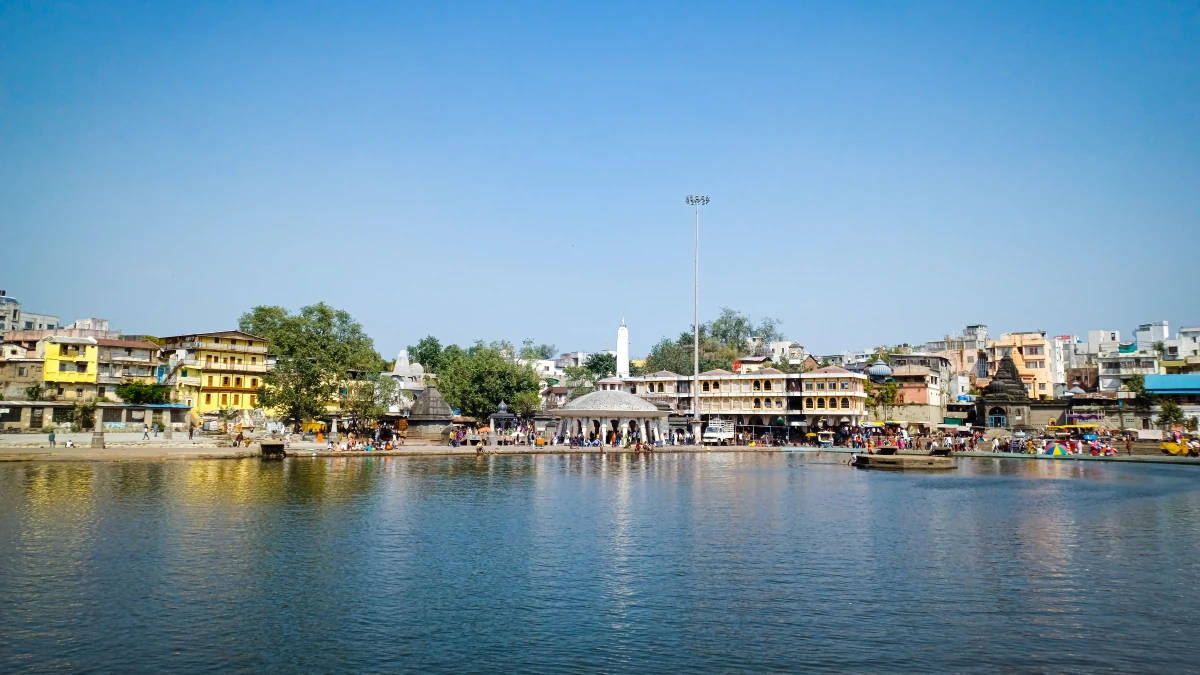
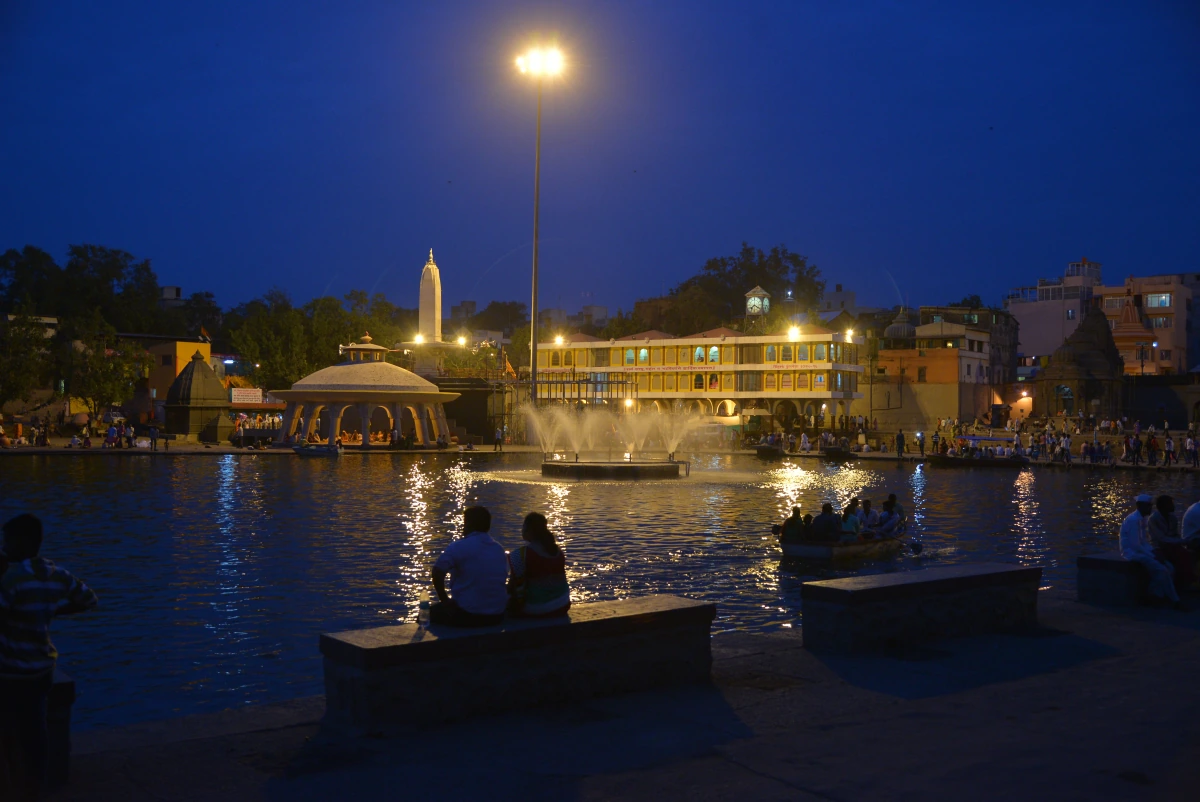
That is local tradition, not Valmiki. The Nashik district administration’s history page ties the city’s name to nasika, the nose Lakshmana ji cut on Bhagwan Rama’s word. The same page gives another story of the name too (Trikantak, Janasthana, then Navashikh), which leaves her out.
How does Tulsidas tell the episode differently?
In the Ramcharitmanas she comes to Bhagwan Rama already in a lovely form, and shows her fearsome one only after being sent between the brothers. There’s no spoken order, either. Bhagwan Rama gives Lakshmana ji a sign, and in doha 17 of the Aranya Kand Lakshmana ji very swiftly leaves her without nose and ears, as if throwing down a challenge to Ravana.
Does Valmiki say what became of Surpanakha after the war?
We found no verse that follows her that far.
Continue on Tirth
- Bhagwan Rama’s page is where to read more about him.
- The Ramkund guide is where to start in the city tied to this story.
- Tirth yatra packages are there if you want to stand where Bhagwan Rama’s story is still kept.
Leave a Reply