The chappan bhog meaning is 56 offerings, a meal of 56 dishes laid before Bhagwan Krishna, and the reason usually given is a sum of eight meals a day for the seven days he held up Govardhan Hill. The Bhagavata Purana tells of those seven days, but the eight meals and the 56 come from later retelling.
Chappan is the Hindi and Odia word for 56. Bhog is food offered to a deity. The spelling wanders, from chhappan bhog and chhapan bhog to plain 56 bhog and, at Puri, Chhapan Bhoga.
Why does chappan bhog have 56 dishes?
The sum is simple enough for a child to repeat. In the telling, Bhagwan Krishna ate eight times a day, and for the seven days he held the hill over Braj against Indra Dev’s storm, 56 meals went by. When the rain stopped, the people of Braj made up the missed meals with 56 dishes.
Then look for its source.
A national news channel’s website, explaining the custom in 2024, called its account general information and common beliefs. A Hindi news channel’s site gave no source beyond old stories, and in its version the villagers cook 56 dishes over seven days after the rain, with no eight meals in it at all. A devotional website cites the Bhagavata for the lifting of the hill, then gives 8 x 7 with no source.
Even the cooks change between tellings. The two news channels have the villagers. A Hindi newspaper’s site has Maa Yashoda preparing 56 dishes to satisfy his hunger, and a site of Hindu articles gives them to the gopis. None of them names a text.
So the 8 x 7 lives in Braj retelling and in print, with no verse behind it.
If you are planning Diwali at home, note that Govardhan Puja falls on Tuesday, 10 November 2026 (New Delhi), which in 2026 is not the day after Lakshmi Puja (see Govardhan Puja in the Tirth Spiritual Calendar for your city).
Other answers to the number are in print too, each offered as one explanation and none with a text behind it. A bhakti portal and the site of Hindu articles describe a lotus of 56 petals in three layers in Bhagwan Krishna’s eternal abode, and the portal puts a sakhi (companion) on every petal. It adds the six rasas, or tastes, which it says combine into at most 56 kinds of dish. It also offers plain arithmetic again, seven days by the eight pahars (watches) of a day and night.
Does the Bhagavata Purana mention 56 bhog?
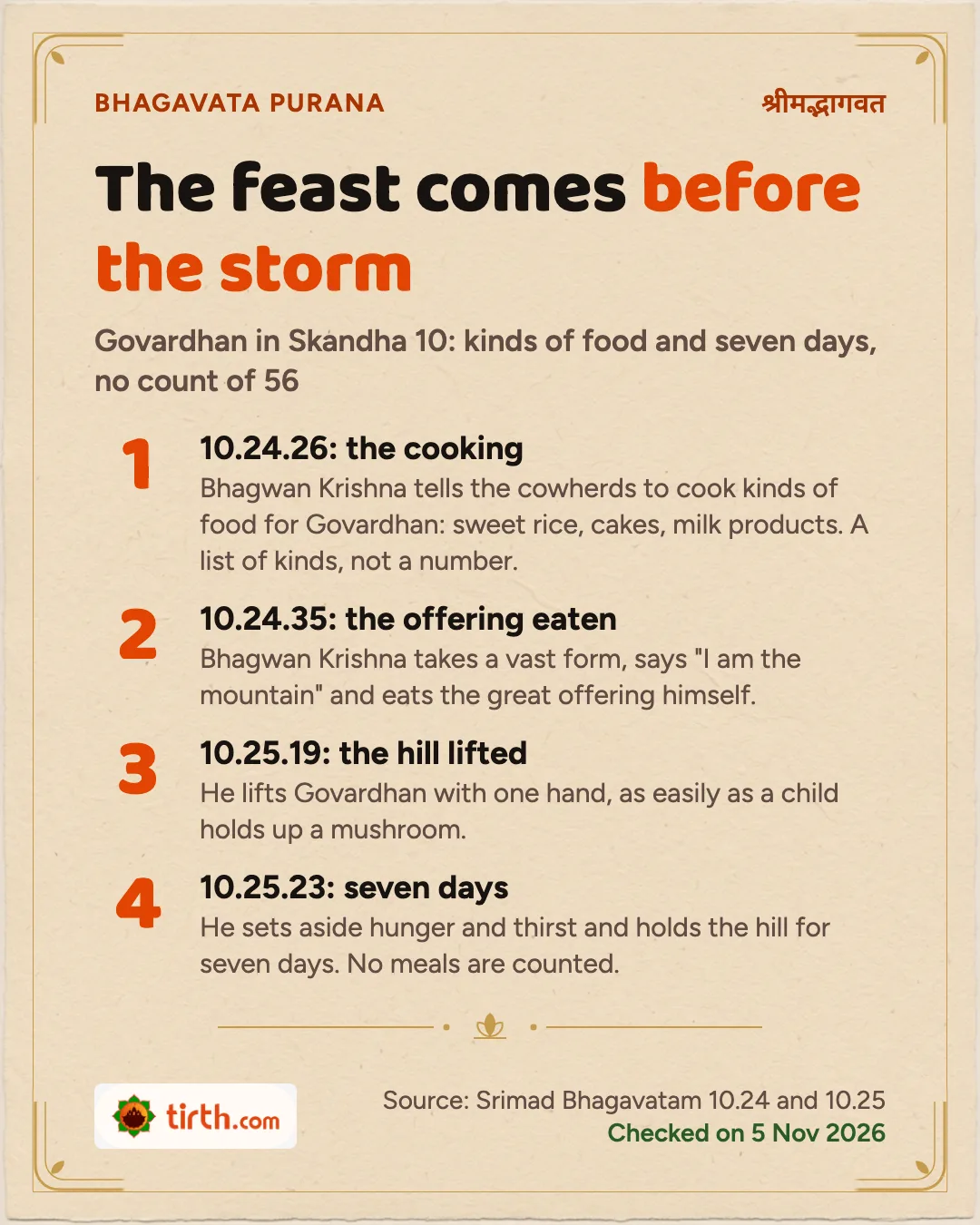
The Bhagavata tells the seven days and what was cooked for the first Govardhan puja. It gives no count of meals, and no 56.
The order of events is the surprise.
In Skandha 10, chapter 24, the feast comes before any storm. Bhagwan Krishna tells the cowherds to use the stores they had gathered for Indra Dev’s sacrifice to worship Govardhan instead, and at 10.24.26 he names the kinds of food to cook, from liquid and vegetable dishes and sweet rice to fried and baked cakes, large rice-flour cakes and all the milk products.
Kinds of food, not a number.
Then, at 10.24.35, Bhagwan Krishna takes another, vast form, says “I am the mountain” (shailo ‘smi) and eats the great offering himself, to reassure the cowherds. In the Bhagavata, then, the first Annakut was eaten by Bhagwan Krishna as the hill, before the storm of chapter 25.
The storm comes next.
At 10.25.19 he lifts Govardhan with one hand, as easily as a child holds up a mushroom (chatraka). At 10.25.23, watched by the people of Braj, he sets aside the pain of hunger and thirst and his own comfort, and holds the hill for seven days (saptaham) without moving from the spot.
Read that verse slowly, because the whole sum hangs on it. It says he set aside hunger and thirst along with his own comfort. It does not say he ate nothing, and nowhere in the two chapters does it count a single meal or give a figure of 56.
For the whole episode, from the cowherds’ first puja to the hill set back in its place, read the full Govardhan Puja story from the Bhagavata.
Nathdwara’s Annakut: a rice mountain of 125 maunds
Annakut means a mountain, or heap, of food. It is the other name for Govardhan Puja, kept on Kartik Shukla Pratipada, and at Nathdwara the mountain is made of rice.
The Nathdwara Temple Board’s own page calls Annakut the most renowned festival of Pushtimarg. A huge mound of rice standing for Govardhan, “weighing 125 maunds”, is arranged in the Doltibari, with a huge gunja (a sweet cake) on top for Bhagwan Vishnu’s head and four more sweets on its four sides for his four weapons. A great variety of other food fills the Nijamandira, the Manikotha and the Doltibari.
The image of Shrinathji, the Board explains, has its left hand raised in the very posture Bhagwan Krishna took to lift the mountain. On the day he wears a dress much like his Diwali dress, with a gokarna mukuta, a crown whose raised edges look like a cow’s ears. Cows are decorated and marked with red handprints. A small Govardhan of cow dung, with a stone from the original hill, is made in the Govardhan Puja chowk and given aarti.
At day’s end, Bhil tribal people may take the rice mountain, as a special favour, and on the next day, the Board’s page says, Shrinathji is fed only khichdi.
The Board’s own Annakut page describes the rice mound and a great variety of eatables and does not use the number 56. A Hindi newspaper, though, reports that chappan bhog is offered to Shrinathji at Nathdwara every year at Janmashtami. Pushtimarg havelis keep it on other days too, and one in Vashi held a chappan bhog in 2024 for its temple’s foundation day.
The Board also calls Shrinathji’s seva “often eight-fold”, unfolding through the day the way Bhagwan Krishna’s own day did, with bhog in thousands of varieties. No source in print links that eight-fold day to the 56.
Why no two lists of the 56 agree
At Puri, two secondary pages say Chhapan Bhoga is a daily offering of 56 items to Bhagwan Jagannath, Bhagwan Balabhadra and Maa Subhadra, though the temple administration’s own Daily Rituals page does not use the number.
The published lists split the 56 differently.
A devotional website, a temple’s website and the Puri pages each group the dishes their own way.
Even the sweets disagree. Puri counts 11 kinds, while the two website lists run to 18 or even 20 of them.
Several pages say plainly that the dishes vary by region and family.
So if your family’s 56 does not match a website’s list, relax. Nothing has gone wrong in your kitchen. Some pages also say it is vegetarian and cooked without onion or garlic, though the sources fix no one rule for every temple.
If you are keeping Govardhan Puja at home, Tirth has the Govardhan Maharaj aarti and the Bhagavata verse to Giriraj, with word meanings, for the day itself. And for the hill that started all of this, there is the Govardhan page.
Frequently asked questions
What is the meaning of chappan bhog?
Chappan is Hindi for 56 and bhog is food offered to a deity, so chappan bhog means 56 offerings. It is the meal of 56 dishes laid before Bhagwan Krishna at Govardhan Puja and Janmashtami, and two secondary pages describe a daily 56 at Puri.
Is chappan bhog offered on Janmashtami or Govardhan Puja?
Both. It is offered at Govardhan Puja, also called Annakut, and at Janmashtami, where several accounts place it at the midnight puja. Pushtimarg havelis hold it on other days as well.
How is Annakut different from chappan bhog?
Annakut means a mountain of food and is another name for Govardhan Puja. At Nathdwara the mountain is a mound of rice weighing 125 maunds, and the Board’s page on it does not use the number 56. Chappan bhog is the count of 56 dishes, offered at Annakut and on other days too.
What is the 56 bhog at Puri?
Two secondary pages say Chhapan Bhoga at Puri means 56 items offered daily to Bhagwan Jagannath, Bhagwan Balabhadra and Maa Subhadra, grouped 9, 11, 13, 9 and 14. The temple administration’s own Daily Rituals page names the offerings but not the number.
Who cooked the first 56 dishes for Bhagwan Krishna?
It depends on who is telling it. News accounts name the villagers or Maa Yashoda, one website names the gopis, and none of them cites a text. In the Bhagavata the cowherds cook for the first Govardhan puja at Bhagwan Krishna’s word, and he eats the offering himself as the mountain.
Continue on Tirth
- Tirth, Govardhan Puja 2026 in the Tirth Spiritual Calendar, for New Delhi and other cities.
Leave a Reply