
In many a family WhatsApp group, one person asks whether the vrat falls today or tomorrow and another replies, very sure, with the other day. Both can be right, and the reason is a tithi, the time the Moon takes to gain 12 degrees on the Sun along the sky.
So, tithi kya hai in practice? It is that 12 degree gain, and the gain takes longer in some tithis than in others. A tithi can begin at any hour of the day or night, and it rarely matches a 24-hour date.
Counting a tithi in steps of 12 degrees
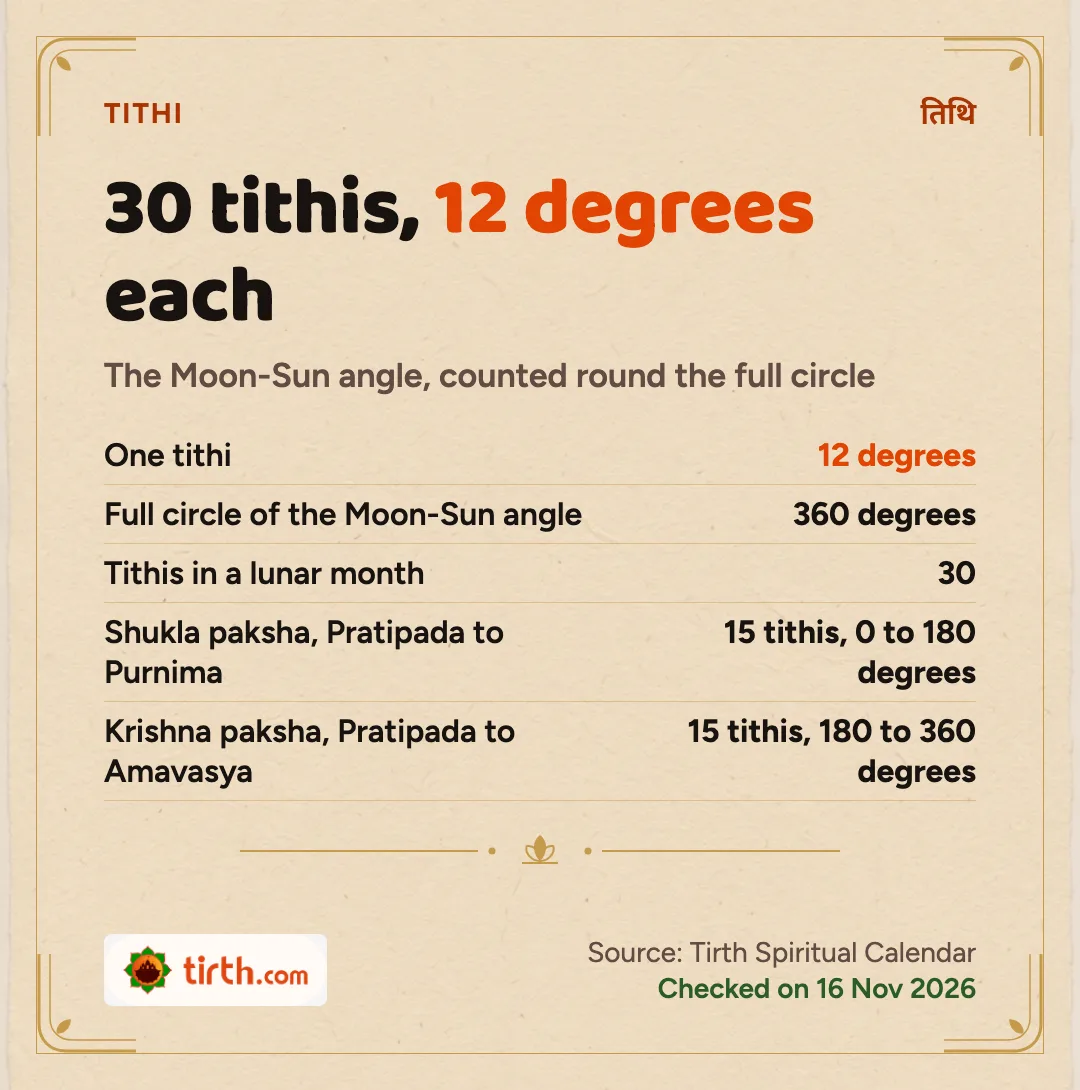
Start with the angle between the two, measured from the Sun to the Moon. It runs from 0 to 360 degrees. Every time it grows by 12 degrees one tithi is finished, and 360 divided by 12 gives the 30 tithis of a lunar month.
Fifteen of them make up Shukla paksha (the bright fortnight), while the angle climbs from 0 to 180 degrees, starting at Pratipada and ending at Purnima. The other 15 are Krishna paksha (the dark fortnight), from 180 to 360 degrees, and Amavasya closes it. (After this much arithmetic, our page on Chandra Dev aarti is a gentler way to sit with the Moon.)
Take Saptami of Shukla paksha. It begins when the Moon is 72 degrees ahead of the Sun, with 6 steps of 12 already behind it, and it ends when the gap reaches 84 degrees, 7 steps of 12. Ashtami begins at that same moment.
When the Tirth panchang sets Delhi, Mumbai and Kolkata side by side, a tithi starts and ends at the same moment in each. What shifts from city to city is sunrise.
Why the 12 degrees rarely take 24 hours
The same 12 degrees take longer in one tithi and less time in another. Divide a lunar month of 29.53 days by 30 and you get the average tithi, about 23 hours 37 minutes, which is already short of a full day. Few tithis land on it.
Most run longer or shorter than the average, some by a little and some by a good deal, so a tithi is rarely exactly 24 hours and its start time keeps drifting to a new hour of the day or night.
Which tithi your calendar prints for the day
A civil date runs from midnight to midnight. A tithi runs from wherever the Moon’s 12 degrees begin to wherever they end. The two never line up, so tradition needs a rule for which tithi a date carries, and the common convention is the tithi that prevails at sunrise. The tithi running when the Sun comes up gives the day its name, and nothing that changes by evening takes that name away.
A long tithi can hold two sunrises. If it begins a little before one sunrise and ends a little after the next, both civil days carry its name, and two dates on the calendar share a single tithi. A short tithi can do the opposite. If it begins after one sunrise and ends before the next, no morning carries its name at all. Kshaya is the word the tradition uses for a tithi that slips between two sunrises like this.
Sunrise is the part that moves with the map. A tithi still running at dawn in one city may have ended before dawn in another, so the same morning can carry two different tithi names. The month names differ too, because many regions count the month purnimanta (ending at Purnima) and many count it amanta (ending at Amavasya).
If you keep a Purnima fast, our guide to Purnima vrat sets out how families keep it.
Two homes, two sunrises, one Ekadashi
Say your parents live in one city and you live in another. If an Ekadashi of Shukla paksha ends in the minutes between their sunrise and yours, one home wakes up inside Ekadashi and the other wakes up after it has ended.
Both homes then follow the same sunrise rule and still hear different answers for the vrat. The Tirth vrat page gives the vrat day for your own city.
Which is why one family can keep the same Ekadashi on two different mornings.
When a festival lands on two dates
Sunrise is the default. Many festivals care about a different moment of the day and take whichever tithi is running at that moment. The Tirth calendar states which rule each festival follows.
| Moment used | Example festival |
|---|---|
| Sunrise | Kartika Purnima, Tulasi Vivah, Ratha Saptami |
| Midday (madhyahna) | Vasant Panchami |
| Dusk (pradosh kaal) | Holika Dahan |
| Moonrise | Sakat Chauth |
| Midnight (nishita kaal) | Maha Shivaratri |
One tithi can cover a festival’s moment on two civil days, one either side of midnight, or a sunrise can catch a tithi in its final minutes, and either way the calendar has two candidate days to choose from. For more on the Moon in a festival evening, read Karwa Chauth and the moon.
Reading today’s tithi on the Tirth panchang
Tithi is one of the five limbs of the panchang, which also include vaar (the weekday) and nakshatra, and the Tirth panchang shows today’s tithi with its start and end for your own city. Compare its end time with your sunrise to see which tithi names your morning. We last checked these patterns on 25 November 2026. Confirm your own city’s start and end on the day.
Frequently asked questions
Tithi kya hai aur kaise ginte hain?
It is how long the Moon needs to pull 12 degrees ahead of the Sun. Measure the Moon-Sun angle from 0 to 360 degrees, call every 12 degree step one tithi, and a lunar month comes out at 30.
How many tithis are in a month?
There are 30, in two halves. Shukla paksha has fifteen, Pratipada to Purnima, and Krishna paksha has fifteen, Pratipada to Amavasya.
Why is a tithi not exactly 24 hours?
The 12 degrees take a different amount of time from one tithi to the next. The average is about 23 hours 37 minutes, a lunar month of 29.53 days divided by 30, and most tithis run longer or shorter than that.
What is the difference between tithi and date?
A date runs from midnight to midnight. A tithi can begin or end at any hour, and the day usually borrows its name from whichever tithi is running at sunrise.
Why does a festival fall on two days?
Each festival looks at its own moment (sunrise, midday, dusk, moonrise or midnight). One tithi can cover that moment on two civil days, or on none.
Why does tithi change by city?
The tithi itself starts and ends at the same moment, and the Tirth panchang shows this for Delhi, Mumbai and Kolkata. Sunrise moves by city, and with it the tithi a city wakes up to.
Continue on Tirth
- Tirth panchang for today’s tithi, start and end times in your city
- Tirth vrat page for the vrat day in your city
- Spiritual Calendar festivals for every festival and the rule it follows
Leave a Reply