Adhik Maas is the extra lunar month the Hindu calendar slips in roughly every 32 to 36 months, at a point when the Sun enters no new zodiac sign at all. It is also called Purushottam Maas, and by tradition that is Bhagwan Vishnu’s own name, given to the month when he took it as his.
If a Pandit has asked your family to hold a date back, the question underneath may well be adhik maas kya hai. If yours was told in May 2026 to hold the griha pravesh (moving into a new house) until the second Jyeshtha, that second Jyeshtha was Adhik Maas.
Adhik Jyeshtha, the latest, lasted from Sunday, 17 May 2026 to Monday, 15 June 2026, and the next to come is Adhik Chaitra in 2029.
Why the moon’s year falls 10.9 days short
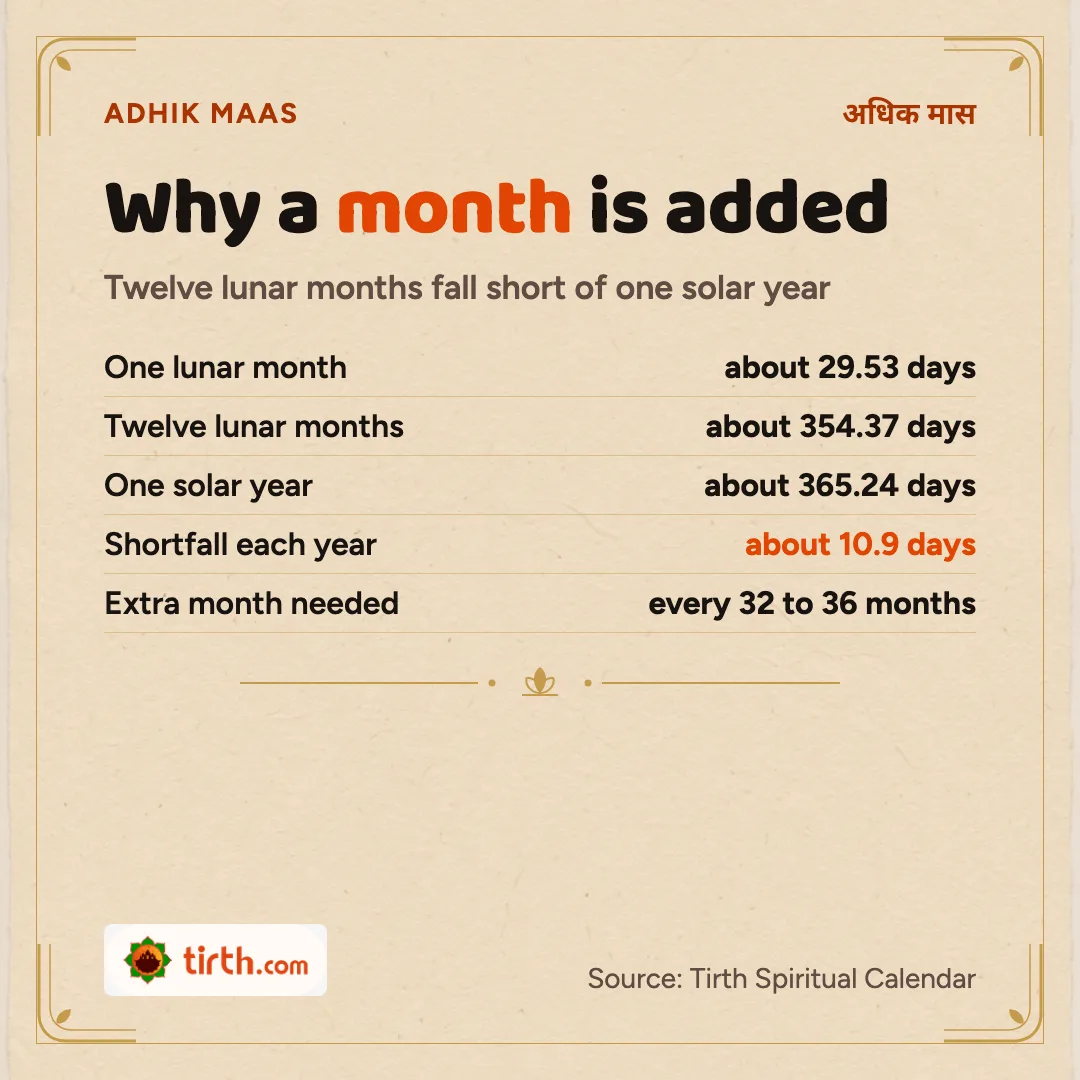
A lunar month is the time from one new moon to the next, which astronomers call the synodic month, about 29.53 days. Put twelve together and you get about 354.37 days. The solar year runs to about 365.24.
| Measure | Length in days |
|---|---|
| One lunar month (new moon to new moon) | about 29.53 |
| Twelve lunar months | about 354.37 |
| One solar year | about 365.24 |
| Shortfall of the lunar year | about 10.9 |
So, year on year, the lunar count loses approximately 10.9 days against the Sun. Let three years go by and the shortfall is past a month (three times 10.9 is close to 33 days), and that is why an extra month shows up roughly every third year. Other calendars average the gap between extra months differently, though in practice it runs from about 32 to 36 months.
February’s leap day is the English calendar’s fix for the same kind of gap, and it adds one day, never more. In the Hindu count nothing goes in until the gap has grown to a whole month.
The month that has no Sankranti in it
Once a month is due, the panchang still has to decide which one to repeat. It settles that by the Sun.
The Sun changes zodiac sign about once a month. Every such crossing is called a Sankranti (the Sun’s entry into a new sign), and Makar Sankranti is one of them. Now and then a lunar month opens and closes with the Sun sitting in the same sign at both of its new moons.
The panchang marks that month, the one without a Sankranti, as Adhik.
Leave the month out and every festival fixed to a lunar tithi would drift about 11 days earlier against the seasons, each year. Give it a couple of decades and a festival your family has always kept after the rains would be falling in late winter or early spring. Putting the extra month in pulls the lunar dates back into line with the Sun.
The Tirth panchang for 2026 shows it. The day before the extra month started was still Vaishakha, and the day after it finished was Nija Jyeshtha (the regular Jyeshtha). So Jyeshtha was, in effect, printed twice, and the first of the two was the Adhik one.
Adhik Chaitra in 2029, Adhik Bhadrapada in 2031
The Tirth panchang works the month out day by day, and for New Delhi it finds three Adhik months between 2026 and 2031. All of them are counted amanta (each month ending on the new moon).
| Year | Adhik month | Begins | Ends |
|---|---|---|---|
| 2026 | Adhik Jyeshtha | Sunday, 17 May 2026 | Monday, 15 June 2026 |
| 2029 | Adhik Chaitra | 16 March 2029 | 13 April 2029 |
| 2031 | Adhik Bhadrapada | August 2031 | September 2031 |
None falls in 2027, 2028 or 2030. If there is already talk at home of a wedding in 2029, check its date against 16 March 2029 to 13 April 2029 before anyone books a thing.
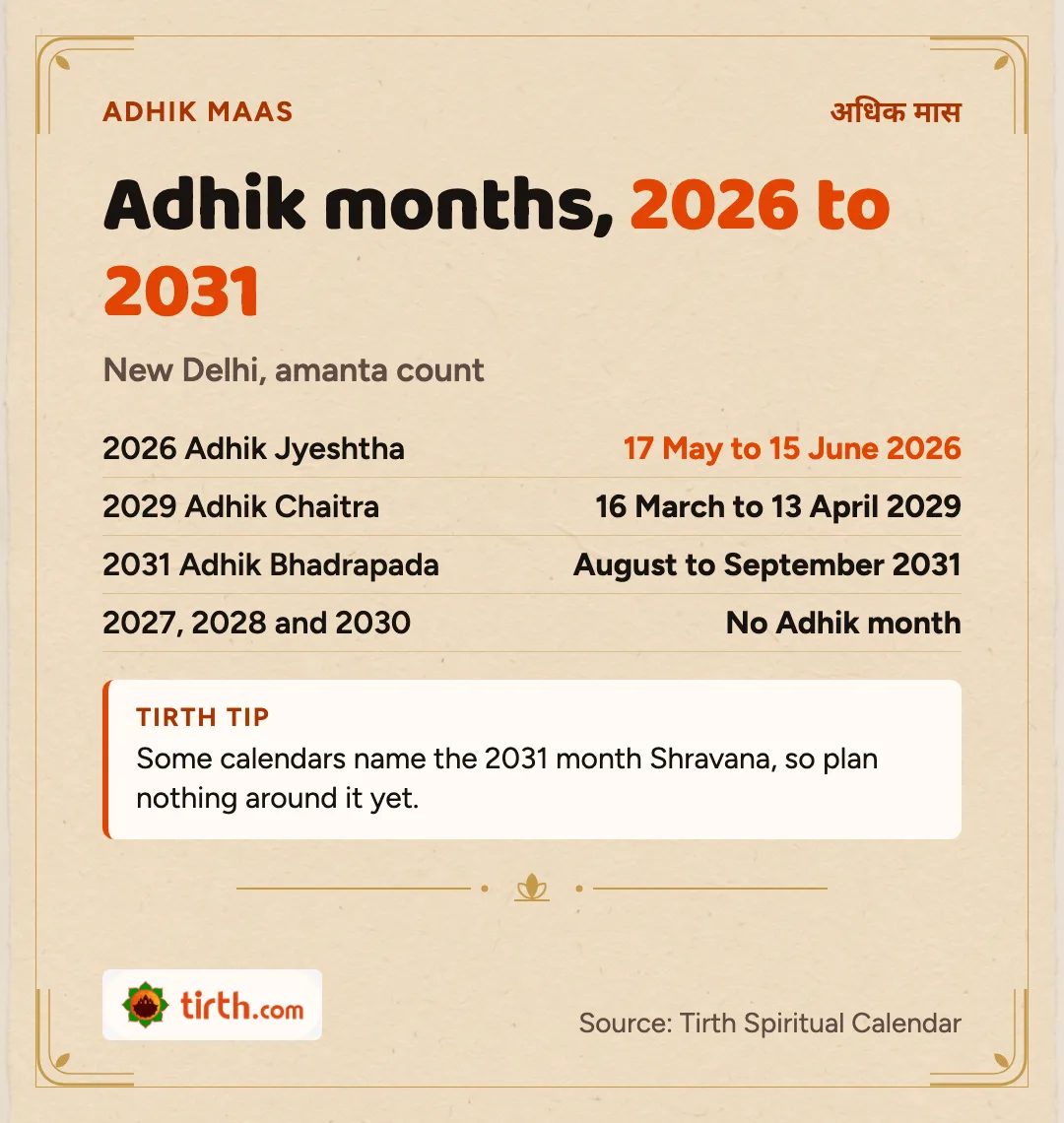
Some calendars print Shravana as the extra month of 2031, where ours has Bhadrapada. That row gives only the months, not the days. Check the Tirth Panchang nearer the time.
Families with one side in the North and one in the South hit a further snag. In North and Northwest India the months are counted purnimanta, each one ending on the full moon, while Maharashtra, Gujarat and much of the South keep the amanta count, where a month ends on the new moon. The same fortnight can carry two month names as a result. A relative in Lucknow and one in Pune may simply be calling it different things.
The Tirth Panchang will show you the tithi and the month for the day, wherever you are, so look up your own city there in your own count.
Mal Maas, Purushottam Maas and the dates families hold back
In the devotional retellings, the story starts with the extra month arriving with no presiding deity of its own.
As the story has it, the month was called Mal, a word usually read as impure or unfit for auspicious work, and people kept weddings and new beginnings away from it.
Then, as the tradition has it, Bhagwan Vishnu took the month under his own name, Purushottam. From then on, as the story is told, prayer, recitation and Vishnu worship are what it is kept for.
Malimmacha and Londa Maas are names for it in some regions.
Tradition advises against marriages, griha pravesh and new purchases during the month. Prayer, recitation, daan (charity) and Vishnu worship are what it encourages in those weeks instead.
Regional panchangs differ on the details, so do individual Pandits, and a family in one city may not draw the line where a family in another does. If a date matters to you, take it to the family Pandit before any card is printed, because the custom your relatives will expect is his.
A few checks save trouble in an Adhik year:
- Open your own city in the Tirth Panchang, since the dates in this post are worked out for New Delhi.
- Find out whether your family counts amanta or purnimanta. A purnimanta calendar at home will not name the months the way the amanta table above does, so go by the dates rather than the names.
- Put Padmini Ekadashi and Parama Ekadashi on the family calendar as soon as the month is announced, because no other month carries them.
Padmini Ekadashi and Parama Ekadashi come in this month and never in any other. The first falls in the bright half, the second in the dark half, and in 2026 they fell on Wednesday, 27 May 2026 and Thursday, 11 June 2026. Check your own city’s dates in the Tirth Panchang. Between the two Ekadashis came Adhika Purnima, the extra month’s full moon, on Sunday, 31 May 2026, with the Purnima tithi in New Delhi running until 2:14 PM.
For a first fast, read why the eleventh lunar day is a fast day before you begin. The year’s regular ones sit in Ekadashi 2026.
Frequently asked questions
How many days is Adhik Maas?
It is one lunar month, so about 29.53 days on average. In 2026, counted amanta, Adhik Jyeshtha ran from Sunday, 17 May 2026 to Monday, 15 June 2026.
When is the next Adhik Maas after 2026?
The next is Adhik Chaitra, due in 2029. Counted amanta for New Delhi, it runs from 16 March 2029 to 13 April 2029, and 2027 and 2028 have none.
Is Adhik Maas the same as a leap year?
Only loosely. A leap year adds one day to the English calendar to keep pace with the Sun, whereas Adhik Maas lets the lunar year fall about a month behind the solar year and then adds a whole lunar month.
Which Ekadashis come only in Adhik Maas?
Padmini Ekadashi and Parama Ekadashi. The first is in the bright half of the extra month and the second in the dark half, and in 2026 those were Wednesday, 27 May 2026 and Thursday, 11 June 2026.
Why does Adhik Maas not come every year?
The gap grows slowly. The lunar year falls behind the solar year by only about 10.9 days a year, so it takes roughly 32 to 36 months for a full month to build up, and that works out to about one every third year.
Continue on Tirth
- The Tirth Spiritual Calendar for every festival and vrat date worked out for your own city, North or South.
- Vishnu mantras with meaning, and what each one means.
- What Chaturmas is and how families keep its four months.
- Kartik Mahatmya stories for another month that families give to Bhagwan Vishnu.
Leave a Reply