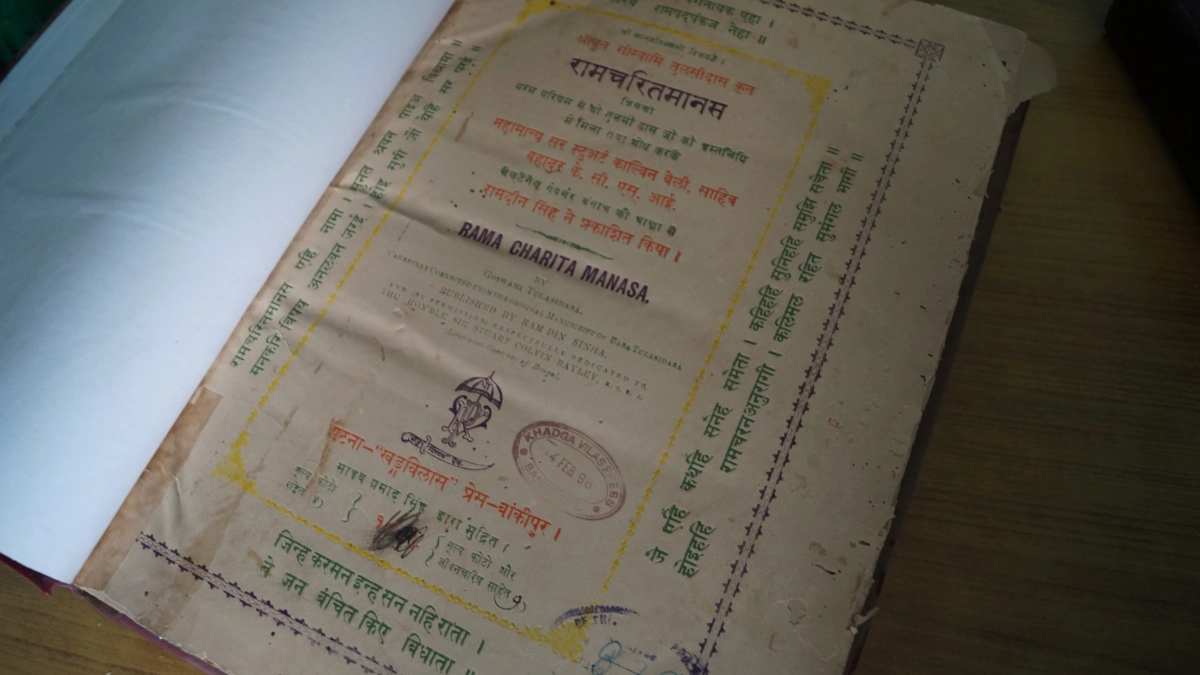
Aarti Shri Ramayan ji ki, the Ramayan aarti, is an aarti sung to a book. The one being praised is Shri Ramayan, the Ramcharitmanas itself, and Shri Ram comes into the refrain as “Siya pi”, Sita ji’s beloved, while the whole verse is traditionally sung when a reading of the Ramcharitmanas comes to its end.
Gita Press gives it a place near the end of the book.
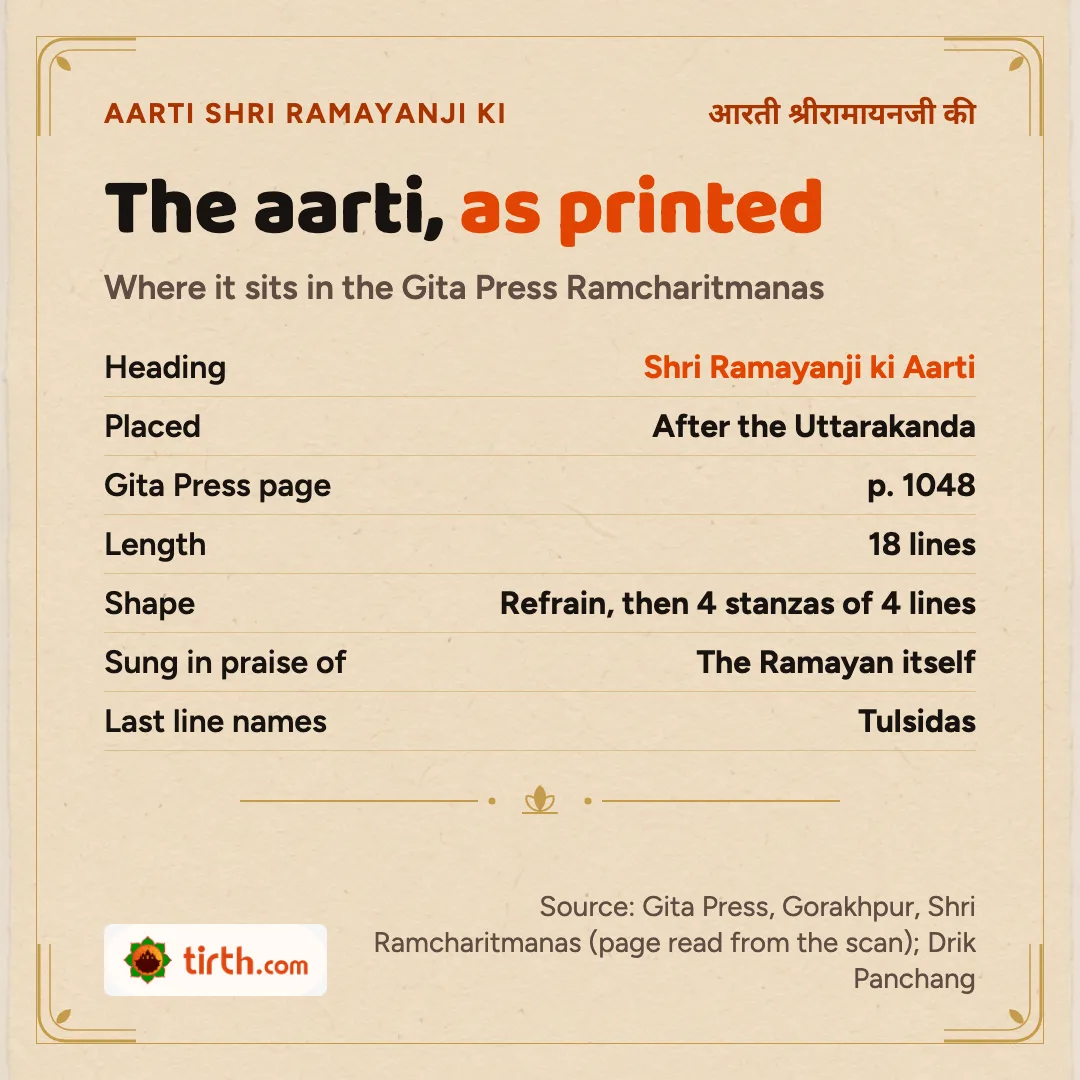
In its Shri Ramcharitmanas (the sachitra, satik, mota type edition from Gorakhpur) the aarti stands after the closing colophon of the Uttarakanda, on page 1048 by the book’s own contents list, and before the short life of Tulsidas, so it serves as the closing aarti of a complete reading.
The Hindi and Roman lines below follow that printed page. The meanings after them are Tirth’s own plain reading, and the word table takes every meaning from Platts’ A Dictionary of Urdu, Classical Hindi, and English, with a page number for each.
Shri Ramayanji ki aarti in Hindi, as printed after the Uttarakanda
The printed page has 18 lines in all.
Gita Press sets the two-line refrain once, at the top, and then four stanzas of four lines each, with no refrain between them. Drik Panchang repeats the refrain after every stanza for singing, and you can do the same if that is how your family sings it.
आरति श्रीरामायनजी की।
कीरति कलित ललित सिय पी की॥
Aarti Shri Ramayanji ki,
Kirati kalit lalit Siya pi ki.
गावत ब्रह्मादिक मुनि नारद।
बालमीक बिग्यान बिसारद॥
सुक सनकादि सेष अरु सारद।
बरनि पवनसुत कीरति नीकी॥
Gavata Brahmadika muni Narada,
Balamika bigyana bisarada
Suka Sanakadi Sesha aru Sarada,
Barani Pavanasuta kirati niki
गावत बेद पुरान अष्टदस।
छओ सास्त्र सब ग्रंथन को रस॥
मुनि जन धन संतन को सरबस।
सार अंस संमत सबही की॥
Gavata Beda Purana Ashtadasa,
Chhao sastra saba granthana ko rasa
Muni jana dhana santana ko sarabasa,
Sara amsa sammata sabahi ki
गावत संतत संभु भवानी।
अरु घटसंभव मुनि बिग्यानी॥
ब्यास आदि कबिबर्ज बखानी।
कागभुसुंडि गरुड के ही की॥
Gavata santata Sambhu Bhavani,
Aru Ghatasambhava muni bigyani
Byasa adi kabibarja bakhani,
Kagabhusundi Garuda ke hi ki
कलिमल हरनि बिषय रस फीकी।
सुभग सिंगार मुक्ति जुबती की॥
दलन रोग भव मूरि अमी की।
तात मात सब बिधि तुलसी की॥
Kalimala harani bisaya rasa phiki,
Subhaga singara mukti jubati ki
Dalana roga bhava muri ami ki,
Tata mata saba bidhi Tulasi ki.
The opening word is spelt two ways. The printed text opens with आरति, while the page’s own heading (श्रीरामायणजीकी आरती), Drik Panchang and ramcharitmanas.info all write आरती, and that is the form used in this page’s title.
What the Ramayan aarti says, stanza by stanza
This is a plain reading, made only from the dictionary meanings in the table further down. A word with no entry there stays in its own form, in italics, and gets no English word guessed for it.
The refrain comes first. It is the aarti of Shri Ramayan ji, the beautiful (kalit) and graceful (lalit) fame (kirati) of Siya’s pi, and Platts gives pi as beloved, dear one, husband, so Siya pi is Sita ji’s beloved, Shri Ram.
The first stanza is a roll of singers, one after another. Brahma and the others sing it (gavat, in Platts, is sing, chant, celebrate, a dialect form of gana), and so do the sage (muni) Narada and Valmiki, written Balamika in the verse, who is called bigyan bisarad (bisarad, in Platts, is learned, wise, skilled), and after them come Suka, the Sanakadi (Brahma’s four sons), Sesha and Sarada. It closes on barani Pavanasut kirati niki, left as printed.
The second stanza turns to the scriptures, and says the Vedas and the ashtadas Puranas sing it too. It is the ras of the chhao sastra and of all the granthan, the wealth of the sages (muni) and the sarabas, all one has, of the santan. And it is the sar ams on which all are agreed, since Platts gives sammat as of one mind, agreed.
In the third, Sambhu and Bhavani sing it santat. Bhavani, in Platts, is a name of Shiva’s wife Parvati. The sage Ghatasambhava, called bigyani, sings it too, Vyasa and the other kabibarj describe and praise it (bakhani), and the stanza closes on Kagabhusundi and Garuda.
The last stanza says what the verse holds the book to be. It is the harani of kalimal, and beside it the ras of the objects of the senses (bisay) is phiki. It is the lovely (subhag) ornament (singar) of the young woman (jubati) mukti, liberation, and it crushes (dalan) the sickness (rog) of worldly existence (bhav), a muri of nectar (ami).
And to Tulsi it is father and mother (tat mat), in every way.
That last line is why the aarti is read as spoken in Tulsidas’s voice. That is why people assume he wrote it. The printed edition sets no author line above it, and authorship has not been established, so calling it Tulsidas’s own aarti goes further than the evidence does.
What the same book does say about Tulsidas is exact. It notes that the Ramcharitmanas was begun in Samvat 1631, and the biography printed straight after this aarti gives his death as Samvat 1680, Shravan Krishna Tritiya, at Assi Ghat in Kashi.
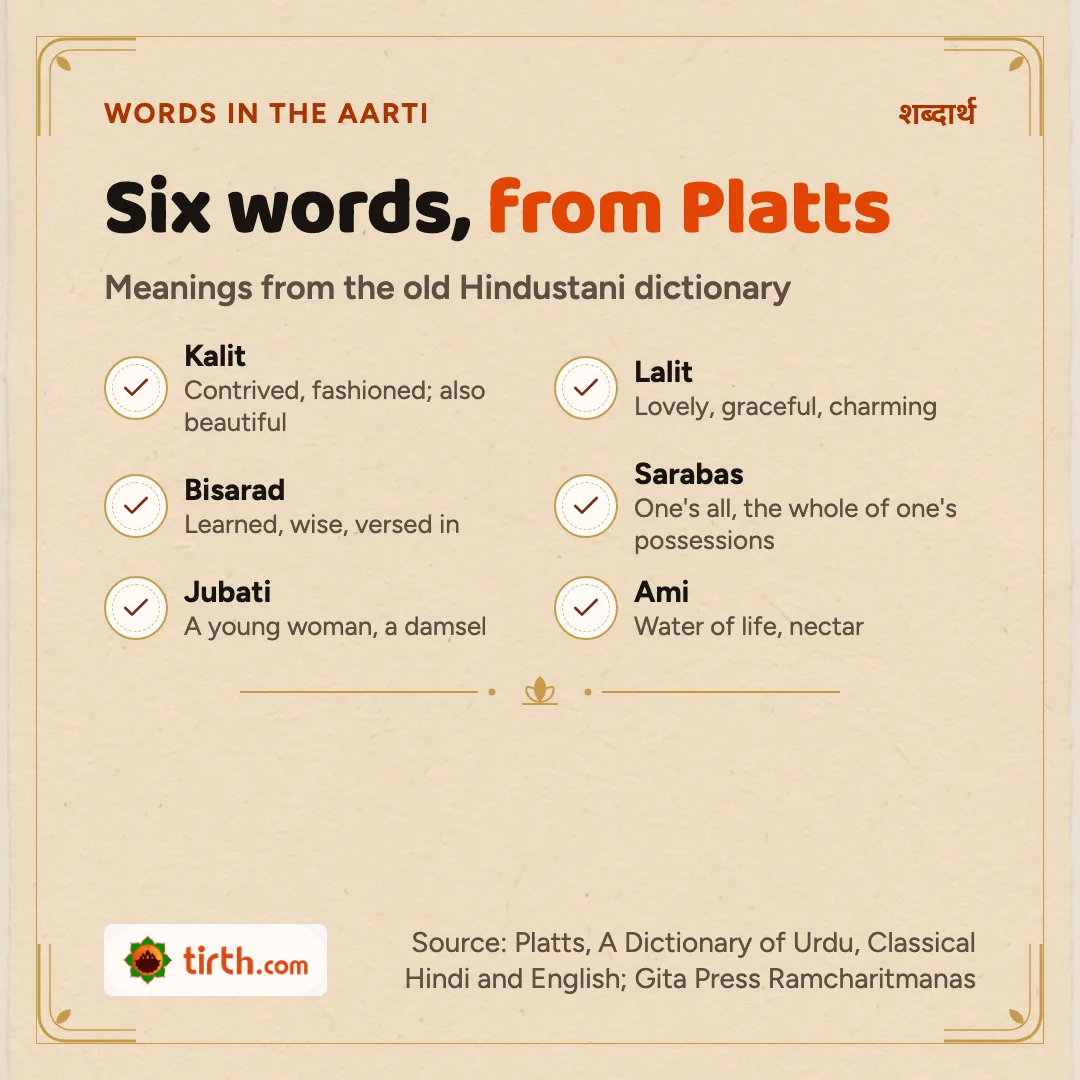
Kalit, lalit, sarabas and the other words, from Platts
Every meaning here is quoted from Platts, with the dictionary page. Some words of the aarti are left out of the table because we could not match the printed spelling to a Platts entry with confidence (नीकी, हरनि, फीकी, मूरि, अष्टदस, संभु, घटसंभव, कबिबर्ज, सास्त्र, बिग्यान, पवनसुत), and they stay in their own form in the meanings above.
| Word in the aarti | Roman | Meaning in Platts | Platts page |
|---|---|---|---|
| कीरति | kirati | fame, renown, glory; good report, praise (Platts lists kīrat as kīrtti) | 888 |
| आरति (आरती) | aarti | ceremony of worship waving a lamp before a deity; also a hymn of praise | 39 |
| कलित | kalit | fabricated, contrived; beautiful | 842 |
| ललित | lalit | lovely, handsome, graceful, charming | 963 |
| पी (पिया) | pi | beloved, dear one, husband | 294 |
| गावत | gavat | sing, chant, celebrate (dialect form of gānā) | 893 to 894 |
| मुनि | muni | an inspired saint, saint-sage, a holy man | 1084 |
| बिसारद | bisarad | learned, wise, skilled, versed in; famous | 154 |
| सेष (शेष) | shesh | remaining, remainder; also the name of a celebrated mythological thousand-headed serpent | 740 |
| बेद | bed | Veda, the sacred scriptures | 207 |
| पुरान | puran | ancient; the Puranas, legendary tales | 236 |
| सरबस | sarabas | the whole of a person’s property or possessions, one’s all (as sarvasva) | 657 to 658 |
| भवानी | Bhavani | epithet of Shiva’s wife, Parvati | 194 |
| ब्यास | Byas | Vyasa, saint said to have compiled the Vedas and Puranas | 205 |
| संमत | sammat | of one mind, of the same opinion, agreed | 674 |
| बखानी | bakhani | description, account, relation; praise (as bakhān) | 161 |
| बिषय | bisay | an object of sense; anything perceptible by the senses | 1195 |
| सुभग | subhag | fortunate, blessed, auspicious; beautiful, lovely | 633 |
| सिंगार | singar | dress, ornament, decoration; also the erotic sentiment | 686 |
| मुक्ति | mukti | release, liberation, final emancipation | 1058 |
| जुबती | jubati | a young woman, damsel | 375 |
| दलन | dalan | breaking to pieces, crushing, rending | 524 |
| रोग | rog | sickness, disease; evil, plague | 607 |
| भव | bhav | existence, life, the world; also an epithet of Shiva | 194 |
| अमी | ami | water of life, nectar | 83 |
| तात | tat | revered, dear; father; a term of endearment | 304 |
| मात | mat | mother; tat-mat, father and mother | 977 |
Bhav carries a second sense in Platts as well, an epithet of Shiva. In the line about the sickness of bhav, the reading above takes the first sense, existence and the world.
Muni jan or muni man? Where copies of the aarti differ
One variant is well known. Gita Press and ramcharitmanas.info print मुनि जन धन (muni jan dhan, the wealth of the sages), while Drik Panchang prints muni-man dhan. This page keeps the printed reading.
This page’s earlier text had smaller differences. It printed शुक सनकादिक शेष for the printed सुक सनकादि सेष, संतान को for संतन को, सब ही की for सबही की, दलनि for दलन, and तात मातु for तात मात.
We would rather you sang from the printed page. If you are closing a full path of the Ramcharitmanas with this aarti, stay with the wording that book prints, and keep it open at page 1048 to read straight from it.
When is Aarti Shri Ramayan ji ki sung after a path?
It is traditionally sung after the Ramcharitmanas path (a full reading of the text). The aarti follows the colophon of the seventh sopan, “iti Shrimad Ramcharitmanase sakalakalikalushavidhvansane saptamah sopanah samaptah”, and comes before the life of Tulsidas, so a family reading from the first kand to the Uttarakanda reaches it at the very end, prior to closing the book.
See also the Ram aarti and the Bhagavad Gita aarti.
More for a Ram path on Tirth: Ram Chalisa, Hanuman Chalisa, Ram mantra and the Janakinath aarti.
If you would like a priest to hold a Sundarkand path or a Ram Raksha Stotra puja in Ayodhya for your family, you can book a puja on Tirth. And for the story behind the name the aarti sings, read what Maryada Purushottam Ram means, or how families keep Ram Navami.
Frequently asked questions
Who wrote the Ramayan aarti?
Who wrote it has not been established.
The last line names Tulsi, so the verse is traditionally read in Tulsidas’s voice, but the Gita Press edition prints it on page 1048 without any author line above it, straight after the colophon that closes the Uttarakanda, and none of the sources behind this page gives evidence that he did.
When is the Ramayan aarti sung?
It is traditionally sung after the Ramcharitmanas path. Gita Press prints it straight after the Uttarakanda and before the biography of Tulsidas, so it closes a complete reading of the book.
What is the meaning of “Kirati kalit lalit Siya pi ki”?
Platts gives kalit as beautiful, lalit as lovely and graceful, and pi as beloved or husband, so Siya pi is Sita ji’s beloved, Shri Ram. Kirati is fame (kirtti in Platts). The refrain praises the beautiful, graceful fame of Sita ji’s beloved.
Why does the aarti end with Tulsi’s name?
Its last line, “Tata mata saba bidhi Tulasi ki”, calls the book father and mother to Tulsi in every way.
Why does Gita Press print the refrain only once?
The printed page sets the two-line refrain at the top and then the four stanzas. Drik Panchang repeats the refrain after each stanza for singing, and either way the words of the stanzas are the same.
Is there a Ramayan aarti in English?
It is sung in Hindi, and the Roman lines above let you follow it without Devanagari.
Leave a Reply