Is Alakshmi really Maa Lakshmi’s sister? In the Linga Purana she is the elder of the two, created before Maa Lakshmi and then married to a sage who could not keep her at home.
That is the Alakshmi story most people half know. The full chapter is stranger. And less one-sided.
The Linga Purana gives her a whole chapter in its first part, the Purvabhaga, under the title “The origin and activities of Alakshmi”. It opens with the sages asking Suta one plain thing. How did Jyeshtha arise from Bhagwan Vishnu?
Which sister was born first, Jyeshtha or Maa Lakshmi?
The chapter says Bhagwan Vishnu brought out two sets of beings. With the first came the Brahmins, the Vedas, Vedic virtue and Padma, also called Shri, who is Maa Lakshmi. With the second came Jyeshtha, who is Alakshmi, along with the people kept outside and sin itself.
And Jyeshtha came first.
In this telling she is born after the terrible poison, as the nectar comes out, and Maa Lakshmi arrives later to become the wife of Bhagwan Vishnu. Which is why the text calls her Jyeshtha, the elder, and why tradition calls her Maa Lakshmi’s elder sister.
The names, as they are usually explained, carry the idea. Jyeshtha is Sanskrit for the elder one, and Alakshmi is read as “not Lakshmi”, the inauspicious one. The chapter puts the two of them side by side, and the inauspicious one simply arrives first.
Maa Lakshmi’s own vrat story is a different katha, by the way, the one told as the Mahalakshmi Vrat Katha.
Why did Alakshmi cover her ears after her marriage?
The sage Duhsaha married her, and it did not go well.
She could not bear the sounds of his world. The names of Bhagwan Vishnu and Bhagwan Shiva, the chanting of the Vedas, the smoke going up from a sacrifice, people with bhasma (sacred ash) smeared on their bodies.
So she covered her ears and ran.
Duhsaha took her into a forest and did penance there. She refused to take part in the penance and wandered from house to house instead. At last he met the sage Markandeya and asked the one practical question a husband in his place had left. Where could the two of them go, and where must they not?
Where did Markandeya say she could and could not live?
Markandeya’s answer comes as two long lists. One of homes the couple must avoid, one of homes they may walk into.
The chapter says the couple must stay away from homes where Bhagwan Vishnu and Bhagwan Shiva, as Rudra, are worshipped, where the Vedas are chanted and the Agnihotra fire is kept, where the linga is worshipped, and where Brahmins, cows and teachers are honoured.
The second list is the telling one. The couple may walk into a house where husband and wife quarrel night after night. Same goes for a house where no guest and no teacher ever comes. The list carries on for many more verses, and the chapter itself is the place to read all of it.
Left at a lake, she asked what she would eat
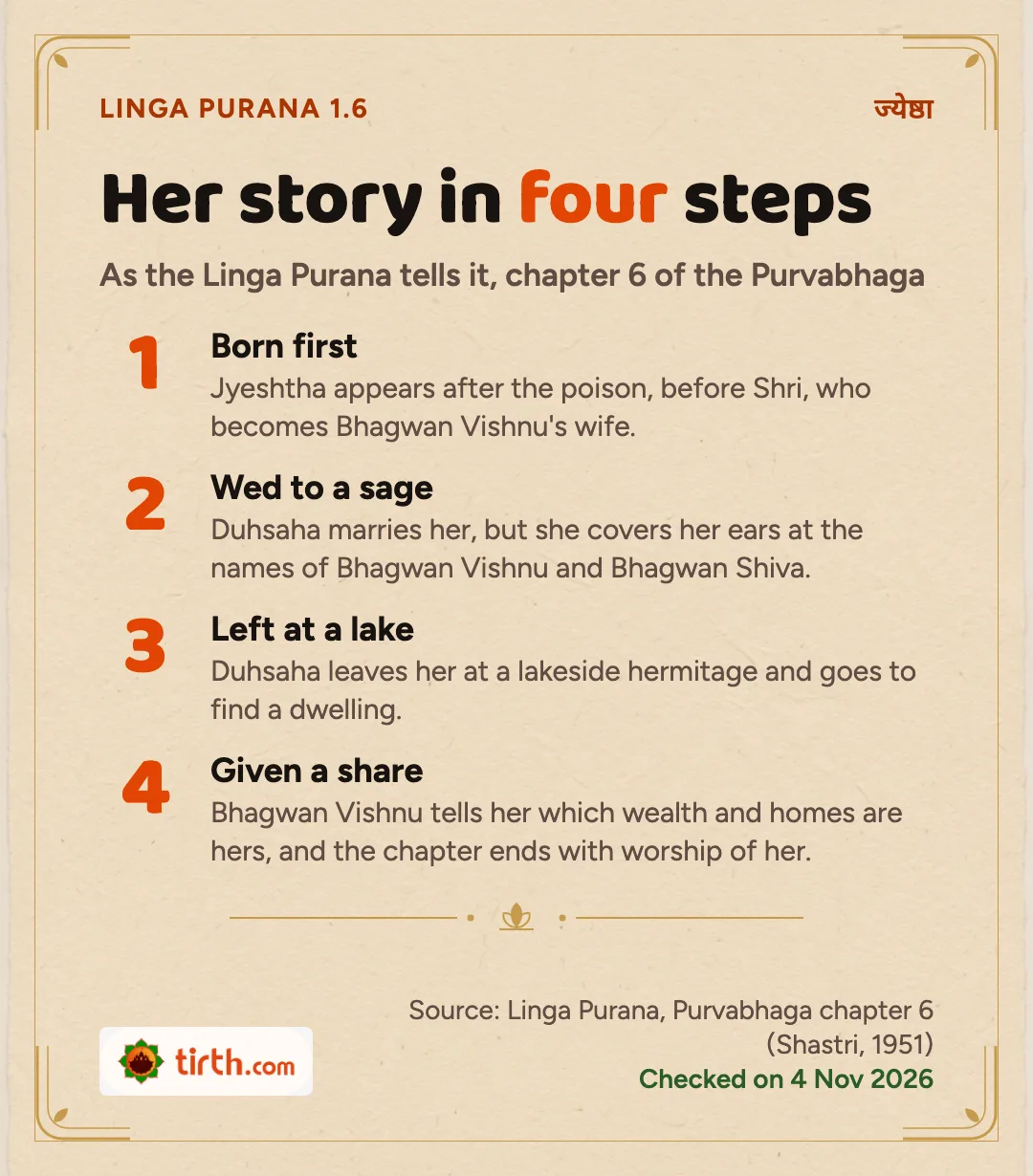
Duhsaha did not stay to see how it worked out. He left her at a hermitage beside a lake and went down to the nether world to find them a dwelling.
Before he went she asked him what she would eat. His answer was one more rule. She was not to enter houses where women offered her oblations, flowers and incense.
Then he was gone.
Then, by chance, she saw Bhagwan Vishnu, and Maa Lakshmi was with him. So the two stand in one scene, the younger beside her husband and the elder telling him hers has just left her and asking how she is supposed to live now.
The chapter says Bhagwan Vishnu laughed.
Then he gave her a share. The wealth of people who revile Bhagwan Shiva, Maa Parvati and his own devotees would be hers. So would the home, the field and the good works of people who worship him and still despise his devotees. He says they are not his devotees at all. Which is a very particular kind of wealth.
What the Linga Purana says her share really is
In the chapter’s own reading she does not drift into a house at random. Her share is tied to conduct: scorn for Bhagwan Shiva and Maa Parvati, and devotion to Bhagwan Vishnu that is only talk while the person despises other devotees.
The ending is not simple. The text says Bhagwan Vishnu went away with Maa Lakshmi and recited the Rudra mantra to bring about Alakshmi’s destruction. Then it says the devotees of Bhagwan Vishnu should always offer her oblations, and that women should worship her with offerings. Whoever reads or hears the account, it says, becomes sinless and fortunate.
So the chapter gives her a share of wealth and a place in worship, and also has Bhagwan Vishnu work toward her end.
If you came here for Maa Lakshmi herself, her own lines are in these Lakshmi mantras.
Did Alakshmi come out of the samudra manthan? Three texts, three orders
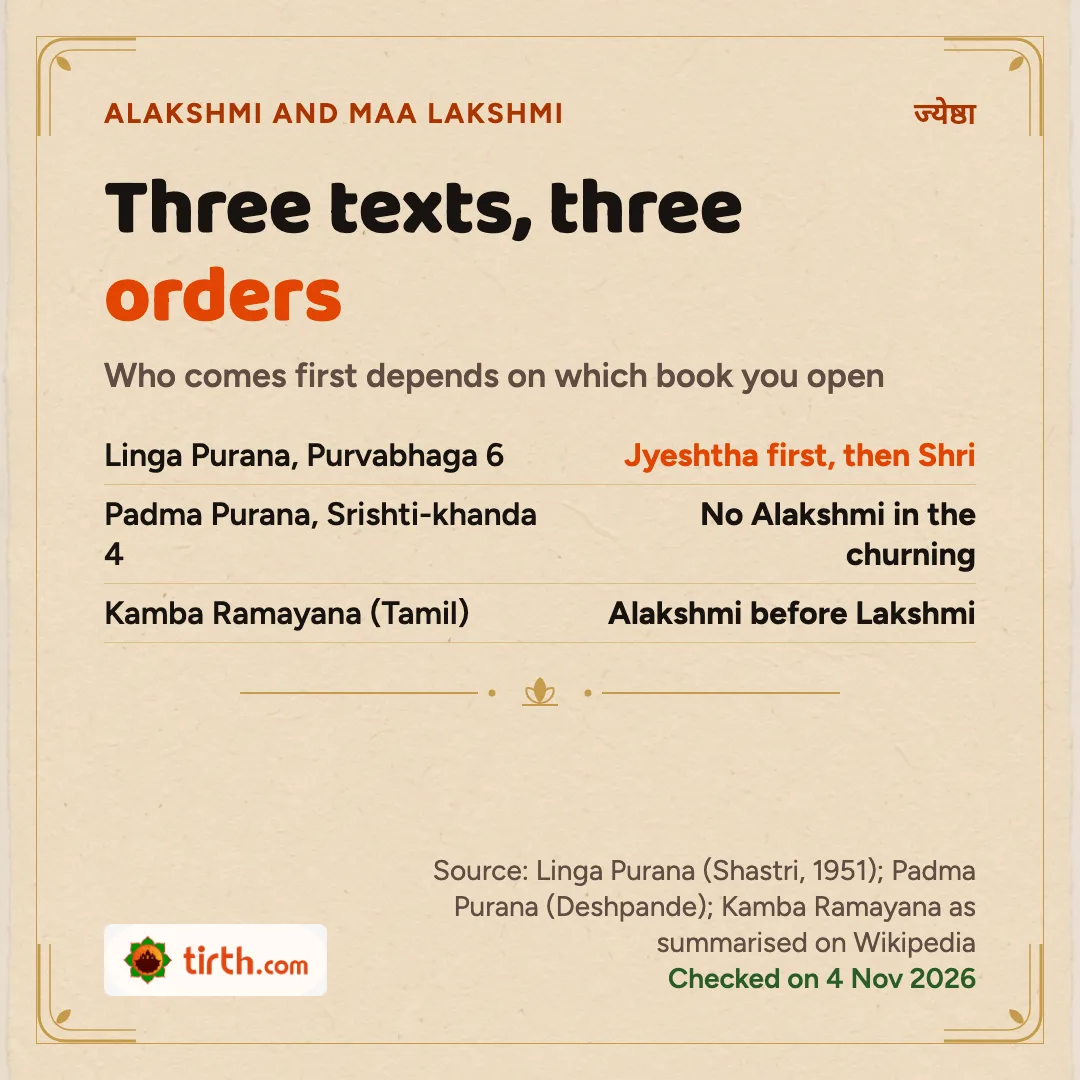
Popular retellings credit the Padma Purana with Alakshmi rising from the churning of the ocean before Maa Lakshmi. Chapter 4 of its Srishti-khanda is its churning chapter, and its list is different. The receptacle of oblation, Varuni Devi, the Parijata tree and the apsaras, the moon, the poison that Bhagwan Shiva drank, Dhanvantari Dev with the nectar, Uccaihshravas and Airavata, and then Maa Lakshmi.
No Alakshmi in it. No Jyeshtha either. Julia Leslie’s 1992 study places Jyeshtha after the poison in a Padma Purana telling, but that passage is not in this chapter.
| Text | Where Alakshmi appears | Who comes first |
|---|---|---|
| Linga Purana, Purvabhaga chapter 6 | Born as Jyeshtha after the poison, as the nectar comes out | Jyeshtha, then Maa Lakshmi (Shri) |
| Padma Purana, Srishti-khanda chapter 4 | Not named in the churning | Maa Lakshmi (Shri) comes after the poison and the nectar |
| Kamba Ramayana (Tamil), as summarised in the Puranic Encyclopaedia | Emerges before Maa Lakshmi | She is the elder sister for that reason |
So whether she came out of the churning depends on which book you open.
Diwali, the night of Lakshmi Puja, falls on Sunday, 8 November 2026, and the timings for your city are on the Diwali 2026 date and Lakshmi Puja timings page.
For the puja itself, step by step, there is Maha Lakshmi Puja on Diwali. And when the lamps are lit and the house is full, the older story is worth one quiet retelling at the table, the sister who came first and was still given somewhere to go.
More on the festival is in the five days of Diwali and what Diwali means.
More legends from the Puranas, each with its text named, are collected in the Puranic Legends section.
Frequently asked questions
Is Alakshmi the sister of Maa Lakshmi?
The Linga Purana makes her the elder of the two. Chapter 6 of its Purvabhaga has Jyeshtha, also called Alakshmi, created first and Shri, who is Maa Lakshmi, afterwards. “Sister” is the tradition’s word for that bond.
Who was Alakshmi’s husband?
The sage Duhsaha, also spelt Dussaha. In the Linga Purana he takes her to a forest, asks the sage Markandeya where the two of them may go, and later leaves her at a lakeside hermitage.
Is Alakshmi the same as Jyeshtha?
Yes, the Linga Purana uses both names for her in one chapter, Jyeshtha meaning the elder one and Alakshmi read as “not Lakshmi”.
Why is Alakshmi not worshipped?
The Linga Purana actually ends her chapter with an instruction to worship her. It says the devotees of Bhagwan Vishnu should always offer her oblations and that women should worship her with offerings, after Bhagwan Vishnu has recited the Rudra mantra to bring about her destruction.
Leave a Reply