
Yama Dev keeps a scribe, Chitragupta ji, and each and every person’s good and evil deeds go into his ledger. The Garuda Purana calls him all-knowing.
Yet in that same verse he asks questions anyway. He asks the Sravanas, who roam heaven, earth and the nether regions, and whatever people say and do they carry back to him.
That, at its centre, is the Chitragupta story (the Chitragupta ki kahani), and on Bhai Dooj, Wednesday, 11 November 2026, Kayastha families worship him with pen and inkpot.
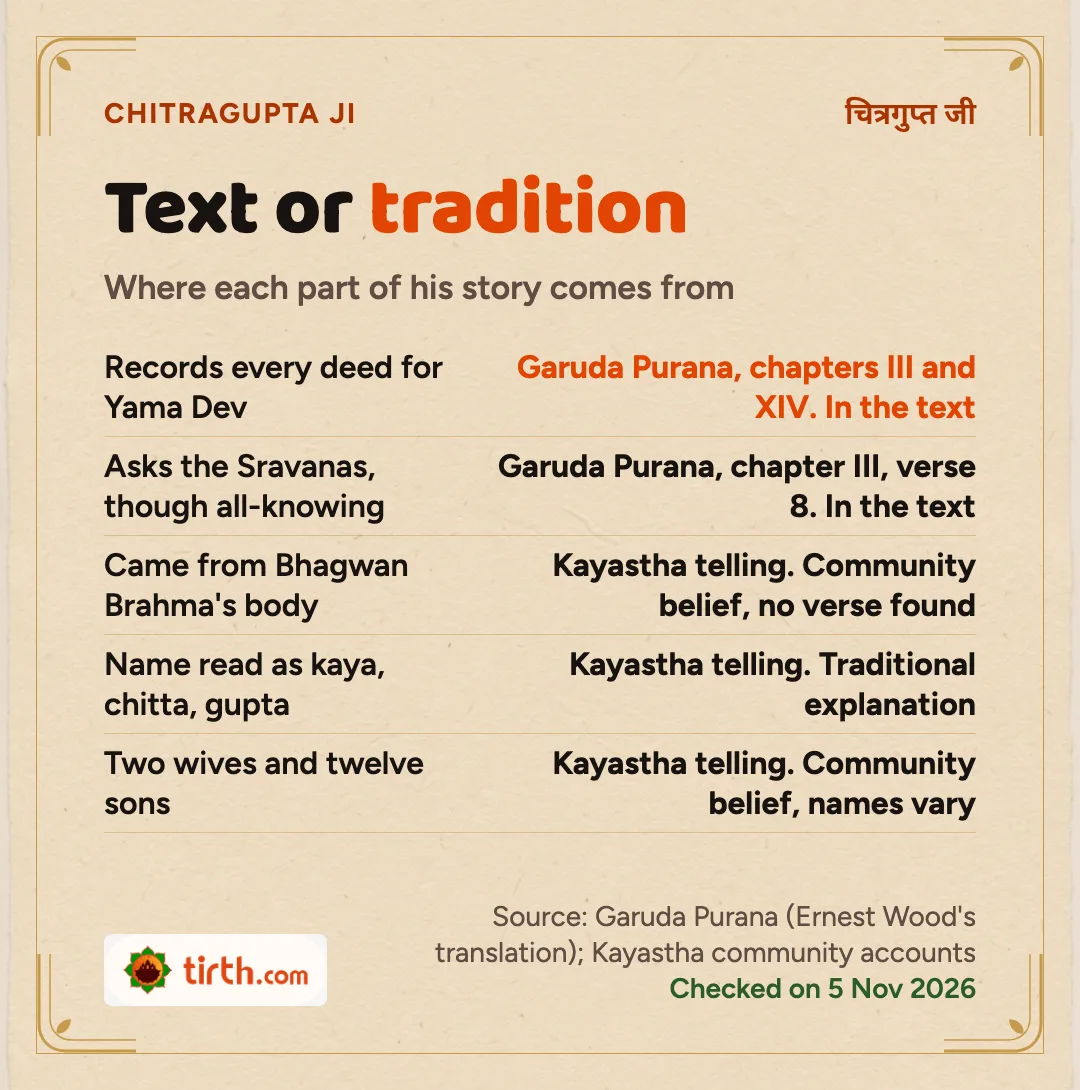
His birth is nowhere in the two Garuda Purana chapters that show him at work. Kayastha families tell that part. I think the two are better kept apart.
Who is Chitragupta ji, Yama Dev’s recorder?
The job of Chitragupta Dev in Yama Dev’s court is to record.
Ernest Wood stops in his Garuda Purana translation to footnote the name, and the footnote reads “Name of the being who records the doings of men.” Apte’s dictionary puts him among the beings of Yama Dev’s world who record vices and virtues. Monier-Williams has him down as Yama Dev’s attendant and recorder.
| Chitragupta ji at a glance | What the texts and families say |
|---|---|
| Role | Records the good and evil deeds of every person |
| Serves | Yama Dev, called the King of Justice in the Garuda Purana |
| Appears in | Garuda Purana, chapters III and XIV (Ernest Wood’s translation) |
| Known for | Asking the Sravanas although he knows everything (chapter III, verse 8) |
| Worshipped as | Family deity of Kayastha families, with pen, inkpot and account books |
| His day | Yama Dwitiya (Bhai Dooj), Kartik Shukla Dwitiya |
| Birth | Not in the Garuda Purana. Kayastha families say he came from Bhagwan Brahma’s body |
Chitragupta ki kahani, as Kayastha families tell it
Yama Dev, in the Kayastha telling, had a problem of scale. Every being’s deeds needed recording, and he could not manage it on his own. He took his complaint to Bhagwan Brahma.
Bhagwan Brahma meditated, and a figure came out of his body carrying a pen and an inkpot. Which is how Chitragupta ji arrives in the story.
About the name, there are two readings going around. Kayastha families call him the father of the Kayasthas because he came from Bhagwan Brahma’s body, the kaya. He is Chitragupta, they say, because he was conceived in Bhagwan Brahma’s mind (chitta) and lay hidden (gupta) there. The other reading is simpler. Chitra for the deeds done openly, gupta for the hidden ones. You won’t find either one as the etymology in a dictionary, mind you.
Then the family, in the same telling. Two wives and twelve sons, and from those sons the twelve Kayastha sub-groups trace their line.
Ask the Kayastha community websites for a source and they name the Yama Samhita for the birth, the Bhavishya Purana for the word Kayastha and the Padma Purana for the twelve sons. No verse is quoted for any of it.
So I read the birth story as a community’s own account of where it began. Or rather, of where its families say it began.
What does Chitragupta ji do when the sinners arrive?
Every chapter and verse number I give from the Garuda Purana is from Ernest Wood’s abridged translation. Those are his edition’s numbers, not the Purana’s own adhyaya (chapter) numbers.
The scene is in chapter III, ‘An Account of the Torments of Yama’, and there the sinners cry out. Their cries reach a doorkeeper. He reports their good and evil deeds to Chitragupta ji, who then tells it to Yama Dev, the King of Justice.
“Chitragupta, although he is all-knowing, enquires of the Śravaṇas.” (Garuda Purana, chapter III, verse 8)
Verses 9 to 12 describe the Sravanas. They wander in heaven, on earth and in the nether regions, hear and see from a long way off, and report to him everything people say and do, openly and in secret. The Sravanas have wives as well, called Sravanis.
Verse 17 then names who sees the sins and merits of the embodied being in full. The King of Justice, Chitragupta ji, the Sravanas, the sun and others.
Yama Dev gives the word, and Chitragupta ji addresses the sinners, still crying over their karmas (verse 24). They grieve over what they did once they hear him. Then they stand silent and motionless (verse 30).
Of everything in his story, this scene is the one I like most. He knows already. Still he checks with the ones who saw and heard, and only after that does he speak to the sinner.
His workplace turns up in chapter XIV of Wood’s translation. The title is ‘An Account of the City of the King of Justice’, and inside that city he has a dwelling of his own, very lovely and of 25 yojanas (an old measure of distance). From his throne in the assembly he considers the lives of men individually.
“He is never mistaken in distinguishing between good and evil deeds”, the chapter says. Yama Dev’s attendants include him, as the recorder of fate.
If it is Yama Dev you want to sing to, Tirth has the Dharmaraj ji aarti.
Why is Chitragupta Puja on Bhai Dooj?
Bhai Dooj is Yama Dwitiya, Kartik Shukla Dwitiya (the second day of the waxing moon after Diwali), and the day belongs to Yama Dev. The story of Yama Dev and Maa Yamuna is in Tirth’s Bhai Dooj guide.
Where Chitragupta ji fits is less settled. The Skanda Purana chapter on Yamadvitiya does not mention him, as our Bhai Dooj guide points out.
So his place on the day stands on two legs. One is a prayer in the printed puja. The other is plain custom.
Vrat Parichay, in its Yama Dwitiya puja, prints a prayer bowing to Chitragupta ji. He is to be pictured with his inkpot, pen and writing tablet. Our Yama Dwitiya katha shows where it comes in the worship, and the custom is down to Kayastha families.
Which is no surprise if you go back to the Garuda Purana. Look at chapter III, verse 42. Among a sinner’s failings it lists that he did not meditate well on Yama Dev and Chitragupta ji, nor repeat their mantra.
City timings for the puja are on the Bhai Dooj date and timings page.
What goes before Chitragupta ji at a Kalam-Dawat puja?
Kayastha families keep Chitragupta ji as their family deity. On Yama Dwitiya they place pens, inkpots and account books in front of him, and worship those as well.
Kalam is the pen and dawat the inkpot, hence Kalam-Dawat puja. The inkpot also goes by Masyadhara, so you will hear Masyadhara Puja for the same puja.
One account adds what they ask him for. Strength, through the pen.
A news report from Lucknow, dated 23 October 2025, gives one city’s version of the day. There the Kayastha Foundation Trust kept the puja at Bhagwan Shri Chitragupt Dham in Jhulelal Vatika alongside Shastra Puja, with his katha read out and a bhog of 56 items offered. The prasad was pens.
Pens on a scribe’s day, and I think that is just right.
Writing and other intellectual work stop over Diwali, the report says, and devotees worship him before taking them up again. That pause is this one report’s account.
The rest of the festival week is on our page for the five days of Diwali.
Chitragupta temples in Kanchipuram, Patna and Khajuraho
In Kanchipuram he has the Chitragupta Swamy Temple.
In Patna, Kayastha families go each and every Yama Dwitiya to the Adi Chitragupt Mandir, also called Kayastha Dham, near Naujar Ghat.
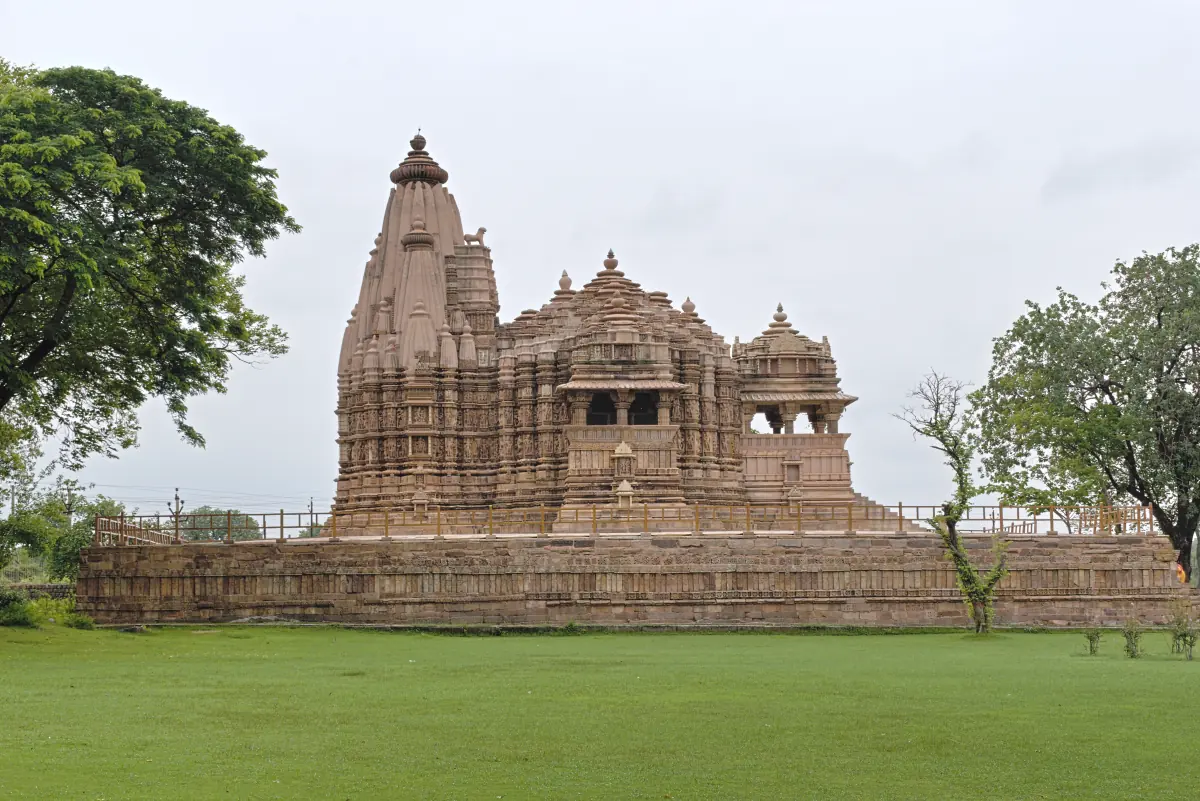
Khajuraho is different. The Khajuraho Chitragupta Temple belongs to Surya Dev. Not to Yama Dev’s scribe.
The Tirth Spiritual Calendar lists Wednesday’s festivals, Bhai Dooj and the ones around it. If your family sings to Maa Yamuna that day, there is the Bhai Dooj aarti.
Frequently asked questions
Who created Chitragupta ji, and why?
In the Kayastha telling, Bhagwan Brahma made him because Yama Dev could not keep every being’s record on his own. Bhagwan Brahma was meditating when Chitragupta ji came out of his body, pen and inkpot in hand. His birth is not in the Garuda Purana chapters where he works.
Does Chitragupta ji decide who goes to heaven or hell?
In the Garuda Purana his job is the record. Reports come to him from the doorkeeper, he passes them on to Yama Dev, the King of Justice, and he speaks to the sinners when Yama Dev commands it.
Why do Kayasthas worship Chitragupta ji?
Because he is the family deity for them. In their telling he was born of Bhagwan Brahma’s body, the kaya, which gives the Kayasthas their name. Their pens, inkpots and account books go before him on Yama Dwitiya.
Who are Chitragupta ji’s wives and sons?
Two wives and twelve sons, say Kayastha families, with the twelve Kayastha sub-groups traced to those sons. The wives’ names change with the account. One gives Irawati and Nandini, and another, citing Bellenoit (2017), gives Shobhavati and Nandini.
Is the Khajuraho Chitragupta Temple dedicated to him?
That one belongs to Surya Dev. The official tourism description does not explain the name.
Continue on Tirth
- Chitragupta ji, Yama Dev’s recorder, on his own page.
- Chitragupta Swamy Temple in Kanchipuram, on its own temple page.
- Bhai Dooj, Yama Dwitiya, the day he shares with Yama Dev.
- The Yama Dwitiya katha, and where his prayer sits in the puja.
Leave a Reply