
Know this Datta as the Trimurti in one form, made of the three gunas. That is the first line of Dattachi Aarti, the Marathi aarti to Lord Dattatreya that begins “Trigunatmak Traimurti Datta Ha Jana”, sung on Thursdays, on Purnima and on Datta Jayanti, and credited to the 16th-century saint Sant Eknath.
The opening matters because everything after it rests on it. Dattatreya is the one form that holds Lord Brahma, Lord Vishnu and Lord Shiva together, and the aarti says so before it says anything else. Three stanzas follow. They show what it means to meet that god, and the poet’s own name is tucked into the very last line.
Trigunatmak Traimurti Datta Ha Jana, all four stanzas in Marathi and roman letters
The Marathi follows the text printed by BhaktiBharat, Shubh Panchang and the Sanskrit Documents Marathi aarti collection, which agree on almost every word. Under each Devanagari line is a roman line for anyone who reads Marathi slowly or not at all. The refrain, Jaya Dev Jaya Dev, comes back after every stanza.
Stanza 1
त्रिगुणात्मक त्रैमूर्ती दत्त हा जाणा ।
Trigunatmak traimurti Datta ha jana
त्रिगुणी अवतार त्रैलोक्य राणा ।
Triguni avatar trailokya rana
नेती नेती शब्द न ये अनुमाना ॥
Neti neti shabda na ye anumana
सुरवर मुनिजन योगी समाधी न ये ध्याना ॥
Suravar munijan yogi samadhi na ye dhyana
जय देव जय देव जय श्री गुरुदत्ता ।
Jaya Dev Jaya Dev Jaya Shri Gurudatta
आरती ओवाळिता हरली भवचिंता ॥
Aarti ovalita harali bhavachinta
Stanza 2
सबाह्य अभ्यंतरी तू एक दत्त ।
Sabahya abhyantari tu ek Datta
अभाग्यासी कैची कळेल हि मात ॥
Abhagyasi kaichi kalel hi maat
पराही परतली तेथे कैचा हेत ।
Parahi paratali tethe kaicha het
जन्ममरणाचाही पुरलासे अंत ॥
Janmamaranachahi puralase ant
जय देव जय देव जय श्री गुरुदत्ता ।
Jaya Dev Jaya Dev Jaya Shri Gurudatta
आरती ओवाळिता हरली भवचिंता ॥
Aarti ovalita harali bhavachinta
Stanza 3
दत्त येऊनिया ऊभा ठाकला ।
Datta yeuniya ubha thakala
भावे साष्टांगेसी प्रणिपात केला ॥
Bhave sashtangesi pranipat kela
प्रसन्न होऊनि आशीर्वाद दिधला ।
Prasanna houni aashirvad didhala
जन्ममरणाचा फेरा चुकवीला ॥
Janmamaranacha phera chukavila
जय देव जय देव जय श्री गुरुदत्ता ।
Jaya Dev Jaya Dev Jaya Shri Gurudatta
आरती ओवाळिता हरली भवचिंता ॥
Aarti ovalita harali bhavachinta
Stanza 4
दत्त दत्त ऐसें लागले ध्यान ।
Datta Datta aise lagale dhyan
हरपले मन झाले उन्मन ॥
Harapale man jhale unman
मी तू पणाची झाली बोळवण ।
Mi tu panachi jhali bolavan
एका जनार्दनी श्रीदत्तध्यान ॥
Eka Janardani Shri Datta dhyan
जय देव जय देव जय श्री गुरुदत्ता ।
Jaya Dev Jaya Dev Jaya Shri Gurudatta
आरती ओवाळिता हरली भवचिंता ॥
Aarti ovalita harali bhavachinta
Sixteen verse lines and two refrain lines, sung four times over.
If you are teaching it to a child, or learning it yourself for the first time, start with the refrain. We would rather someone sang the refrain well and followed the stanzas from the page than mumbled all of it, because the refrain comes back after every verse.
What Dattachi Aarti says, from Trimurti to “me and you”
The four stanzas move in a straight line. First the aarti tells you who Datta is, then where he is, then what happens when he comes, and last what happens to the one who meditates on him. What follows is Tirth’s own plain reading of each stanza, kept to what the words themselves say.
The first stanza calls Datta the three-fold Trimurti, the avatar of the three gunas and the lord of the three worlds. Then it stops trying to describe him. The third line uses the Vedic phrase “neti neti”, and Shubh Panchang reads the line as saying that he is beyond words and beyond inference, the one whom even the Vedas describe only as neti neti. The fourth line names the best of the gods, the sages and the yogis, and says he does not come within their meditation, even in samadhi.
Next comes where he is, not what he is. Inside and outside, you are the one Datta. The two lines after that are where the books disagree on the actual words, so read them with the variants further down in mind. The stanza closes on the end of the cycle of birth and death.
Only the third tells a small story. Datta comes and stands there. The devotee falls in full prostration (sashtang, the whole body on the ground) with devotion, and Datta, pleased, gives his blessing. The round of birth and death is escaped.
In the last stanza the singer repeats “Datta, Datta” until that name is all the meditation holds, the mind is lost in it, and the sense of “me” and “you” dissolves. The last line signs the aarti with the words Eka Janardani and ends on meditation on Shri Datta.
The refrain is plainer. Jaya Dev, victory to the Lord, victory to Shri Gurudatta, and as the aarti is waved, the worry of worldly life is gone.
Who wrote Dattachi Aarti, and why the last line says Eka Janardani
Dattachi Aarti is traditionally attributed to Sant Eknath, the 16th-century Marathi saint-poet of the Warkari line. The proof most people point to sits inside the aarti itself. Eka is Eknath, and Janardan is his guru, Janardan Swami, so “Eka Janardani” is the poet signing off as Eknath of Janardan, his guru’s name joined to his own in the very last line.
The Sanskrit Documents Marathi aarti collection prints a short note right after this aarti saying it is by Sant Eknath and that Eka Janardan names his guru. Shubh Panchang credits Eknath too.
One small trap. The same archive has a line saying “is by Samartha Ramadas” sitting just above the Datta aarti, and it is easy to read it as a second claim on this one. It is not. That note belongs to the Ganesh aarti printed before it, whose own last verse signs off with “daasa raamaachaa”. It has nothing to do with Datta.
For another aarti from the Marathi saint-poets, there is the Tukaram Aarti.
Is Dattachi Aarti sung on Thursday, Purnima or Datta Jayanti?
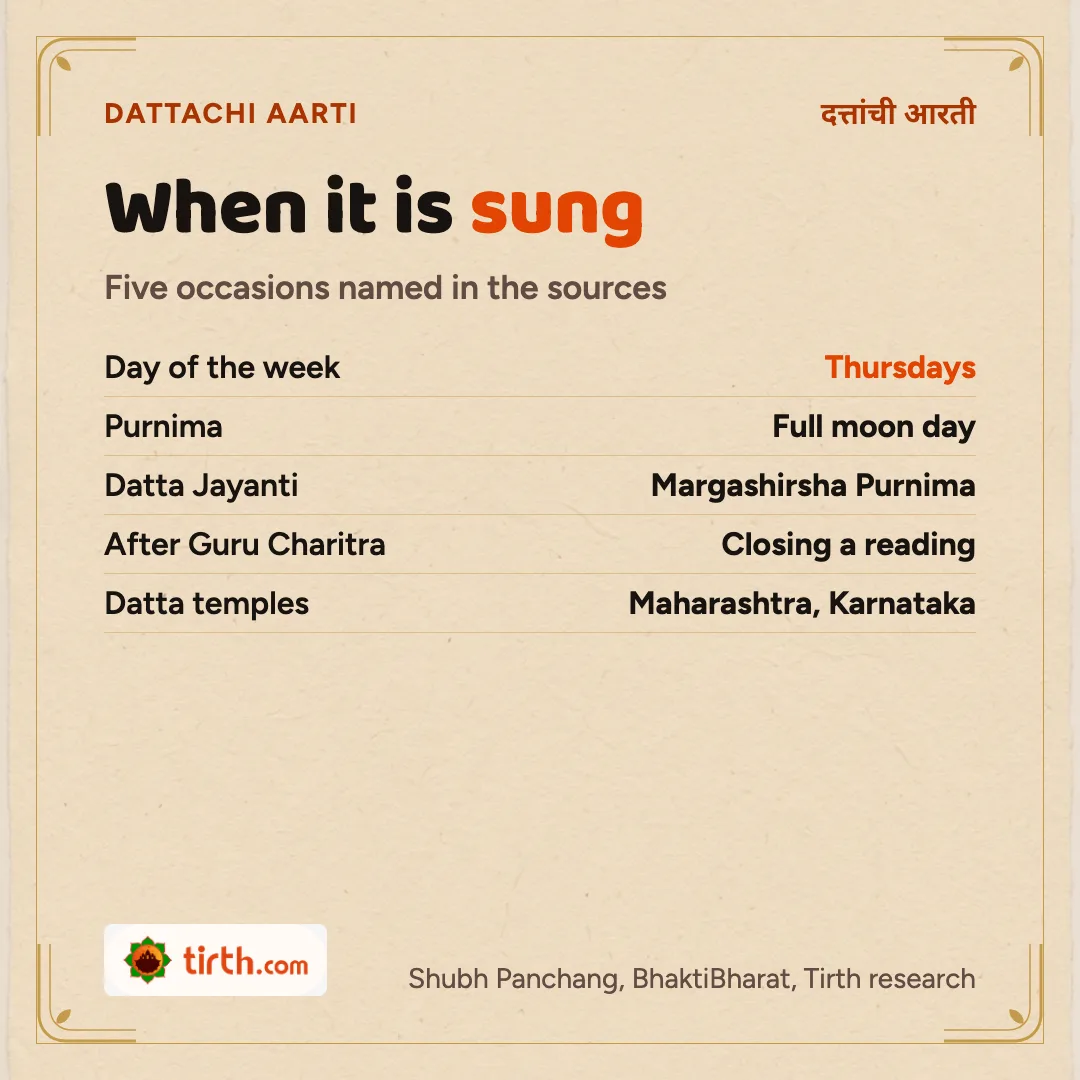
All three. Dattachi Aarti is sung on Thursdays and on Purnima, and above all on Datta Jayanti, which falls on Margashirsha Purnima. Shubh Panchang adds that it is traditionally sung after a reading of the Guru Charitra, and that it is heard in Datta temples across Maharashtra and Karnataka.
For this year’s Datta Jayanti date, see the festival dates in your city page.
On an ordinary Thursday it pairs naturally with the Brihaspati Dev Aarti, and on a full moon with the rest of the Purnima Vrat.
One common way to do it at home, as Shubh Panchang lays it out, is to offer tulsi and yellow flowers, sandalwood, udumbar (fig) leaves, sweets, incense and a diya, then wave the thali clockwise. Four waves at the feet. Two at the navel, one at the face, and seven over the whole form. It is one site’s method, not a rule, so if your family has always done it differently, keep your family’s way.
For a priest to do the Datta puja for you, book a puja on Tirth.
Sadbhave or bhave? The Datta aarti lines that differ between books
If you are singing from your grandmother’s aarti book and a word does not match the text above, you are probably not wrong. Three readings move around.
In stanza 2, the Sanskrit Documents text reads “abhaagyaasii kaisii nakaLe hii maata” (कैसी नकळे ही मात) where BhaktiBharat and Shubh Panchang read कैची कळेल हि मात, and it has कैसा हा हेत in place of कैचा हेत in the next line. In stanza 3, Shubh Panchang and Sanskrit Documents open the second line with सद्भावे (sadbhave), BhaktiBharat with भावे (bhave), and Sanskrit Documents also records साष्टांगे नमने प्रणिपात केला as another version of that line. The last line of stanza 3 ends in फेरा चुकविला in most copies but फेरा वाचविला in Sanskrit Documents.
Sing what your family sings.
Read about Lord Dattatreya on his own page. Or browse every aarti on the Tirth blog, including these guru and Marathi aartis: Gurudev Aarti, Sai Baba Aarti, Ganesh Aarti and Om Jai Jagdish Hare.
Frequently asked questions
Who wrote Dattachi Aarti?
It is attributed to Sant Eknath, the 16th-century Marathi saint. The last line carries his signature, “Eka Janardani”, which joins his own name to that of his guru, Janardan Swami.
What is the meaning of “Trigunatmak Traimurti Datta Ha Jana”?
The line asks you to know Datta as the three-fold Trimurti, one form of Brahma, Vishnu and Shiva. The next line adds the three gunas and the three worlds.
When is Dattachi Aarti sung?
On Thursdays, on Purnima and on Datta Jayanti, which is Margashirsha Purnima. Shubh Panchang adds that it is sung after a reading of the Guru Charitra and in Datta temples in Maharashtra and Karnataka.
What does “neti neti” mean in the aarti?
In the first stanza it says that Datta cannot be reached by words or by inference. Shubh Panchang describes him here as the one whom even the Vedas describe only as neti neti.
How many times is the refrain “Jaya Dev Jaya Dev” sung?
Four times, once after each of the four stanzas. The refrain hails Shri Gurudatta and says that, as the aarti is waved, the worry of worldly life is gone.
Continue on Tirth
- Tirth Spiritual Calendar, festival dates (Datta Jayanti for your city)
Leave a Reply