The Dhanteras aarti is “Jai Dhanvantari Deva”, sung to Lord Dhanvantari, physician of the gods. Drik Panchang counts it among his most popular aartis and says it is sung especially on Dhanvantari Trayodashi, the very Trayodashi on which Dhanteras falls and which is also kept as his birth anniversary, Dhanvantari Jayanti.
One opening couplet holds the refrain, and six more follow it, each closed by that same refrain.
Dhanteras in 2026: Friday, 6 November (Kartika Krishna Trayodashi, New Delhi).
Jai Dhanvantari Deva in Hindi and Roman letters, couplet by couplet
These words are Drik Panchang’s, from its Hindi page, read side by side with a Patrika printing that has the same words all the way through and parts company only over the wording of the refrain. Devanagari sits on top in each couplet with the Roman line under it (keep the Roman line in view if Hindi is slow going on a phone screen). After every couplet, go back to the refrain, जय धन्वन्तरि देवा.
जय धन्वन्तरि देवा, जय धन्वन्तरि जी देवा। जरा-रोग से पीड़ित जन-जन सुख देवा॥
Jai Dhanvantari Deva, jai Dhanvantari ji Deva. Jara-rog se peedit jan-jan sukh deva.
तुम समुद्र से निकले, अमृत कलश लिए। देवासुर के संकट आकर दूर किए॥
Tum samudra se nikle, amrit kalash liye. Devasur ke sankat aakar door kiye.
आयुर्वेद बनाया, जग में फैलाया। सदा स्वस्थ रहने का, साधन बतलाया॥
Ayurved banaya, jag mein phailaya. Sada swasth rehne ka, saadhan batlaya.
भुजा चार अति सुन्दर, शंख सुधा धारी। आयुर्वेद वनस्पति से शोभा भारी॥
Bhuja chaar ati sundar, shankh sudha dhaari. Ayurved vanaspati se shobha bhaari.
तुम को जो नित ध्यावे, रोग नहीं आवे। असाध्य रोग भी उसका, निश्चय मिट जावे॥
Tum ko jo nit dhyaave, rog nahin aave. Asaadhya rog bhi uska, nishchay mit jaave.
हाथ जोड़कर प्रभुजी, दास खड़ा तेरा। वैद्य-समाज तुम्हारे चरणों का घेरा॥
Haath jodkar Prabhuji, daas khada tera. Vaidya-samaaj tumhare charnon ka ghera.
धन्वन्तरिजी की आरती जो कोई नर गावे। रोग-शोक न आए, सुख-समृद्धि पावे॥
Dhanvantariji ki aarti jo koi nar gaave. Rog-shok na aae, sukh-samriddhi paave.
Small words shift from one printed copy to the next. Patrika’s, for example, starts with “Om” and has the longer refrain “Swami jai Dhanvantari Deva, Om jai Dhanvantari ji Deva”.
Sing it the way your family already does.
What does Jai Dhanvantari Deva mean?
Tirth put this English together itself, word by word, from the glosses in Platts’ Hindi dictionary and in Monier-Williams’ Sanskrit dictionary. Sing from the Hindi, and keep the plain English beside you as a help while you do.
| Couplet | Plain meaning (Tirth’s rendering) |
|---|---|
| 1. Jai Dhanvantari Deva | Glory to Lord Dhanvantari, glory to revered Dhanvantari, the god. Giver of happiness to people afflicted by old age and disease. |
| 2. Tum samudra se nikle | You came out of the ocean holding the pot of amrit, the nectar of immortality. Having come, you removed the trouble of the gods and the asuras. |
| 3. Ayurved banaya | You made Ayurveda (the science of health and medicine) and spread it in the world. You explained the way to stay always healthy. |
| 4. Bhuja chaar ati sundar | Four very beautiful arms, holding the conch and the nectar. With Ayurveda and trees, the splendour is great. |
| 5. Tum ko jo nit dhyaave | Whoever meditates on you daily, the aarti says, disease does not come to them. Even their incurable disease is certainly wiped away. |
| 6. Haath jodkar Prabhuji | With joined hands, Lord, your servant stands. The community of physicians is gathered round your feet. |
| 7. Dhanvantariji ki aarti | The last couplet speaks of the aarti itself: to whoever sings this aarti of Dhanvantari ji, disease and sorrow do not come, and that person gains happiness and prosperity. |
Look twice at deva in the first couplet. In the refrain it is “god”, and Platts lists dewā as a deity. At the close of the second line, in sukh deva, Platts reads the same spelling as “a giver”, taken from dena, to give.
Vanaspati in the fourth couplet is plainly a tree, “a large forest-tree; a tree (generally)” in Platts and “king of the wood”, a forest-tree, in Monier-Williams.
How do you do the Dhanvantari aarti at home?
Platts describes a ceremony of adoration in which a platter holding a five-wicked burning lamp, flour and incense is moved in a circle around the image of the god, and he gives the hymn of praise as the word’s second sense. Monier-Williams lists a pair of Sanskrit entries close to it. Aratrika is the light, or the vessel holding it, waved at night before an image, and nirajana is the waving of lights before an image as an act of adoration.
Keep two things in front of you.
- a murti of Lord Dhanvantari, or a picture of him
- a plate holding a five-wick lamp, some flour and incense
Circle the plate before the image as you sing. For a first-timer the refrain is the part to learn before anything else, since it is sung after every couplet and so far more often than any other line. Get that right and the couplets can come slowly.
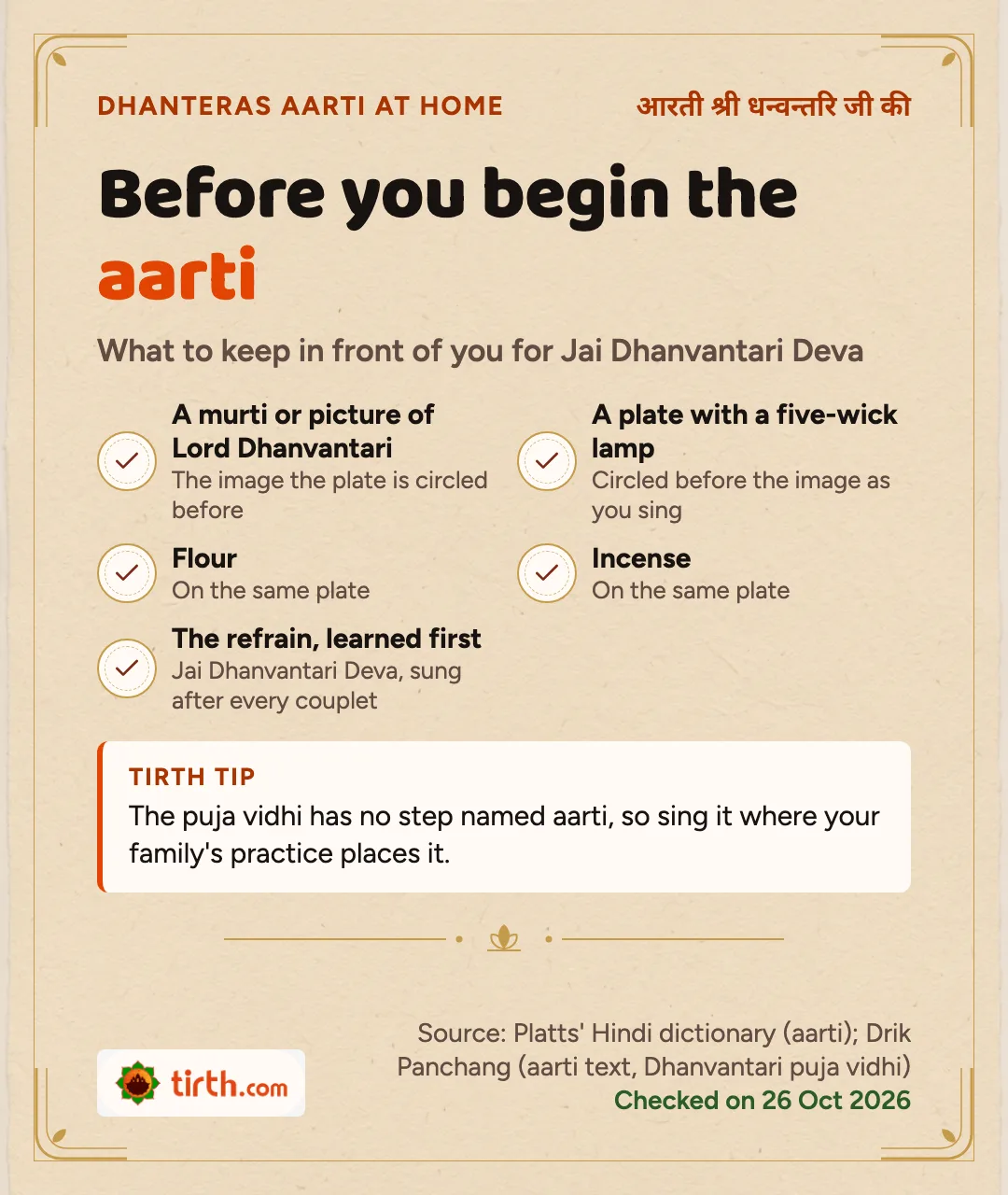
Placing it inside the puja is harder. Drik Panchang’s Dhanvantari Puja Vidhi for Dhantrayodashi counts 21 steps, beginning with Achamana and Sankalpa and Dhyana before a lit ghee lamp, going through the offerings of water, sandal paste, flowers, incense, a lamp, food, betel and dakshina, and ending with pradakshina, a full prostration and Kshama-Prarthana (asking forgiveness). Step 13 is Deep-Samarpan, the lamp offering. None of the 21 steps is named aarti, so families sing it wherever their own practice places it.
There is a timing point too. Drik Panchang sets a morning (pratahkala) muhurat for the Dhanvantari puja, apart from the evening (pradosh) puja of Dhanteras, and notes that the day matters especially to people who practise Ayurveda or medicine. On it, people worship Dhanvantari and pray for good health. City-wise times are on the Dhanteras page in the Spiritual Calendar.
Why is Dhanvantari worshipped on Dhanteras?
Dhanteras is Krishna paksha Trayodashi. It comes two days prior to the Diwali Lakshmi Puja and opens the five days of Diwali. North India’s purnimanta calendar puts that Trayodashi in Kartika, while amanta calendars name the same day in Ashwin.
Drik Panchang also calls the day Dhanvantari Trayodashi or Dhanvantari Jayanti, the birth anniversary of Lord Dhanvantari, physician of the gods and teacher of Ayurveda. Goddess Lakshmi is worshipped with Lord Kuber that same day, and the rest of the festival is in the full Dhanteras guide.
His story is in the Bhagavata Purana (8.8.33 to 34). At the churning of the ocean Dhanvantari appeared carrying a jug filled with nectar (amrita), and those verses call him a plenary portion of a plenary portion of Lord Vishnu, well versed in the science of medicine. Monier-Williams draws much the same figure in his dictionary entry, the physician of the gods who was produced at the churning of the ocean with a cup of Amrita in his hands and was the supposed author of the Ayur-veda.
The aarti sings all three back, the ocean and the pot of amrit in its second couplet and Ayurveda in its third.
For more to sing on the day, Tirth has the Dhanvantari mantra, Lakshmi mantras and the Om Jai Jagdish Hare aarti (Drik Panchang gives it as the aarti of Lord Jagdish, also known as Lord Satyanarayan).
Want the Lakshmi and Kuber puja done in your family’s name? Tirth lists a Dhanteras samuhik Mahalakshmi-Kuber puja and havan at Shri Ayodhya Dham, a collective ceremony where your name and gotra are recited in the sankalp.
Frequently asked questions
Which aarti is sung on Dhanteras?
Lord Dhanvantari’s aarti, “Jai Dhanvantari Deva”. Drik Panchang notes it is sung especially on Dhanvantari Trayodashi, and that is Dhanteras by another name.
Who is Lord Dhanvantari?
Physician of the gods. In the Bhagavata Purana (8.8.33 to 34) he rises at the churning of the ocean holding a jug of nectar, and the same verses call him well versed in the science of medicine. Monier-Williams calls him the supposed author of the Ayur-veda.
Is the Dhanvantari aarti found in a scripture?
No source used for this page names a scripture or an author for it. The scanned Gita Press Aarti-Sangrah on the Internet Archive was searched as well, and its text has no Dhanvantari aarti in it. The link to scripture is the story itself, since the Bhagavata Purana (8.8.33 to 34) has Dhanvantari appear from the churned ocean with a jug of nectar and the aarti’s second couplet has him come out of the ocean with the pot of amrit.
Can the Dhanvantari aarti be sung on other days?
Yes. Drik Panchang says people sing it on most occasions connected with Lord Dhanvantari, Dhanvantari Trayodashi being the main one.
Why do some copies begin with Om?
Printed copies vary a little. Patrika’s begins with “Om” and sings the longer refrain “Swami jai Dhanvantari Deva, Om jai Dhanvantari ji Deva”, where Drik Panchang’s text keeps to “Jai Dhanvantari Deva”.
Continue on Tirth
- Dhanteras puja timings by city, Tirth Spiritual Calendar
Leave a Reply