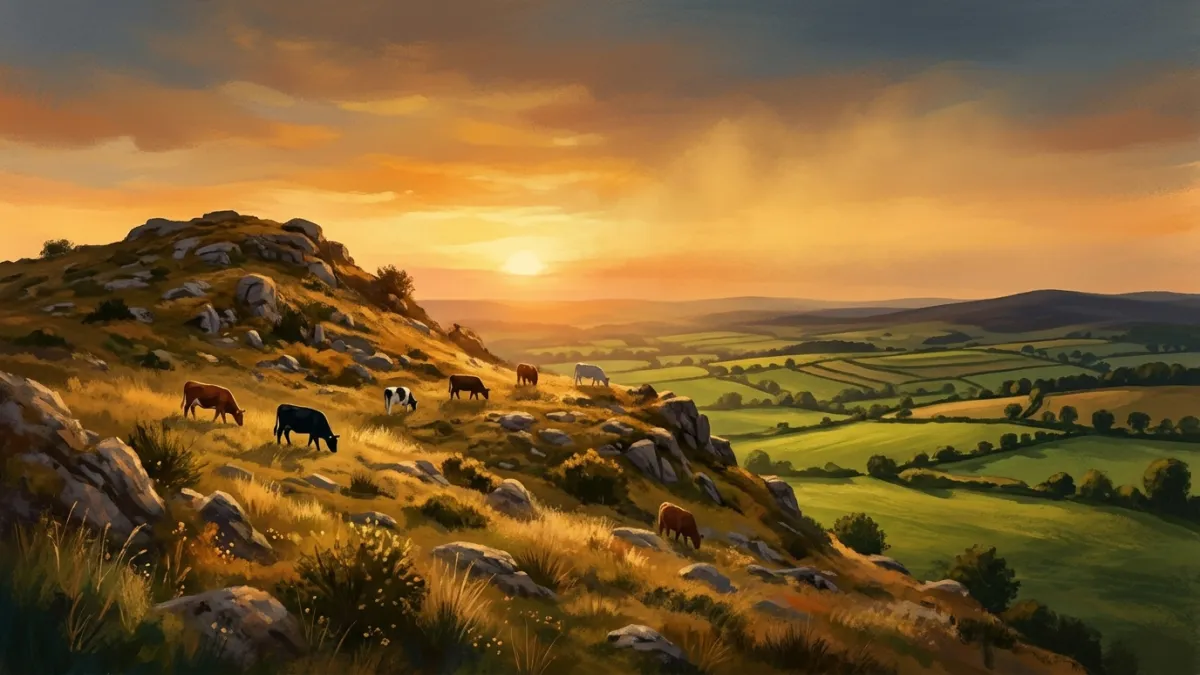
Nanda Baba kept young Bhagwan Krishna with the calves in Vrindavan. Only calves. Anything bigger was not yet for him.
Then the bright half of Kartik reached its eighth day, and that changed. That is the Gopashtami ki kahani. It comes in two halves, and most pages never set them side by side.
Gopashtami in 2026: Tuesday, 17 November. Ashtami tithi in New Delhi: 4:18 AM on 17 November to 6:04 AM on 18 November. Govardhan Puja, seven days earlier, is on 10 November.
See the festival days of Kartik in the Tirth Spiritual Calendar
When did the calf boy become a cowherd?
Start with the Padma Purana. Its Kartik Mahatmya from the Padma Purana calls the bright eighth of Kartik Gopashtami, and says that from this day Vasudeva, a name of Bhagwan Krishna, was a gopa, a cowherd, where before he was a vatsapa, a keeper of calves. Commentary on the Bhagavata supplies a reason of its own. To Nanda Baba, full-grown cows, bulls and oxen were too much for so young a boy, so out of love he kept Bhagwan Krishna with the calves.
Turn to the Bhagavata Purana, Book 10, chapter 15, verse 1, and the same moment shows up from the other side. Paugaṇḍa age, approximately six to ten years, has come to Balarama ji, named Rama in the verse, and to Bhagwan Krishna, and the cowherd men let both tend the cows. Vrindavan became auspicious through their footprints.
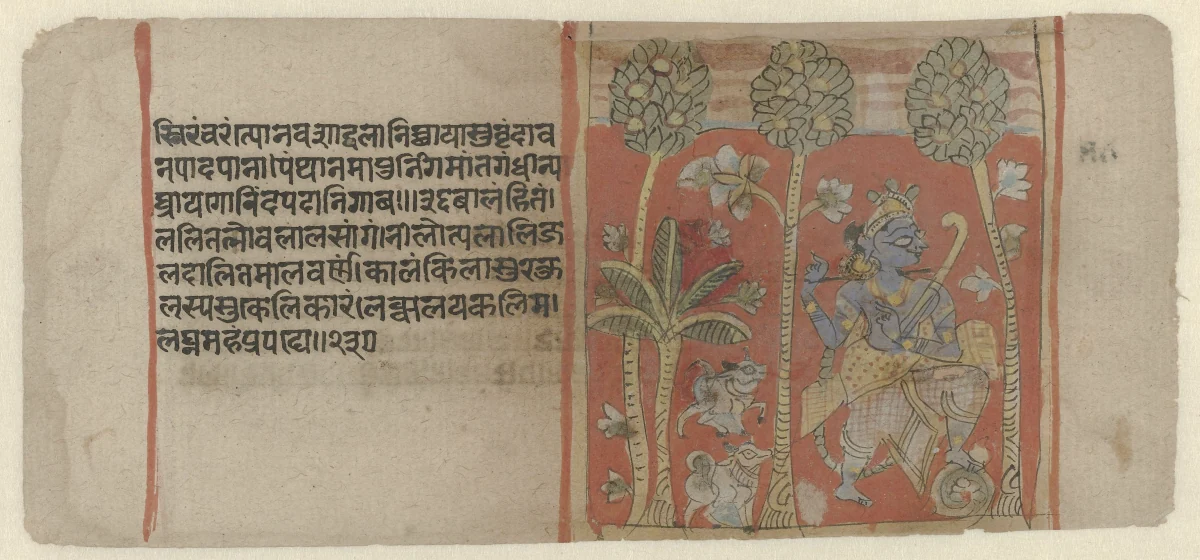
One text names the day, and the other gives the age and the place. Neither has the morning as it is told at home.
What do families add to the katha?
That scene is from homes, and the Purana verse does not hold it. It is a lovely scene, and worth labelling for what it is, since you may be the one retelling it.
Here Bhagwan Krishna turns to Maa Yashoda and declares himself grown, ready to herd the cows. Nanda Baba objects. Too young still. A Pandit is sent for, and after going through the panchang he can find only one day that works, and that day is Gopashtami.
Next, the shoes. There are none. Bhagwan Krishna goes barefoot because his cows wear none, and it is the part people keep repeating. With Balarama ji and the other boys he leads the herd into the forest, playing the flute.
Many pages end at the barefoot boy and his flute. The texts keep going.
How is Govardhan tied to the eighth day?
Go back one week. Bhagavata Purana 10.25 has Bhagwan Krishna lifting Govardhan Hill on a single hand, as a child would hold up a mushroom (10.25.19). Cowherd families take shelter under it. Seven days pass with the hill held up, without rest or food, until Indra Dev, having seen his power, calls back the clouds (10.25.23 and 24).
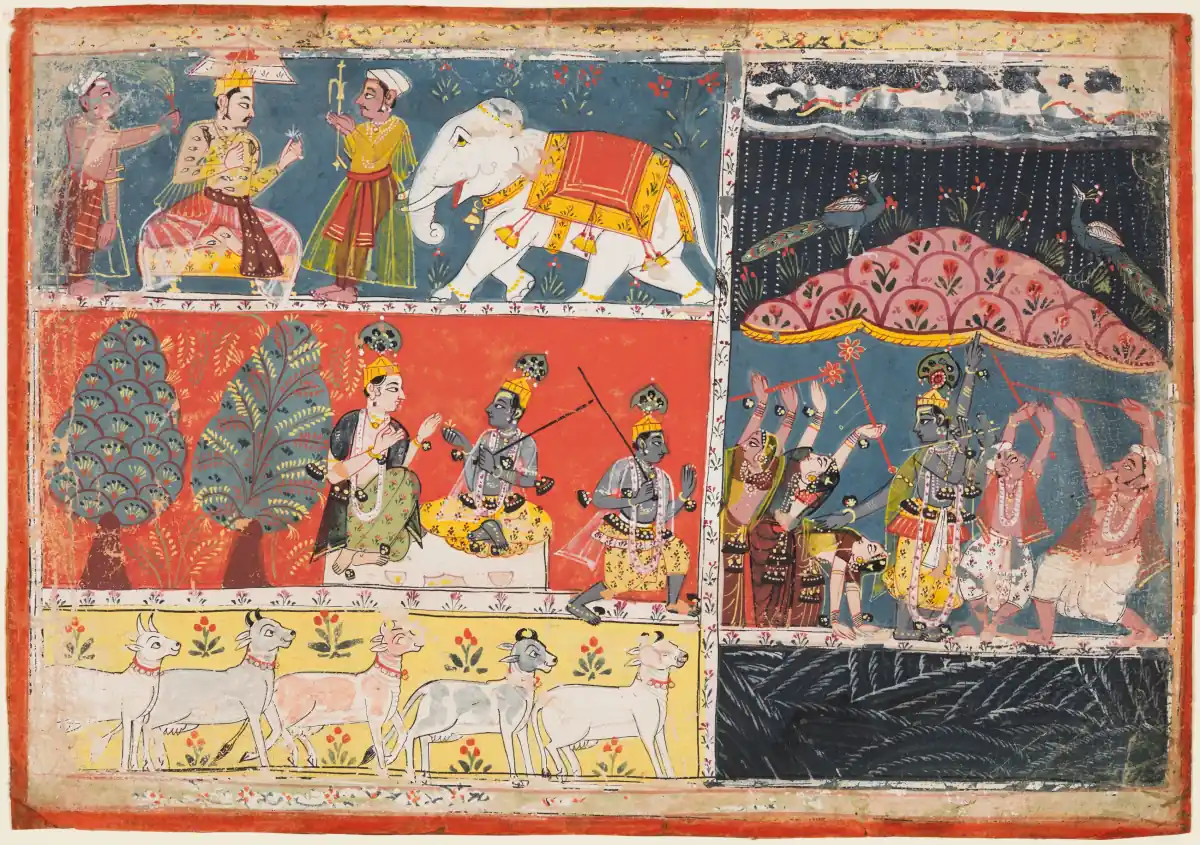
For the whole telling, read the Govardhan Puja story. The week itself has a page too, the seven days under Govardhan.
Govardhan Puja is kept on Pratipada, the first day of the bright half, and Ashtami comes seven days after it. That makes the eighth day after the hill the bright eighth, Gopashtami.
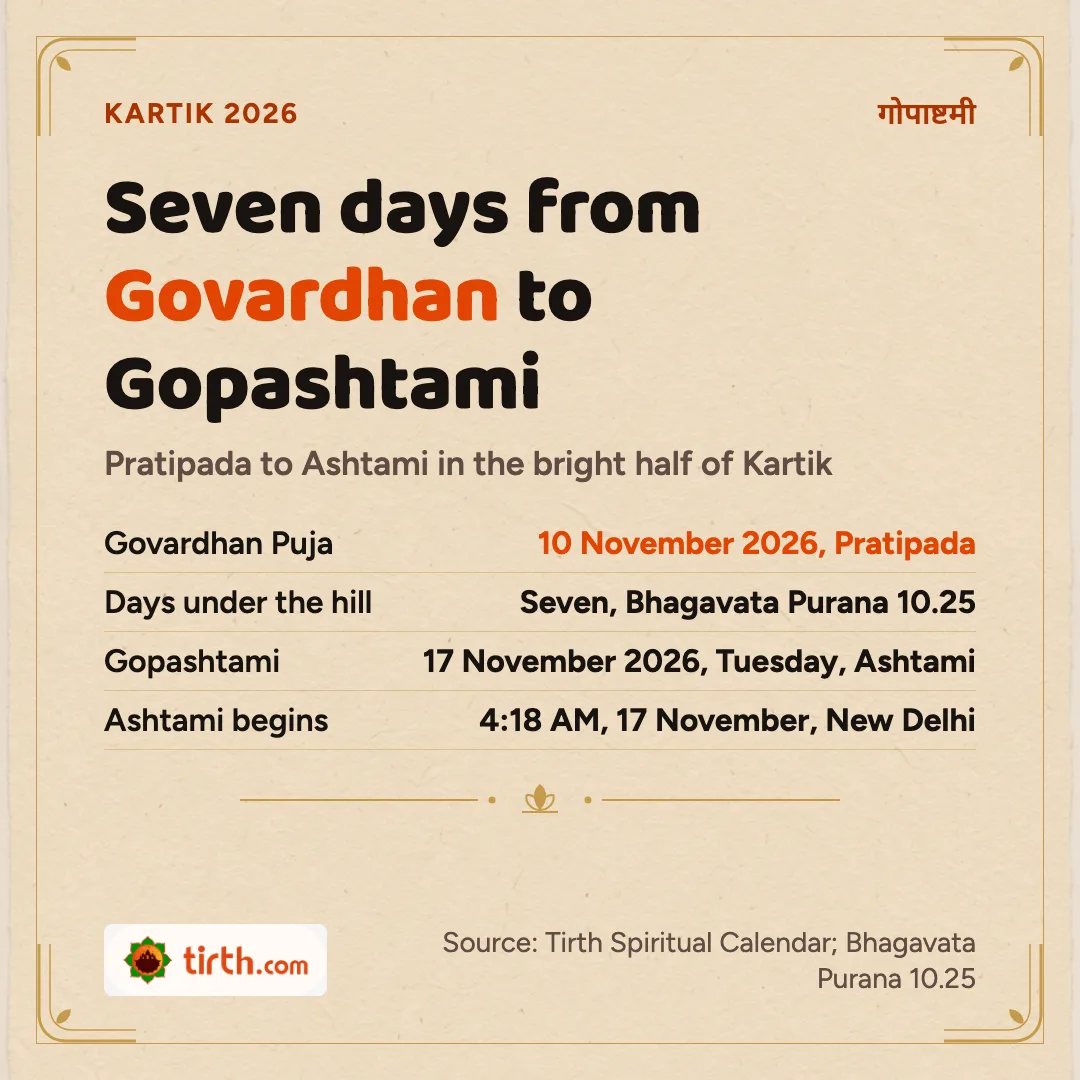
The Bhagavata gives the seven days, the milk bath and the name, and has no Ashtami at all. Placing Indra Dev’s apology on that day is later tradition.
In chapter 27, Indra Dev stands ashamed, and Maa Surabhi, the mother of cows, has come with him. His helmet touches Bhagwan Krishna’s feet as he bows and asks forgiveness (10.27.2 to 13). Bhagwan Krishna’s reply (10.27.15 to 17) is to tell him to go, remain king of heaven and drop his pride.
Then comes the anointing. Maa Surabhi bathes Bhagwan Krishna with her own milk, Maa Aditi and the mothers of the gods urge Indra Dev to do his part, and Indra Dev pours Ganga water carried by his elephant Airavata. In the presence of the gods and sages he crowns Bhagwan Krishna and gives him a new name, Govinda (10.27.22 and 23).
The Bhagavata gives both baths, one after the other.
Where does the name Govinda come in?
The Padma Purana’s word for the cowherd is gopa, and Gopala is the name people use for the cowherd boy.
Govinda came later, at the anointing. Indra Dev gave it, the gods and sages looked on, and the mother of cows poured the milk herself.
For those who count the seven days, the eighth day carries a promotion and a crowning. The Bhagavata sets them in different chapters, so they are two memories that tradition gives one tithi: the boy is trusted with the herd, and Indra Dev honours him before the gods and sages. Janmashtami has Bhagwan Krishna’s birth. This day has the herd and the anointing.
What is in the texts, and what did families add?
This one day carries two stories, drawn from two different sources. The table lines them up so that you know what you are passing on when you tell the katha.
| The detail | Where it comes from |
|---|---|
| The bright eighth of Kartik, calf-keeper to cowherd | Padma Purana, Kartik Mahatmya |
| Paugaṇḍa age, cows tended in Vrindavan | Bhagavata Purana 10.15.1 |
| Hill lifted, seven days, Indra Dev withdraws the clouds | Bhagavata Purana 10.25 |
| Indra Dev’s apology, Maa Surabhi’s milk, the name Govinda | Bhagavata Purana 10.27 |
| The Pandit, the single muhurat, the cows that wear no shoes | The katha as families tell it |
| Indra Dev’s apology on Ashtami | Later tradition |
Why do people honour cows on this day?
Cows sit at the centre of this story: Maa Surabhi, the mother of cows, comes with Indra Dev to bathe Bhagwan Krishna, and the families around him live by the herd.
Cow worship marks the day. Cows are bathed and decorated, fed, circled and given aarti, often at gaushalas. That suits the story, because the story itself is about cows and the people who keep them.
The steps deserve a guide of their own, so I will not cram them in here.
Frequently asked questions
Why is Gopashtami celebrated?
It marks the day Bhagwan Krishna turned from a keeper of calves into a cowherd, as the Padma Purana names the bright eighth of Kartik. Indra Dev’s apology after the seven days under Govardhan is also linked to this day, but that link is later tradition.
How old was Bhagwan Krishna on Gopashtami?
Paugaṇḍa age, says the Bhagavata Purana, and commentary reads that as about six to ten years. So the answer is a range, not a single number.
What is the connection between Gopashtami and Govardhan Puja?
Pratipada is the day of Govardhan Puja. Count seven days under the hill and you arrive at Ashtami as the eighth. The seven days are in the Bhagavata, and the naming of Ashtami is later tradition.
Who is Maa Surabhi?
She is Maa Surabhi, the mother of cows. Bhagavata Purana 10.27 has her coming with Indra Dev to bathe Bhagwan Krishna with her milk.
Why did Bhagwan Krishna not wear shoes in Vrindavan?
The family katha has him walk barefoot, because his cows wear none. The verses give no such reason.
Is Gopashtami the same as Gosthashtami?
Yes, it is the same day. Gopashtami is also written Gopastami or Gosthashtami, so you may meet either spelling on other pages.
Continue on Tirth
- Start with the Bhagavata verse to Giriraj, the hill this story turns on.
- For the rest of Kartik’s festival days, open the Tirth Spiritual Calendar.
- To see where it all happened, open the Vrindavan page.
Leave a Reply