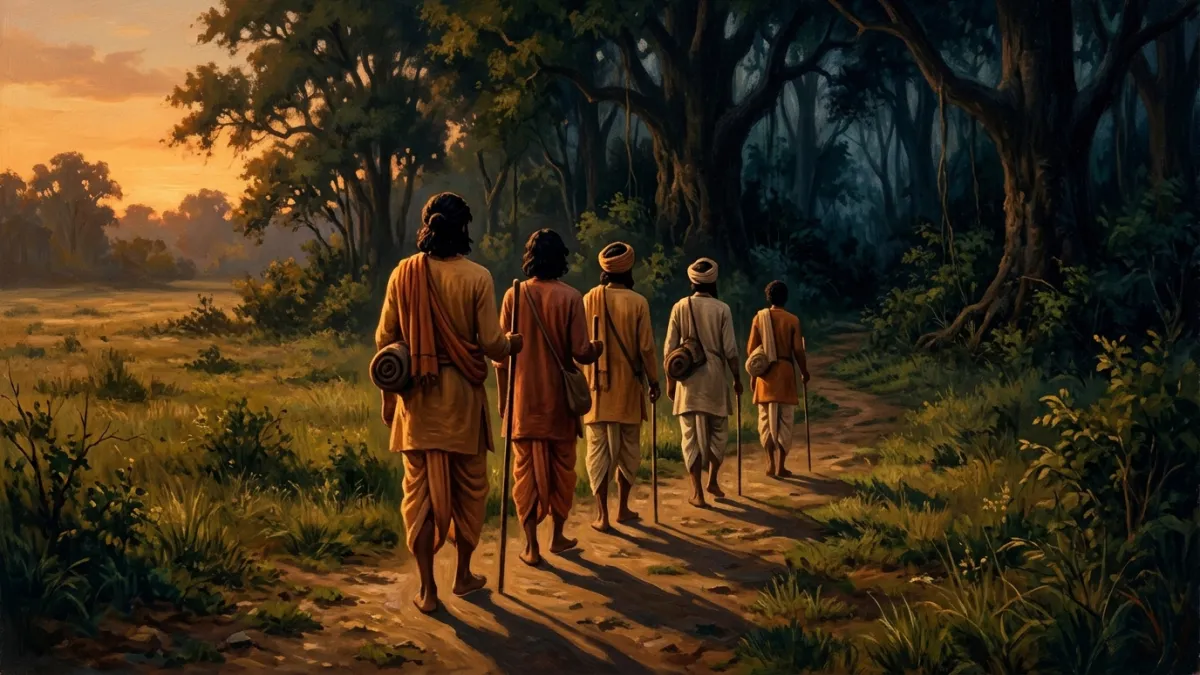
Pandu fathered none of the Pandavas. Yet the Mahabharata calls all five his sons. The pandav names are Yudhishthira, Bhima, Arjuna, Nakula and Sahadeva, and each came by the grace of a god. Their story starts in a forest with a borrowed mantra and runs to the field of Kurukshetra.
Who is who: the mothers, the gods and the birth order
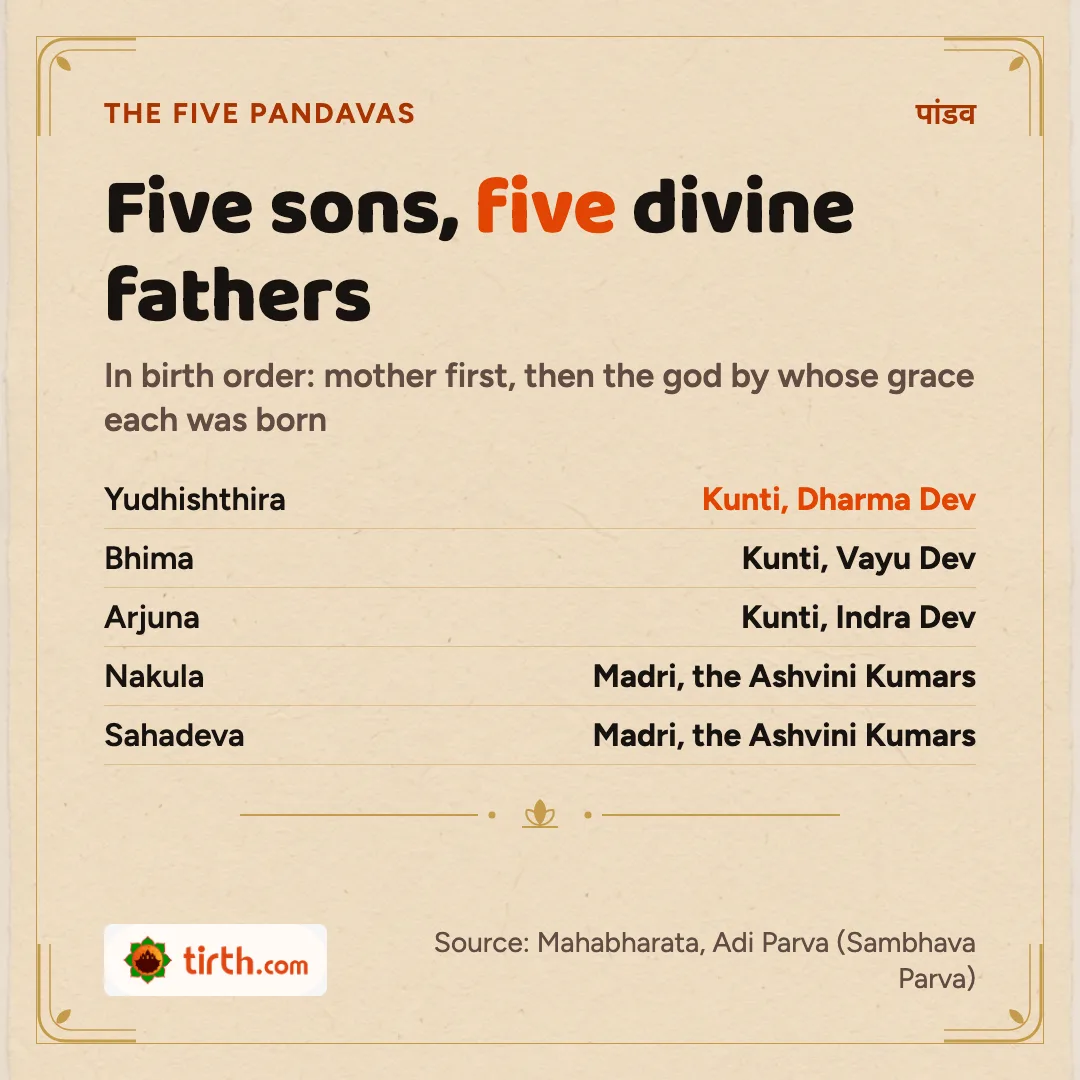
Every name in the table comes from the Mahabharata (how the Mahabharata came to be written has a post of its own), and the five are listed in birth order.
| Name | Mother | Divine father | One scene to remember | Birth order |
|---|---|---|---|---|
| Yudhishthira | Kunti | Dharma Dev (Yama Dev in many retellings) | Stakes and loses the kingdom at dice | First |
| Bhima | Kunti | Vayu Dev | As an infant, falls from Kunti’s lap and breaks the rock beneath him, unhurt | Second |
| Arjuna | Kunti | Indra Dev | Drona presents him at the arena, and the crowd praises his weapons | Third |
| Nakula | Madri | The twin Ashvini Kumars | Raised by Kunti after Madri’s death | Fourth, a twin |
| Sahadeva | Madri | The twin Ashvini Kumars | Raised by Kunti after Madri’s death | Fifth, a twin |
Yudhishthira’s father appears under two names. The Mahabharata gives Dharma Dev, and many retellings give Yama Dev instead, treating the two as a single god.
Karna, Kunti’s first son, was born before her marriage to Pandu, and he is not counted among the Pandavas, so he has no row in the table.
Spellings differ from page to page, and on other pages the same brothers appear as Yudhisthir, Bheem, Arjun and Sahdev. We keep to one spelling for each so the table stays easy to scan.
How Durvasa’s mantra gave Pandu his sons
A sage had spoken over Pandu. Union with his wife would end his life, and so he could not father children himself. The Sambhava Parva of the Adi Parva (a parva is one book of the Mahabharata, and the Adi Parva is the first) tells what the family did about it, and the answer begins with the sage Durvasa, who had taught Kunti a mantra she used to call the gods. The mantra worked each time. Dharma Dev gave Kunti Yudhishthira, Vayu Dev gave her Bhima, and Indra Dev gave her Arjuna, one call after another, until three sons had come.
Pandu asked for more. Kunti would not call a god a fourth time. Madri’s twins came by a single invocation instead, and the text is careful about who did what. Pandu asked Kunti to give Madri the formula, Kunti gave it to her once, Madri called the twin Ashvini Kumars, and they fathered Nakula and Sahadeva.
If a child asks why the Pandavas have gods for fathers, begin with Pandu’s inability and Durvasa’s mantra, because the rest of the answer hangs on those two.
Five boys, one mother and Drona’s arena
Pandu died in the forest. Madri asked to follow him onto the funeral pyre and to have her sons entrusted to Kunti, and she did exactly that, which left one woman to raise all five.
Bhima’s best-known scene is from his birth, on the mountain of a hundred peaks. A tiger frightened Kunti, and as she rose the baby slipped from her lap onto the slope. He shattered the rock beneath him and was unhurt.
Drona taught the Pandavas and the Kauravas side by side in Hastinapura. At the arena exhibition, which the Adi Parva describes, the crowd split into camps for Duryodhana and for Bhima, until Drona stepped in and presented Arjuna. The crowd praised him, and the rivalry between the cousins was already plain for everyone to see.
Draupadi’s swayamvara and the marriage to five brothers
The Adi Parva tells of the swayamvara, the ceremony at which a bride’s suitors compete for her. Drupada held it for his daughter Draupadi, and the test was a stiff bow and a mark fixed high on machinery. Because their mother had ordered it, Yudhishthira said, Draupadi must be the common wife of all five brothers. Drupada would not accept it. Then Vyasa arrived in the middle of the discussion, and the argument that follows is the one the text records for this marriage.
This is a sensitive subject, and readers come to it from different family backgrounds, so the post keeps to what the Mahabharata says at that point and adds no argument of its own.
Indraprastha, the dice hall and the forest years
Once the kingdom was partitioned, the Pandavas received Khandavaprastha and built Indraprastha there. The Rajasuya, a royal sacrifice, followed, and it is told in the Sabha Parva, which also holds the dice game. The game cost Yudhishthira his kingdom and his brothers, and then himself, and Draupadi was lost with the rest. A second game set the terms of the exile. Twelve years in the forest are told in the Vana Parva, and a thirteenth year in hiding, spent in Virata’s city, is told in the Virata Parva.
Through the dice game the senior elder of the Kuru house, Bhishma, was in the hall. His own story belongs to Bhishma’s vow and the bed of arrows.
Peace mission, eighteen days of war and the last journey
Before the fighting began, Bhagwan Krishna went to Hastinapura on a peace mission, to settle the quarrel without a war, and the Udyoga Parva holds it. The mission did not hold.
The war lasted eighteen days. Its telling starts in the Bhishma Parva, named for Bhishma, the commander of the Kuru army, and ends with the Sauptika Parva, a night raid that comes after the fighting of the last day had already ended.
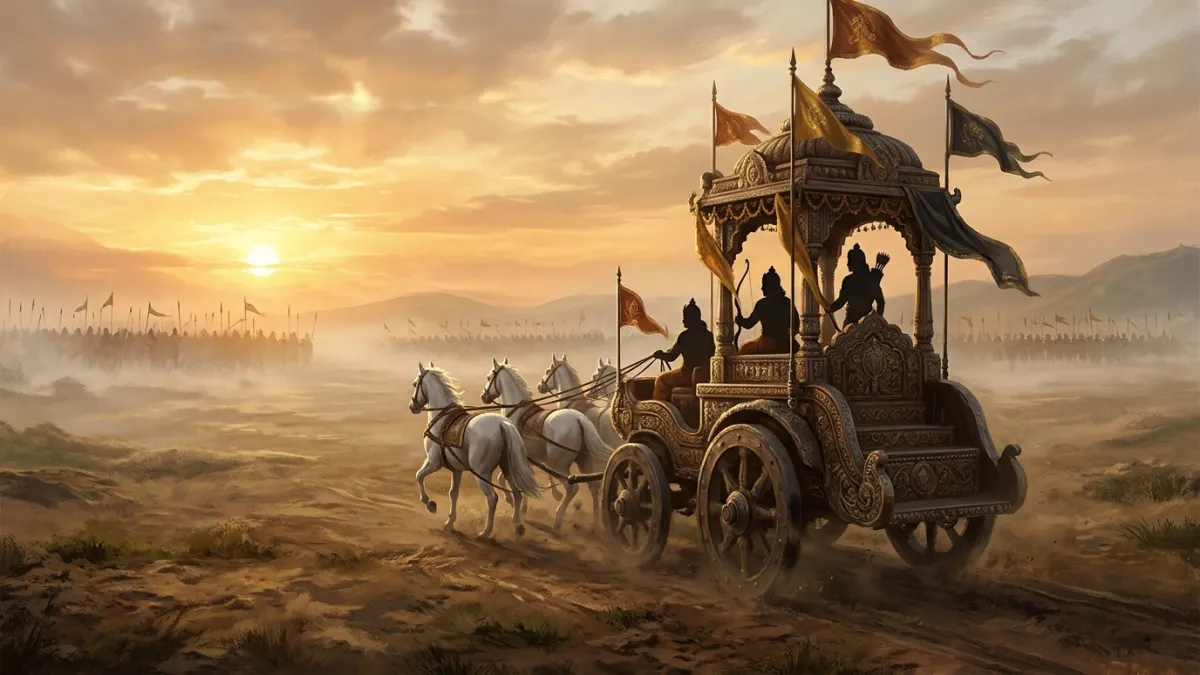
The Bhagavad Gita sits inside the Bhishma Parva, and Tirth has a Gita Jayanti page for it.
The Pandavas’ last journey fills the Mahaprasthanika Parva and the Svargarohana Parva, and Yudhishthira reaches heaven.
Places that keep the Pandavas in mind
Tirth has pages for the Pancha Pandav Mandir, the Panch Pandav Gufa and the Pandav Gufa, and the Kedarnath story links the Pandavas with Bhagwan Shiva.
Frequently asked questions
What are the names of the five Pandavas?
Yudhishthira, Bhima, Arjuna, Nakula and Sahadeva, in birth order.
Who were the parents of the Pandavas?
Kunti and Madri were the mothers, and since Pandu could not father children, a god’s grace gave each son.
Which god was the father of each Pandava?
Dharma Dev for Yudhishthira, Vayu Dev for Bhima, Indra Dev for Arjuna, and the twin Ashvini Kumars for Nakula and Sahadeva.
Who is the eldest Pandava?
Yudhishthira, who was born first.
Why did Draupadi marry all five Pandavas?
Yudhishthira said their mother’s order made her the common wife of all five, and Drupada objected until Vyasa arrived.
Why did the Pandavas go into exile?
Yudhishthira lost his kingdom and his brothers at dice, and exile followed.
Continue on Tirth
- The Bhagwan Krishna page for the one whose peace mission in the Udyoga Parva came before the war.
- Kedarnath Temple for the place the Pandavas are linked with, through the story of Bhagwan Shiva.
- Janmashtami, the festival of Bhagwan Krishna’s birth.
- Yatra packages to see the trips Tirth offers.
Leave a Reply