Who wrote the Mahabharata? The epic names the sage Vyasa. Its opening section adds that Bhagwan Ganesha wrote it down, and that second half is what most people half remember.
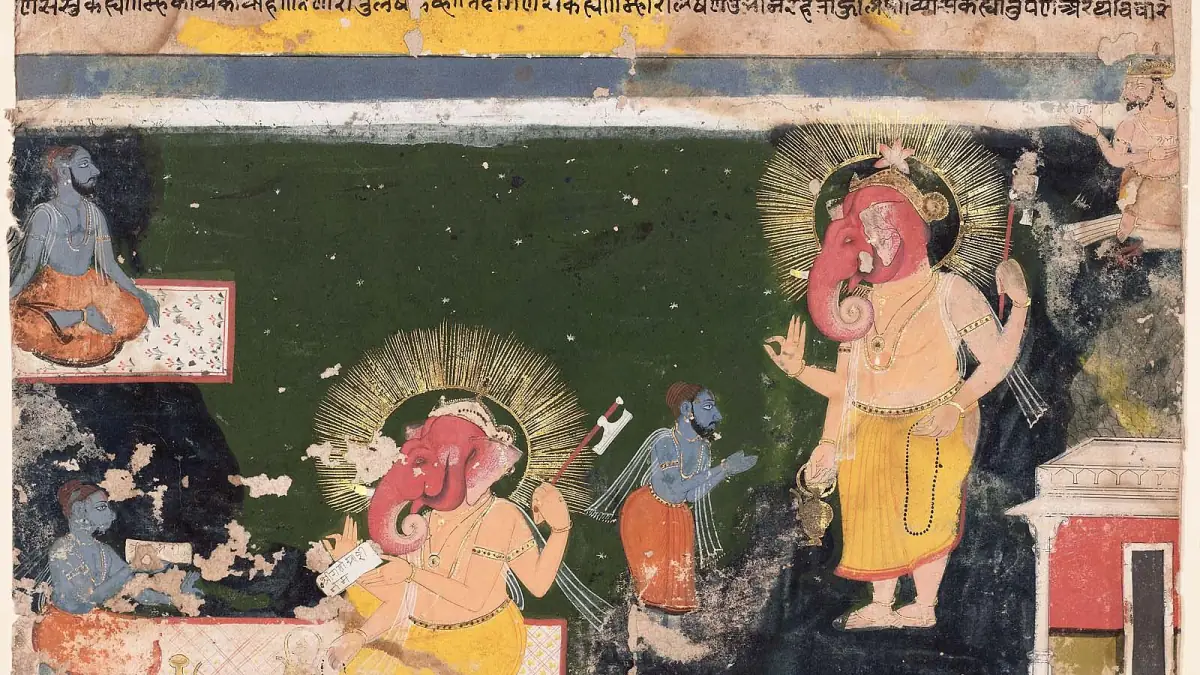
Picture Vyasa just before the first word is written. Bhagwan Brahma has come to see him and has praised the poem. Brahma tells him to call Ganesh ji, and once Ganesh ji arrives, Vyasa asks him to be the writer who sets the whole poem down.
Vyasa, an author who is also in the story
The epic names its author as Krishna Dvaipayana, the sage called Vyasa, the arranger, for his work arranging the Veda. He is also a character in his own story.
The pen, the two conditions and the knot verses
Section 1 of the Adi Parva, at the very start of the epic, holds the scene. Ganesh ji will write, but he sets a condition: the pen must not stop. Vyasa sets one in return. Where Ganesh ji fails to understand a line, he must put the pen down.
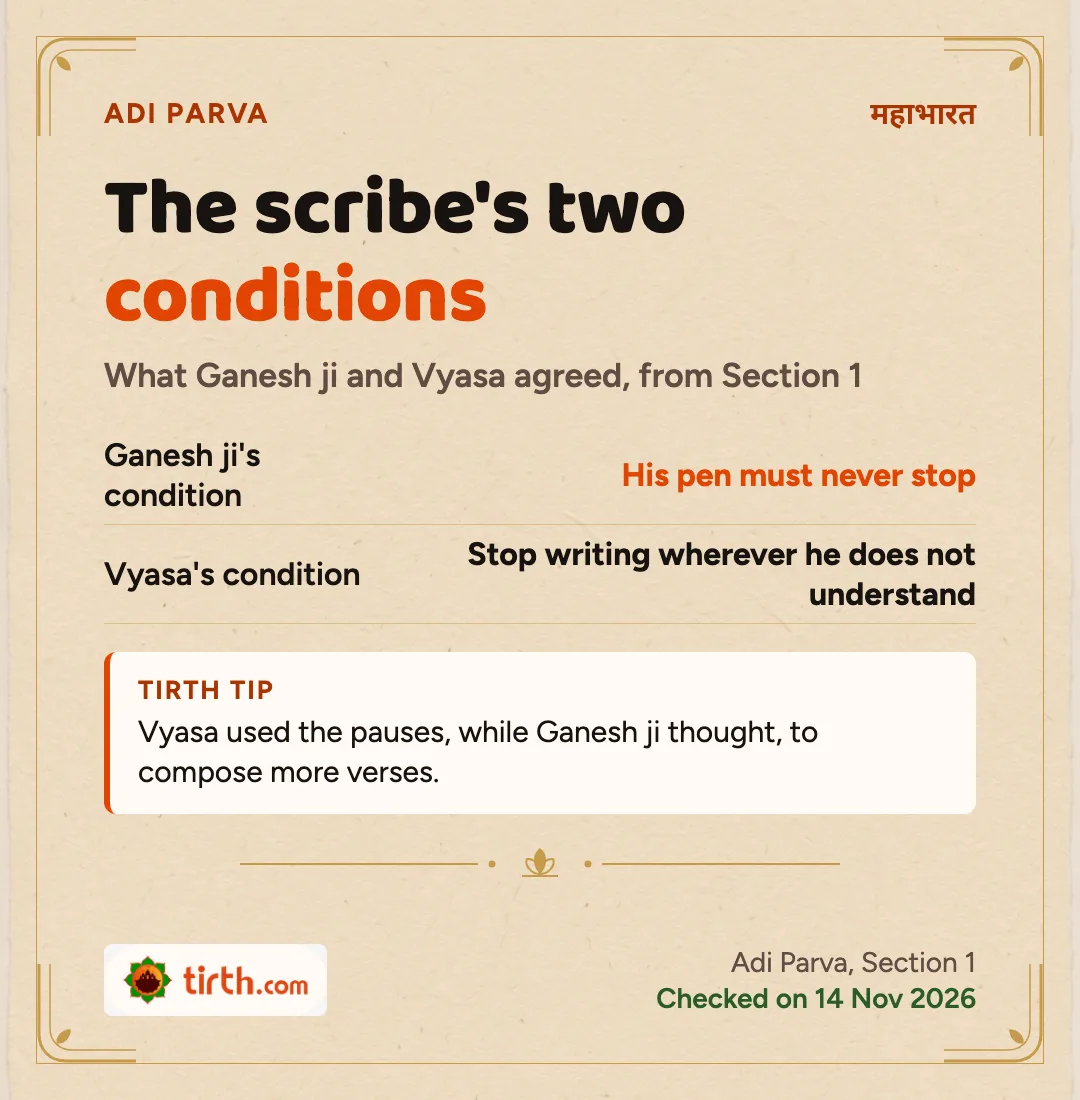
Vyasa found his way through. He wove some verses so densely that Ganesh ji had to stop and think about them. Those are the grantha-granthi, the knot verses. The pen waited on the meaning, and Vyasa spent that wait composing more.
The tellers after Vyasa
Vyasa taught Vaishampayana, and Vaishampayana recited the epic to King Janamejaya at his snake sacrifice. Later, Ugrashravas Sauti, son of Lomaharshana, told it to the sages who had gathered for Shaunaka’s twelve-year sacrifice in the Naimisha forest. It is this second telling that has come down to us.
Three years, and how the verse count grows
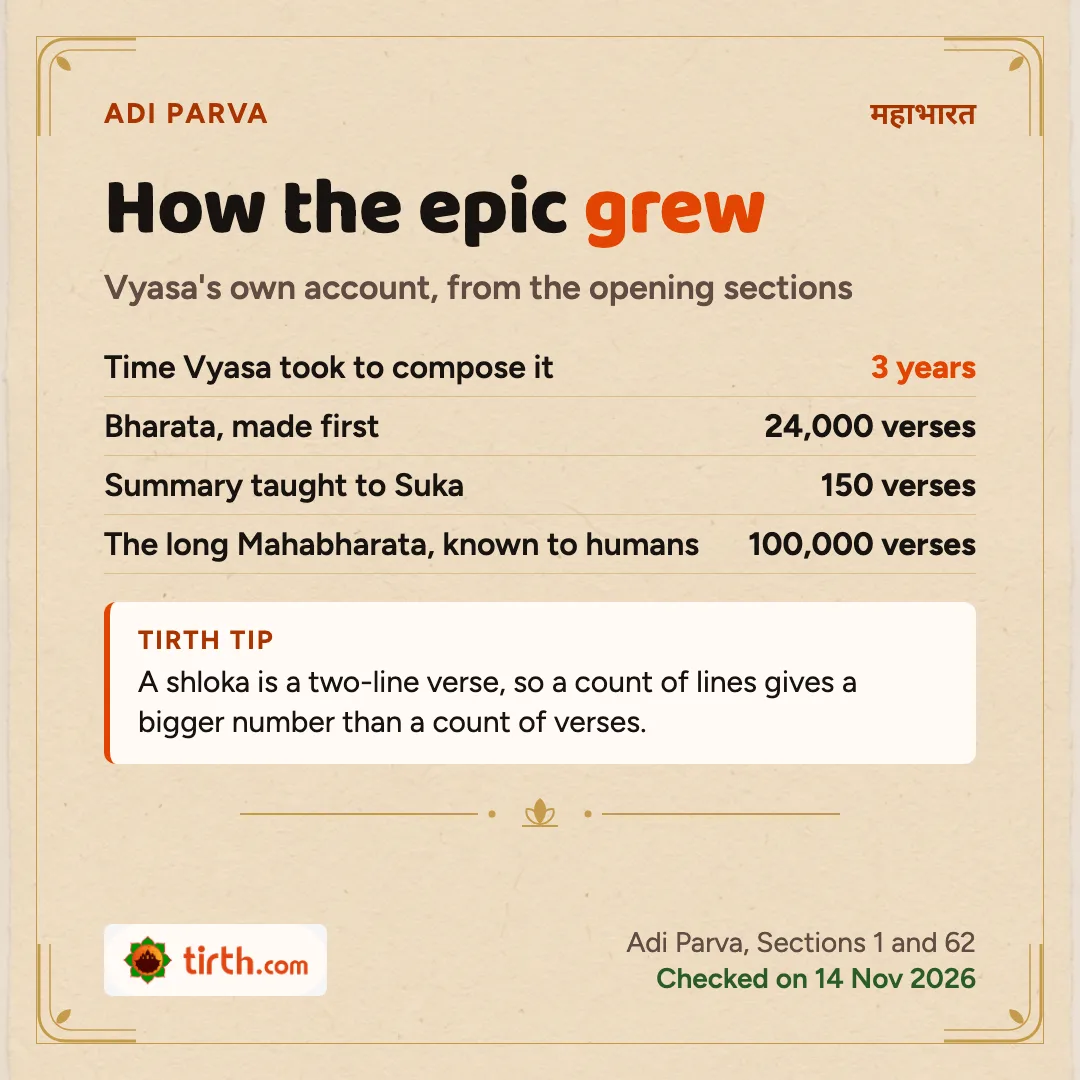
Section 62 answers the question of time: three years. Krishna Dvaipayana composed the Mahabharata in that span, and each day he rose purified and went through his ascetic devotions. The same section has Vaishampayana, reciting to Janamejaya, describe a hundred thousand shlokas made by Vyasa.
The epic tells how it grew while Vyasa shaped it. He started with the Bharata, 24,000 verses long. Then came a summary of only 150 verses, which he handed to his son Suka and other disciples. A far longer compilation followed, and Sauti says 100,000 of its verses are known in the human world. A shloka is a verse of two lines.
| Stage | Size | Who has it |
|---|---|---|
| Bharata | 24,000 verses | Made by Vyasa first |
| Summary | 150 verses | Taught to Suka and other disciples |
| The long Mahabharata | 100,000 verses | The part known among humans, as Sauti tells it |
In its final form the epic is divided into 18 parvas, and an appendix, the Harivamsha, comes after them.
Where the broken tusk comes in
Open Section 1 and you will find a pen, and only that. Many families, though, grow up with another version, where Ganesh ji snaps off one of his tusks and writes with it so that his writing never stops. His name Ekadanta, the one-tusked, is tied to this retelling as well.
Many families know this version well. It is a popular retelling and not what the epic itself says.
What scholars say about the epic’s author
Scholars frame the question another way. In their picture the epic was a tale carried by bards and spoken aloud, and it kept growing across several centuries, roughly the last centuries BCE and the first centuries CE, so it was never one man’s single draft. Even so, the epic presents Vyasa as its author, and that is how it speaks of itself.
Scholars give rough dates for that growth, about 400 BCE to 400 CE. The oldest preserved parts are not much older than about 400 BCE, and the text had reached its final form by the early Gupta period, around the 4th century CE. None of this changes what the epic says about itself. It is a statement about how a long, spoken tale was carried and gathered, not a rival name for the author.
The size of the work explains why the question stays open. The epic has 18 parvas, followed by the Harivamsha appendix, and the longest version has over 100,000 shlokas, which is over 200,000 lines.
Careful modern work has tried to settle the text itself. The Critical Edition of the Bhandarkar Oriental Research Institute in Pune ran from April 1919 to September 1966. It filled 19 volumes and over 15,000 pages, and its constituted text has over 89,000 verses, drawn from 1,259 manuscripts. Dr Sarvapalli Radhakrishnan, then President of India, released it in September 1966, and V. S. Sukthankar wrote its Prolegomena.
| Question | Family telling | The epic’s text |
|---|---|---|
| Who composed it | Vyasa | Names Vyasa as author |
| Who wrote it down | Ganesh ji | Section 1 has the scribe scene, with a pen |
| The tusk | Ganesh ji breaks it to keep writing | Not in the Section 1 text we read |
Vyasa is honoured every year on Guru Purnima, also called Vyasa Purnima. The Spiritual Calendar carries the day.
Frequently asked questions
Who wrote the Mahabharata?
Vyasa, as the epic itself says: it names the sage Krishna Dvaipayana Vyasa as its author. Scholars add that the long epic grew over centuries and passed through many tellers before it reached the form we read.
Did Bhagwan Ganesha really write the Mahabharata?
Section 1 of the Adi Parva has Ganesh ji writing the poem as Vyasa gives it. Scholars see the epic as a tale that grew through many tellers. Section 1 is where it starts.
Why did Ganesh ji break his tusk?
Section 1 has a pen and no tusk. The snapped tusk is a popular retelling, which many families know well and which the epic’s own text does not give.
How long did it take to write the Mahabharata?
Three years, according to Section 62. All through them Vyasa rose purified each day and kept to his ascetic devotions.
How many verses are in the Mahabharata?
The epic itself describes three stages: a Bharata of 24,000 verses, a summary of 150 verses, and a much longer compilation, of which 100,000 verses are known among humans. A shloka is a verse of two lines.
Continue on Tirth
- Spiritual Calendar: find Vyasa Purnima for your city.
- Bhagwan Ganesha: the deity page.
- The churning of the ocean: another great story, told in full.
- Temples: plan a darshan with your family.
- How Ganesh Chaturthi is kept
- Ganesha mantras word by word
Leave a Reply