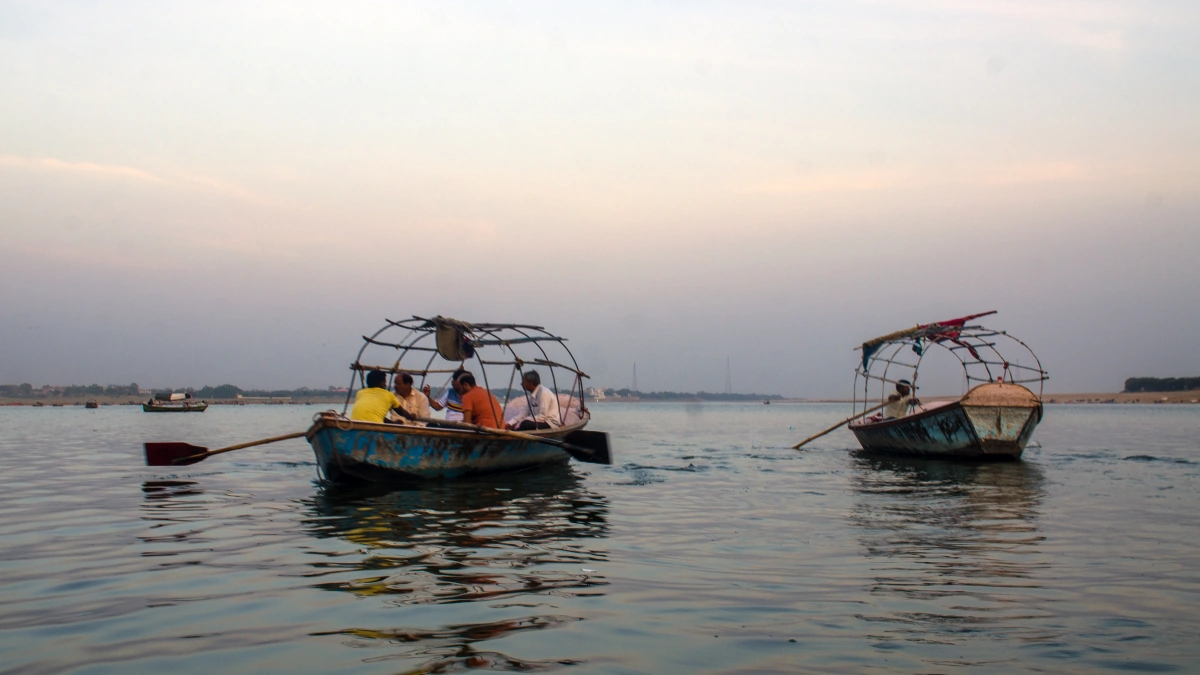
Prayagraj is called Tirtharaj because the Puranas give it that title. Tirtharaj is the raj (king) of the tirthas (sacred bathing places), and the Padma Purana puts the whole idea into one short line of praise. That Prayag, the king of tirthas, is victorious.
sa tirtharajo jayati prayagah
The Matsya Purana uses the same title for it. Down below the city is the Sangam, where families come to bathe once in twelve years for the Prayagraj Kumbh Mela and each and every year for the Magh Mela, and where Maa Ganga and Maa Yamuna meet while Maa Saraswati is held to join them unseen.
Which Puranas call Prayag Tirtharaj?
In the Matsya Purana the praise of Prayag comes down a line of listeners. Brahma Dev spoke it to Markandeya Rishi, and he in turn told it to Yudhishthira.
That telling also gives Prayag a second name. Prajapatikshetra, the field of Prajapati (Brahma Dev), the ground of his sacrifice. Tirtharaj turns up in the very same passage.
The Mahabharata has a similar account. In the Vana Parva, as it goes round the tirthas, Prayag’s name is said to come from the sacrifice of the Grandsire.
It is the Padma Purana that pushes the title furthest, and the line quoted at the top of this page comes from its Uttara Khanda chapters on Prayag. The Padma Purana puts Prayag above every other place of pilgrimage and Brahma Dev himself gave it the name Tirtharaj. The Brahma Purana describes bathing at Prayag in the month of Magh.
If you want to find these lines in the books, search for the Prayag passages by name. The Matsya and Padma Puranas are printed in more than one numbering. The chapter and verse numbers shift from edition to edition.
Akbar founded the city as Illahabas in 1575, later Allahabad, but in the Puranas the place is Prayag, the Tirtharaj.
What you will see at the Triveni Sangam
The Triveni Sangam sits below the eastern ramparts of Akbar’s fort, and the two rivers do not hide their meeting. Maa Ganga comes in brownish. Maa Yamuna is the greener of the pair.
Maa Saraswati is unseen and held to flow underground.
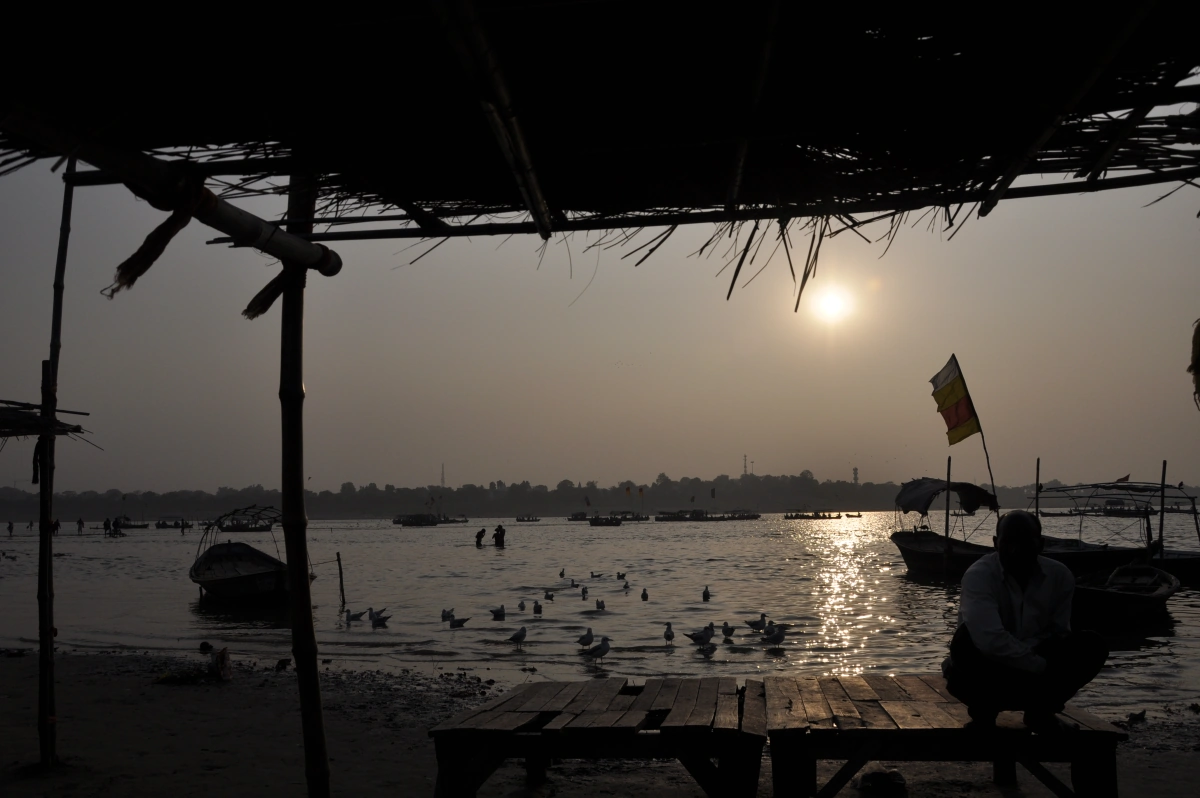
Bathing where the three rivers meet, and drinking that water, brings release from rebirth according to the Padma Purana.
Shri Ram came this way too. The Ayodhya Kanda of the Valmiki Ramayana brings Shri Ram, Sita ji and Lakshman ji to the meeting of Maa Ganga and Maa Yamuna, where they stay at the hermitage of Bharadwaj Rishi and the sage tells them to go on to Chitrakuta.
Why the Akshayavat is called undying
The Akshayavat is the undying banyan of Prayag. Bhagwan Shiva guards it, says the Matsya Purana. When the twelve Adityas burn the worlds at the dissolution, the same text says, this one tree is left unburnt. Another passage goes further still and has Bhagwan Shiva become the banyan himself.
Bhagwan Vishnu comes into it through the Padma Purana. He lies on one of its leaves, and the tree is still seen at the end of the kalpa (the age that closes in dissolution).
How often do the Magh Mela and the Kumbh come to Prayagraj?
For the Kumbh you have to go back to the churning of the ocean. Four drops of amrit fell on earth in that legend, and they fell at Prayag, Haridwar, Nashik and Ujjain. Those four are the Kumbh cities.
Here at Prayag the Kumbh comes round once in twelve years, while the Magh Mela is held every year.
Prayagraj held the Maha Kumbh in 2025. So the next big melas here are a few years off, with an Ardh Kumbh expected in 2031 and a Purna Kumbh in 2037. Some lists give 2030 for that Ardh Kumbh. Treat 2031 as expected until it is announced. If you want all four cities in one place, read the next Kumbh Mela timeline, and if it is the names that confuse, Ardh Kumbh and Maha Kumbh explained untangles them.
Till then, the yearly mela is the one a family can really plan around (for the Kumbh years that do fall in 2027, there is the Kumbh Mela 2027 guide).
Why Magh at the Sangam, and what a month of Kalpvas involves
The month counts for a lot in the texts. The Matsya Purana puts a figure on it. Bathing at Prayag three times a day, in Magh above all, is equal to the gift of a hundred thousand cows, it says, and in Magh ten thousand tirthas and crores of rivers are present in Maa Ganga.
Kalpvas is the name for a month spent living at the Sangam. From Paush Purnima to Maghi Purnima the Kalpvasis keep a month of austerity by the river. About thirty days in all.
The 2027 Kalpvas starts on Friday, 22 January and finishes on Saturday, 20 February (both days are in the snan table further down).
The practice is there in the Matsya Purana, minus the name. A month of bathing at the confluence with a restrained life comes up in its Prayag chapters, and so does a stay of three months. Search those verses for the word Kalpvas, though, and it is not there.
If it is a parent who wants to keep Kalpvas, sit down and talk the whole month through with them well before the date.
When are the Magh Mela 2027 snan days?
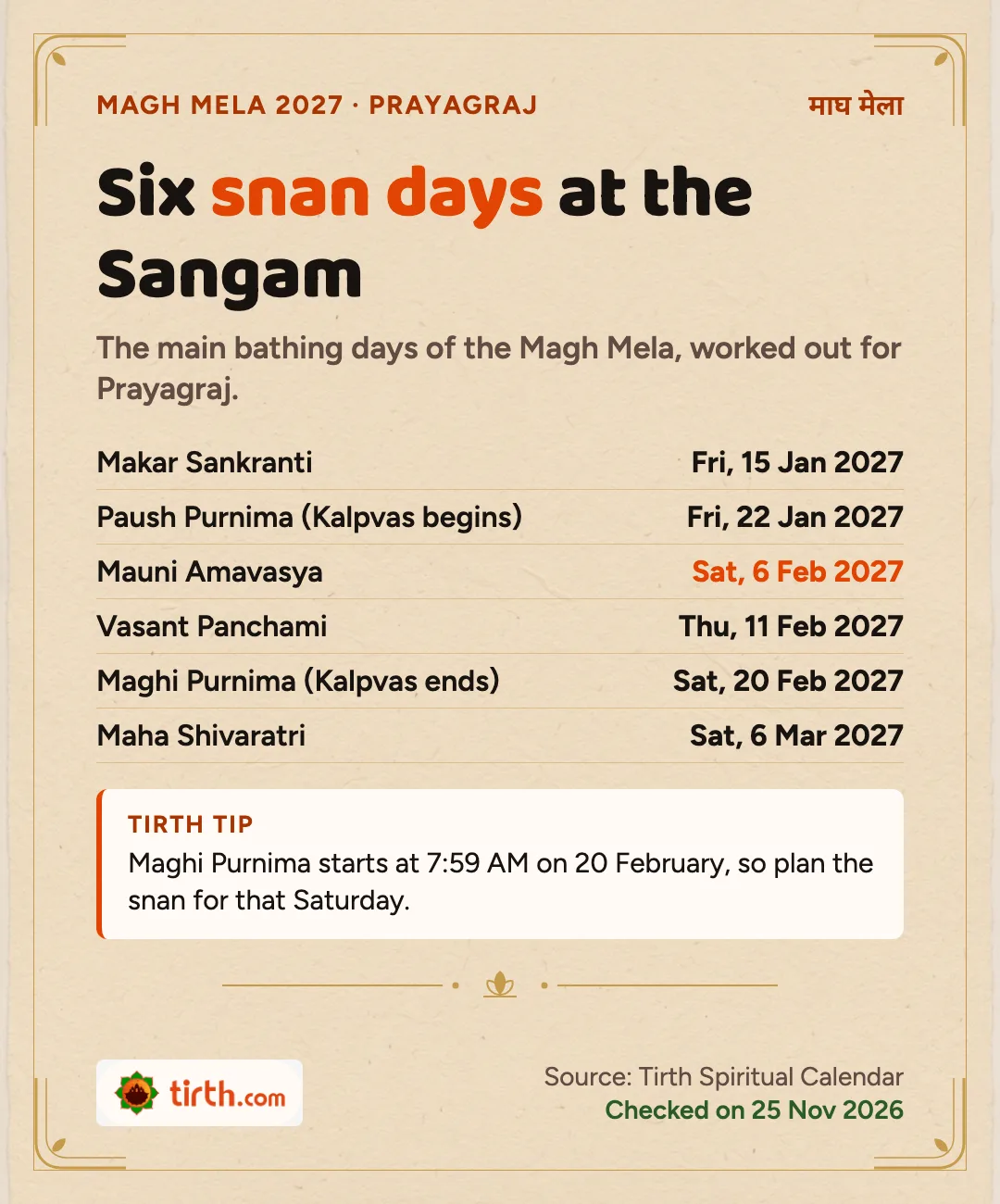
The Tirth Spiritual Calendar is the source of every snan day in the table, each one worked out for Prayagraj.
| Snan | Day and date | Tithi at Prayagraj |
|---|---|---|
| Makar Sankranti | Friday, 15 January 2027 | Sankranti falls on the evening of 14 January, so the snan is the next morning |
| Paush Purnima | Friday, 22 January 2027 | Purnima 9:29 PM, 21 January to 5:46 PM, 22 January. Kalpvas begins |
| Mauni Amavasya | Saturday, 6 February 2027 | Amavasya 7:05 PM, 5 February to 9:25 PM, 6 February |
| Vasant Panchami | Thursday, 11 February 2027 | Panchami 3:04 AM, 11 February to 3:18 AM, 12 February |
| Maghi Purnima | Saturday, 20 February 2027 | Purnima 7:59 AM, 20 February to 4:52 AM, 21 February. Kalpvas ends |
| Maha Shivaratri | Saturday, 6 March 2027 | Chaturdashi 12:03 PM, 6 March to 1:46 PM, 7 March |
The full list of official dates is on the KumbhMela.info Prayagraj dates page.
Mauni Amavasya, on 6 February, is the one regarded as the main snan.
Maghi Purnima needs the most care, and if you check only one date before you book, make it this one. The Purnima tithi starts at 7:59 AM on 20 February, a little after sunrise, and runs out at 4:52 AM the next morning, before the following sunrise. So the snan is on Saturday, 20 February. Plan to be at the Sangam on the 20th, because a family that turns up the day after reaches the water once the tithi is already over. Because the tithi begins after sunrise, a panchang that goes by the tithi at sunrise may name another day, so check the mela authority’s snan list once it is out.
Makar Sankranti is the reverse case. Evening of 14 January for the Sankranti itself, then the snan the morning after, Friday, 15 January.
Pujas and darshan to add to a Sangam snan
If the visit is for your ancestors, there is pind daan in Prayagraj.
- Akshayavat
- Bharadwaj Ashram
- Saraswati Koop
The Prayagraj travel guide keeps them together, and for a trip with Tirth there is Tirth’s Prayagraj yatra.
Frequently asked questions
Why is Prayagraj called Tirtharaj?
Tirtharaj means king of the tirthas. The Padma and Matsya Puranas both give Prayag that title.
Which rivers meet at the Sangam, and where is Maa Saraswati?
Maa Ganga and Maa Yamuna join in plain view, while Maa Saraswati is unseen and held to flow underground.
How is the Magh Mela different from the Kumbh Mela at Prayagraj?
The Magh Mela is held at the Sangam every year in Magh. The Kumbh comes to Prayag once in twelve years, and the next Ardh Kumbh is expected in 2031.
When does Kalpvas start and end in 2027?
From Paush Purnima, Friday, 22 January 2027, to Maghi Purnima, Saturday, 20 February 2027.
What is the Akshayavat?
It is Prayag’s undying banyan, which the Matsya Purana says Bhagwan Shiva guards and the dissolution does not burn.
Continue on Tirth
- Prayagraj travel guide, for the Sangam, the Akshayavat and the ashrams on one page.
- Mauni Amavasya 2027, regarded as the main snan of the Magh Mela, in the Tirth Spiritual Calendar.
- When is the next Kumbh Mela? Every city and year, in order.
Leave a Reply