To win a race round the world, Bhagwan Ganesh walked round his parents, Bhagwan Shiva and Maa Parvati, three times over. A walk like that is a parikrama.
So the circumambulation meaning, put plainly, is going round something sacred with it kept on your right hand from the first step to the last.
Here is how families tell it. Bhagwan Shiva had a divine fruit in his keeping, and he gave his word that it would go to whichever son first went round the world three times. Bhagwan Kartikeya, the other son, took to the air on his peacock.
Ganesh ji took his parents to be the whole world, and three rounds of them won him the fruit.
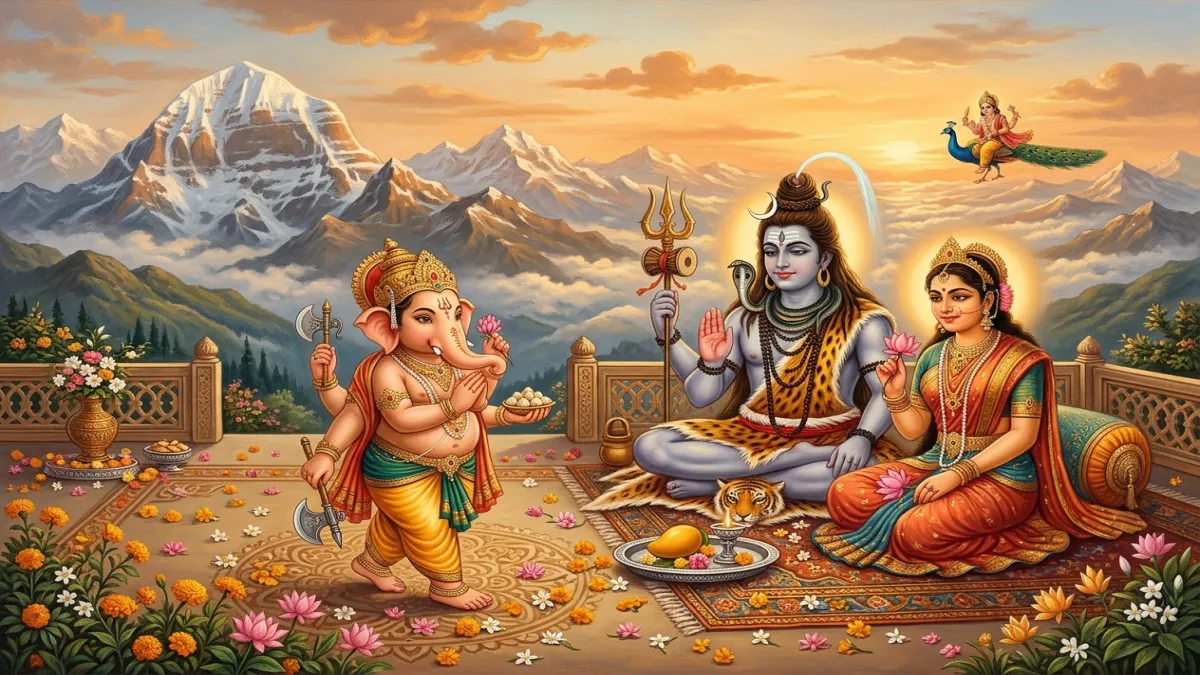
The fruit itself changes with the teller. Some call it jnana palam, the fruit of knowledge. Others, a mango. In one version Ganesh ji circles Maa Parvati alone, and the Tamil telling closes with Bhagwan Kartikeya leaving for Palani. The tellings we read name no scripture, and families pass it on to their children as a story.
Which way round do you walk a temple?
You go clockwise. Walk that way and the centre stays at your right side the whole time. The name of the practice gives the direction away, because pradakshina means “going to the right” in Diana L. Eck’s entry on circumambulation in the Encyclopedia of Religion. The Monier-Williams Sanskrit-English Dictionary agrees and spells it out a little more, as circling a person or an object from left to right with your right side turned towards it, done as worship or as a mark of respect.
You will also hear parikrama, the path that goes round something. Both words are used mostly for sacred things. (Even the left side has a word of its own, vama, the opposite of dakshina.)
Eck also names ritual texts that speak of moving sunwise in a rite, the Shatapatha Brahmana and the Grihyasutras among them. What sits in the middle of the circle varies, and it may be a sacred fire, a teacher, a deity or a temple.
Round the sanctum, or round the whole temple?
Most often, in a Hindu temple, what you go round is the garbhagriha (the sanctum). How wide the circle is depends on how big the temple is. Eck describes people circling the whole complex at some temples, and only the inner courts at others, before they go in for darshan. A big temple may have several routes, and they usually take in the smaller shrines on the way.
Where you are in India changes the line too. At some popular northern temples you walk close against the wall. In the South, and in Kerala and Karnataka especially, markers often fix a respectful distance between you and the shrine (look out for them before you begin).
The walk was built into early Buddhist stupas as well, with a path called the pradakshinapatha running between the outer fence and the dome.
From a tulsi plant to 3,500 km of the Narmada
At the small end of Eck’s list of sizes is a single turn on the spot, as at Kanyakumari. At the big end are whole mountains, among them Kailasa, Arunachala, Kamadgiri and Govardhan. Same walk, every size.
Closer to home it shrinks to a plant. People walk round the tulsi. The peepal gets the same, and for the sacred fig the round even has its own name, aswattha pradakshina. When a couple go round the sacred fire in the mangal phera at their wedding, that is a pradakshina too. Anga pradakshina goes further, with the body rolled along the ground instead of walked (if you have never done it, ask at the temple first).
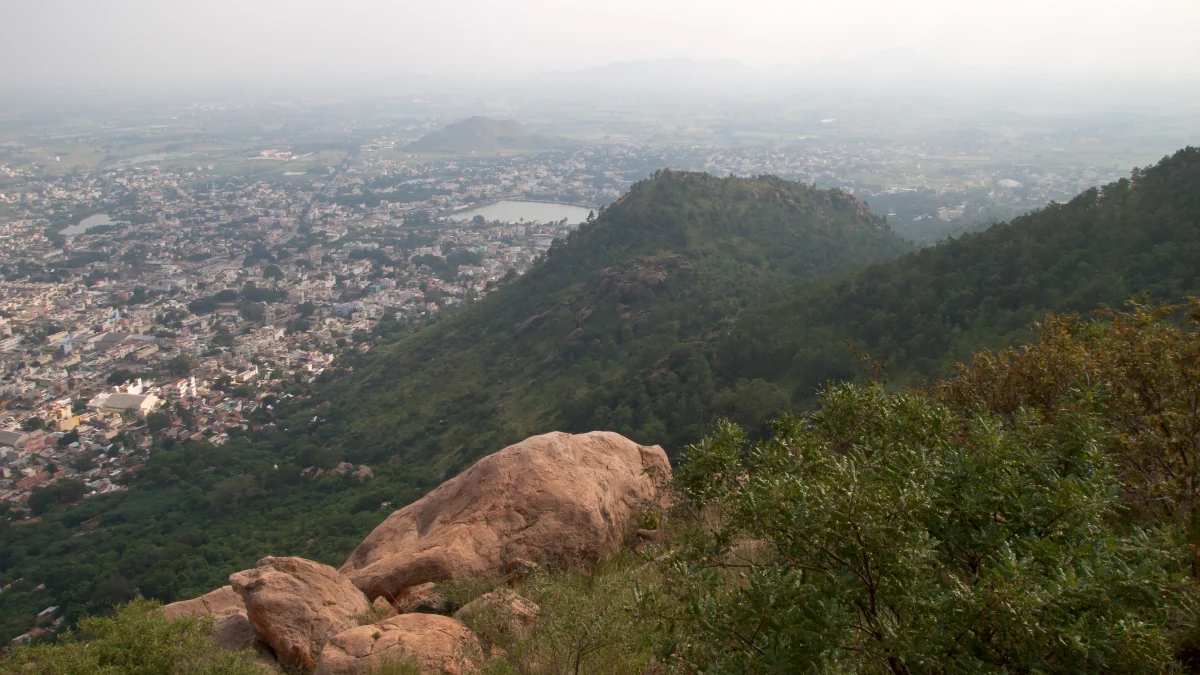
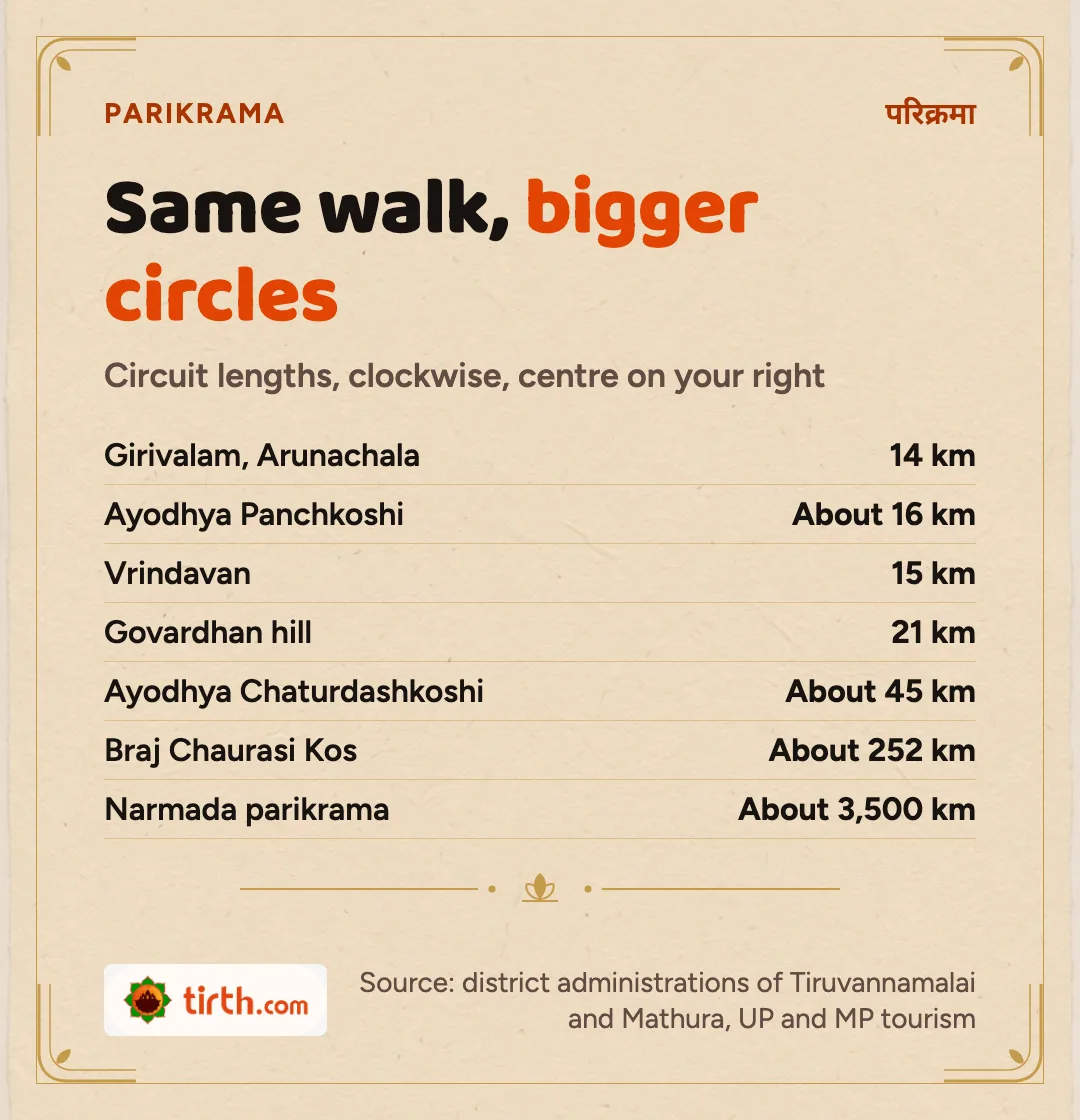
Then the hills. At Tiruvannamalai the walk round Arunachala hill, with the hill on your right, is called Girivalam or giri pradakshina. The Tiruvannamalai district administration gives the road round it as 14 km, about 8.5 miles. Full-moon days bring people out to walk it, and so do festival days such as Karthigai. Along the road stand eight shrines, the Ashtalingams.
Braj has rounds inside rounds. On the Mathura district administration’s list, the 84 kos of the Braj Chaurasi Kos work out at approximately 252 km. Govardhan hill comes to 21 km (7 kos) on the same list, while Vrindavan and Mathura are 15 km (5 kos) each. Barsana, Nandgaon and Gokul are among the smaller rounds. If it is Vrindavan you are planning for your parents, our piece on the Vrindavan parikrama on foot covers the walk itself.
In Ayodhya there are three to choose from. The Antargrahi is the shortest and takes a day, beginning with a bath in the Saryu and finishing at Kanak Bhawan. The state tourism site puts the Panchkoshi, which starts at Chakratirtha, at about 16 km, and the Chaturdashkoshi at about 45 km, walked on Akshaya Navami and completed in one day. Lengths quoted elsewhere differ slightly. I would take both as round figures for that reason.
Last, a whole river. Madhya Pradesh Tourism’s account of the Narmada parikrama has you walking barefoot for approximately 3,500 km, setting out from Amarkantak and ending there.
| What is circled | About how far | Who gives the figure |
|---|---|---|
| Tulsi, peepal, the wedding fire | The plant or fire itself | Done at home or at a wedding |
| A temple’s sanctum or inner courts | Depends on the temple | Encyclopedia of Religion (Eck) |
| Arunachala hill (Girivalam) | 14 km | Tiruvannamalai district administration |
| Vrindavan | 15 km (5 kos) | Mathura district administration |
| Ayodhya Panchkoshi | About 16 km | Uttar Pradesh state tourism |
| Govardhan hill | 21 km (7 kos) | Mathura district administration |
| Ayodhya Chaturdashkoshi | About 45 km | Uttar Pradesh state tourism |
| Braj Chaurasi Kos | About 252 km (84 kos) | Mathura district administration |
| Narmada parikrama | About 3,500 km, barefoot, from and back to Amarkantak | Madhya Pradesh Tourism |
Planning one of the long ones? Begin with Tirth’s walking routes (padayatras) pages.
Half a circle for Bhagwan Shiva, and a leftward round for the dead
Two customs break from the plain clockwise round, and both tend to catch people out the first time.
The first, somasutra pradakshina, is kept at many Bhagwan Shiva temples. There is an outlet for the abhishek water, the gomukhi, and the clockwise walk goes only as far as that, not across it. Then you come back anticlockwise along the inner path and finish with one more clockwise stretch, and the whole of that is counted as a single pradakshina. The exact route differs from temple to temple. If the gomukhi is hard to spot, ask before you start, since crossing that channel is exactly what the custom avoids.
The second custom turns the direction round. Prasavya is the name for circling to the left. Eck connects it with the left hand, and with rites for the dead, for the ancestors and for the nagas. The pyre at a Hindu funeral is circled that way, counter-clockwise. In many traditions, she writes, a reversed circle stands for reversing the natural order.
Is there a right number of rounds?
The temple you are in decides that. Where nothing is written up, the Pandit at the shrine can tell you what is done there, and I would ask rather than guess.
So how did three rounds beat a trip round the world?
What won Ganesh ji the race was a parikrama. A walk round the centre of something.
For him the centre of the world was his parents, and he circled them the way you would circle a shrine, or a hill, or a river 3,500 km long. Three rounds of his parents, and in the story they are worth the whole earth.
Our Ganesh Chaturthi story is the one to read next if this tale gets told in your home. And if a lamp gets circled at home as well, there is a piece on the lamp in worship too.
Frequently asked questions
What is the meaning of pradakshina?
Literally, “going to the right”. The Monier-Williams Sanskrit-English Dictionary has it as worship or respect shown by circling a person or an object from left to right, with the right side turned towards it. Parikrama, for its part, is the path round something.
Why do we go clockwise?
Going clockwise keeps the deity on your right-hand side, the side Diana L. Eck calls auspicious in the Encyclopedia of Religion.
How many times should one circle a temple?
Go by that temple’s own custom, and ask the Pandit there when nothing is written up.
Why do Bhagwan Shiva’s temples have a half circle?
Many Shaiva temples keep the gomukhi, the outlet for the abhishek water, uncrossed. So you go clockwise up to it, come back anticlockwise along the inner path and then go clockwise again, and the whole of it counts as one round.
Why is a funeral circled the other way?
The leftward circle, prasavya, is kept for rites for the dead and the ancestors. At a funeral, it is counter-clockwise round the pyre.
What is the Govardhan parikrama?
The Mathura district administration lists the walk round Govardhan hill in Braj at 21 km, or 7 kos. The Chaurasi Kos round of Braj is about 252 km.
Continue on Tirth
- Tirth walking routes (padayatras), for the long parikramas on foot.
- Bhagwan Ganesh, his forms and his worship.
- The Saryu at Ayodhya, the river the Antargrahi round begins with.
- Devotional Lifestyle and Culture, more on what Hindu customs mean.
Leave a Reply