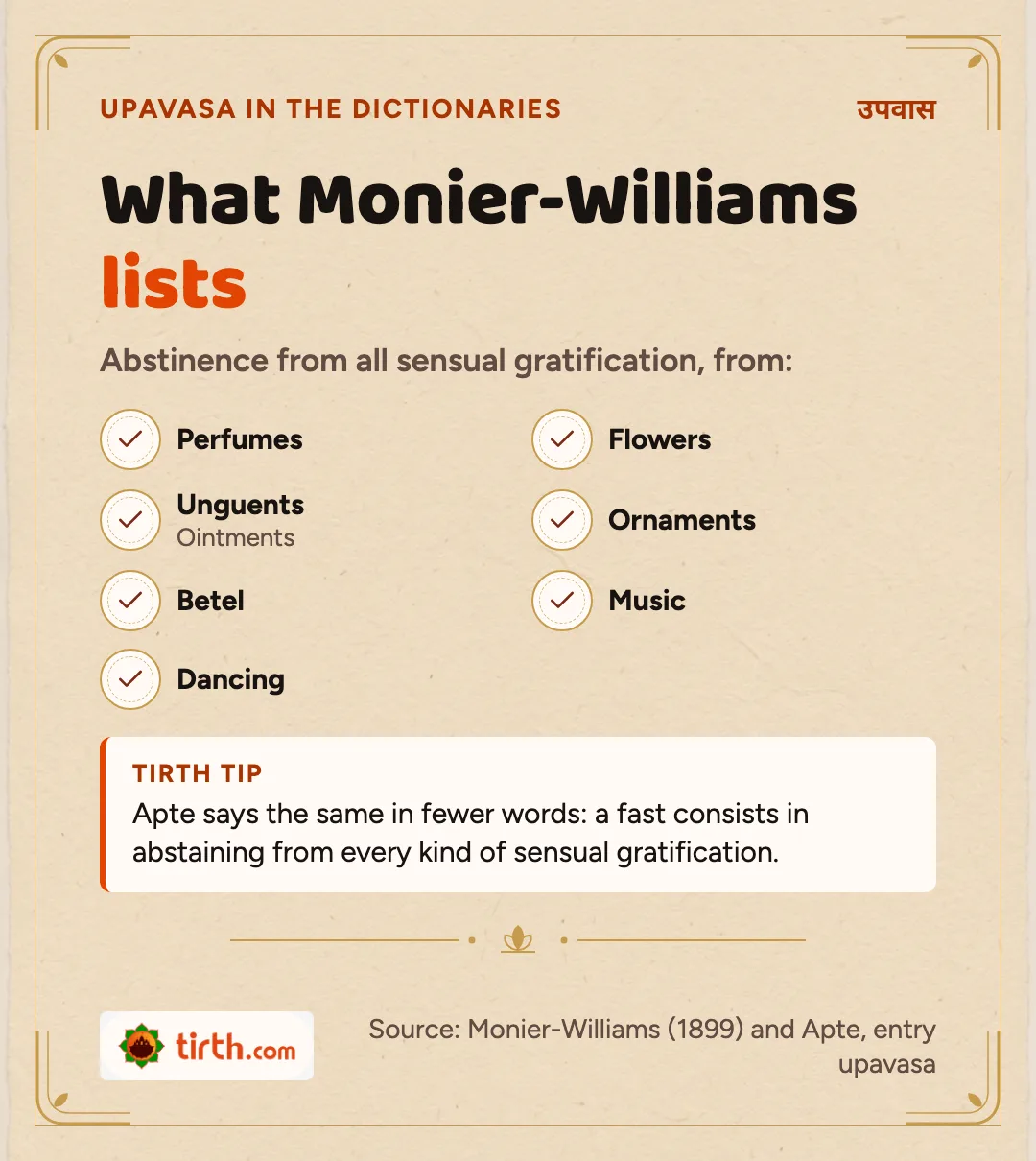
A Hindu fast in Sanskrit is upavasa, and Monier-Williams defines it as fasting done as a religious act “comprising abstinence from all sensual gratification”. The bracket after that names what goes, from perfumes and flowers through unguents, ornaments and betel to music and dancing, and food is not on it.
So the fasting meaning you meet in the dictionaries goes further than skipping meals.
Hindu fasting is generally a matter of choice. How strict it gets is fitted to the person keeping it, anywhere from nirjala, with not even water, to a day of fruit and milk.
What do Monier-Williams and Apte say upavasa is?
Monier-Williams is the Sanskrit-English dictionary of 1899, and its entry opens plainly with “a fast, fasting”. Then comes the bracket. It reads religious act first. After that come perfumes, flowers and unguents (ointments), then ornaments, betel, music, dancing etc.
No food in it. We read that as no gap at all (the headword already says fasting, so the bracket only has to cover what comes on top of an empty plate).
Apte says it in fewer words. His entry calls a fast something that “is a religious act and consists in abstaining from every kind of sensual gratification”. For that sense of the word each dictionary points back to the lawbooks, Apte to Manu 11.196 and to Yajnavalkya 1.175 and 3.190, and Monier-Williams to Manu 2.183 and 11.195 and 212.
Say your fast days so far have meant no meals, with music on in the house and your jewellery worn as on any other day. By our own reading that is one part of an upavasa, and Monier-Williams’s bracket names more of what it asks.
The noun has a verb behind it. Upa-vas, upa joined to vas. Monier-Williams puts “to abide or dwell with or at” first among its meanings, with “to stay, wait” beside it, and it is further down that same entry that the verb turns to abiding in a state of abstinence, to abstaining from food and at last to fasting.
Is a vrat just another word for upavasa?
In everyday speech vrat and upavasa get used for each other. Look the first one up, though, and Monier-Williams gives vrata as “a religious vow or practice”. He stretches it to any pious observance or act of austerity, and the examples in his bracket are fasting and continence.
So a fast is one kind of vrat, by that entry, and continence is another, which means a vow can ask for more than skipping meals.
Some vows run for weeks. The 41-day vow kept for Sabarimala is one (its rules have a page of their own).
Why do Hindus fast? What the dictionaries and Banglapedia say
The dictionaries hand you the first reason themselves. Monier-Williams and Apte both file upavasa as a religious act, a holding back from every kind of sensual gratification, and they cite Manu for it, Apte adding Yajnavalkya.
Then there is the vow. Once a person has taken a vrat, fasting may simply be how they keep it.
Devotion is the third, and for it the source is Banglapedia, whose upavasa entry describes fasting as giving a sense of closeness with the divine. That is how we would rather read upavasa too. Staying near Bhagwan. Our reason is the verb, whose first sense in the dictionary is to dwell with, and this reading gives that sense a job again. Both readings, the encyclopedia’s and ours, are devotional ones. The dictionary itself says only dwell with or at, and does not say with whom.
And the fourth is the day itself, or the occasion.
The fast days named here were checked against the Tirth Vrat Calendar in November 2026; the calendar carries the live dates for each year.
Devout Hindus fast before a puja. On the Tirth Vrat Calendar several fast days carry a deity’s name (Masik Shivaratri, Masik Durgashtami, Vinayaka Chaturthi etc.), whereas Purnima and Amavasya are just the full moon and the new moon. Ekadashi, the eleventh day of each lunar fortnight, gets a post of its own on why Ekadashi is a fast day. For its dates and parana windows (parana is the breaking of the fast), go to the Ekadashi vrat calendar.
Who keeps the fast can differ too. Men and women may keep one together, or it may be a fast for women alone or for men alone. Karwa Chauth is one of the women’s fasts, kept by married women.
Must you fast, and how strict should the fast be?
In general, no. It is left to your choice, and the strictness follows a person’s condition and what they can manage.
The question gets sharper with Ekadashi. For Vaishnavas, Shaivites and worshippers of Surya Dev, the Dharma Sindhu (an 18th-century rulebook) treats that fast as compulsory, as Tirth’s Ekadashi guide notes. Tirth’s Ekadashi guide adds that anyone from age 8 to 80 may keep it.
A softer form is allowed even there. Fruit, milk, water or ghee, for those who cannot fast fully. Five graded ways of keeping the day appear in the guide. Nirjala sits at the strict end and naktabhoji at the gentle end, and the table picks out steps along that scale without naming all five.
| Form of the fast | What it allows |
|---|---|
| Nirjala | Nothing, not even water. The strictest form. |
| Water and light food | Water, with fruit or puffed rice. |
| Fruit, milk, water or ghee | Allowed on Ekadashi for those who cannot fast fully. |
| Naktabhoji | The gentlest of the five Ekadashi ways in Tirth’s guide. |
When do fast days fall, and where do you find them?
Usually a fast falls on a fixed weekday, on Ekadashi, Purnima or Amavasya, or in the time before a puja.
| Fast day | When it comes | On Tirth |
|---|---|---|
| Weekday fast | One fixed day each week | Kept by those who choose it |
| Ekadashi | The eleventh day of each lunar fortnight, twice a month | Ekadashi vrat dates and parana times |
| Purnima and Amavasya | Full moon and new moon | Tirth Vrat Calendar |
| Sankashti Chaturthi, Vinayaka Chaturthi | Dates for the next 12 months on the calendar | Tirth Vrat Calendar |
| Masik Shivaratri, Masik Durgashtami, Kalashtami | Each month | Tirth Vrat Calendar |
| Festival fasts, for example Navratri | During the festival, for those who choose to fast | Navratri |
If you are planning one, look at the Tirth Vrat Calendar first, since it lists the coming fast days with their timings.
Frequently asked questions
What is the meaning of upavasa?
It is a fast kept as a religious act. Both Monier-Williams and Apte describe it as abstaining from every kind of sensual gratification. Among the things given up, Monier-Williams names perfumes, flowers, unguents, ornaments, betel, music and dancing.
Why do Hindus fast?
For religious reasons, in the sources this page uses. The two dictionaries call upavasa a religious act of holding back the senses. A fast can also be how a vow (vrat) is kept. Banglapedia describes fasting as giving a sense of closeness with the divine, and devout Hindus fast before a puja and on fast days such as Ekadashi.
What is the difference between vrat and upavasa?
Vrat means a vow. Monier-Williams calls it “a religious vow or practice”, and fasting is one way to keep one. He names continence as well, so a vow can ask for more than a fast does.
Is fasting compulsory in Hinduism?
Generally not. Fasting is left to the person’s choice, and its strictness is fitted to them. Ekadashi needs its own answer. Tirth’s Ekadashi guide notes the Dharma Sindhu’s rule, which treats that fast as compulsory for Vaishnavas, Shaivites and worshippers of Surya Dev and lets anyone from age 8 to 80 keep it. Anyone who cannot keep the full fast may still take fruit, milk, water or ghee.
Can you drink water or eat fruit during a Hindu fast?
In the usual form, yes. People drink water and take something light such as fruit or puffed rice. Nirjala is the exception, the strictest form, with no water at all.
Do Hindus fast for health?
The reasons on this page are religious ones, taken from dictionaries that file upavasa as a religious act. This page makes no claim either way about fasting and health.
Continue on Tirth
- Ekadashi vrat dates and parana times lists each coming Ekadashi with its window for breaking the fast.
- Ekadashi kya hai explains why the eleventh day is kept, and the five ways people keep it.
- The Tirth Vrat Calendar covers Pradosh, Sankashti, Purnima, Amavasya and the rest of this month’s fast days.
Leave a Reply