
Kaikeyi tells Bhagwan Ram he must leave for the forest so that Bharata can be crowned, and he says yes without being shaken. That yes is the Maryada Purushottam Ram meaning in one scene: the best of men, keeping to a limit when stepping past it would have been far easier.
The two words say the same thing. The Monier-Williams Sanskrit-English Dictionary gives maryada as a boundary or limit, the bounds of morality and propriety among them, and purushottama as the best of men, also the highest being.
Valmiki’s Ramayana is where the limits get tested. In it you’ll find Narada’s list of qualities, a few hard choices Bhagwan Ram makes, and praise from a rakshasa who was trying to stop Ravana.
If you want his whole life from start to end, Who was Bhagwan Ram, as Valmiki tells it has it. This post asks something narrower. Why him, and why that particular word, maryada.
Where do the 16 qualities of Bhagwan Ram come from?
The Ramayana starts with a question, and it is Valmiki who asks it, of the sage Narada, in Bala Kanda, sarga 1. Who in the world today is a man of 16 named qualities?
The name Narada gives is Bhagwan Ram, of the Ikshvaku line.
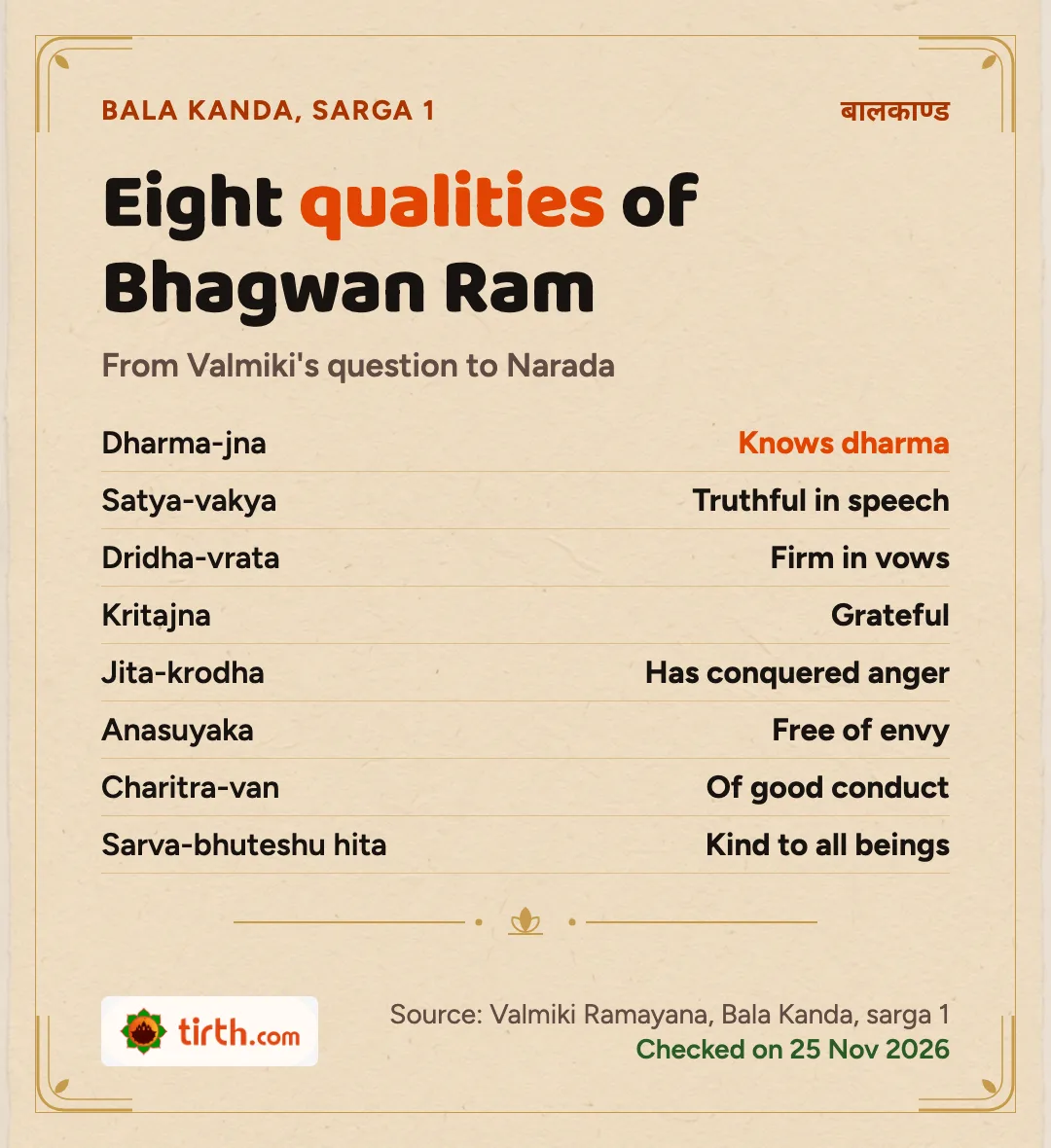
Eight of the 16 are in the table, each next to what the word means.
| Quality in the text | Meaning |
|---|---|
| Dharma-jna | Knows dharma |
| Satya-vakya | Truthful in speech |
| Dridha-vrata | Firm in vows |
| Kritajna | Grateful |
| Jita-krodha | Has conquered anger |
| Anasuyaka | Free of envy |
| Charitra-van | Of good conduct |
| Sarva-bhuteshu hita | Kind to all beings |
Narada doesn’t stop at the list. Later in the same sarga he goes on. A man who knows his duty, keeps his promises and looks after the welfare of his people. Patient like the earth. In truth, like dharma itself.
Anger under control and vows held firm are both about restraint.
So the list already holds the maryada of the title. What follows in the Ramayana puts these words to the test, one at a time.
The first test, and the yes he gave Kaikeyi
Ayodhya Kanda, sarga 18, is where it happens. His father will not speak. Kaikeyi is the one who tells Bhagwan Ram about the two boons.
One is for Bharata to be crowned, the other for Bhagwan Ram to go and live in the forest.
You’d expect a fight in sarga 19, or one sharp word back at the very least. Valmiki doesn’t give him one. He hears it all unshaken. He agrees to go and says he’ll take leave of his mother Kausalya.
And the question he does ask is why his father will not tell him himself. A man who has just lost a kingdom in one conversation.
Why Kaikeyi wanted all this is a separate story, told properly in why Kaikeyi asked for the exile. For us the yes is enough.
Bharata begs, Jabali argues, and he still won’t take the throne
The second test comes from the other direction. From his own brother.
Sarga 100 brings Bharata to the forest. Bhagwan Ram’s questions are about their father and the running of the kingdom. Sarga 101 is Bharata pleading with him to return, and it is here that Bhagwan Ram hears Dasharatha has died.
The king who gave those boons is gone now, and the brother they were meant to put on the throne doesn’t want it. If Bhagwan Ram had been looking for a way out, there it was.
He doesn’t take it. His answer, in sarga 107, is that Bharata should go back and rule.
Even that isn’t the end of the pushing. Then Jabali, a brahmin, tries in sarga 108. He goes as far as arguing against Vedic practice itself so that Bhagwan Ram will take the kingdom. Sarga 109 is the reply. Truth is the highest virtue, he says, and he holds to dharma and will not abandon his father’s vow.
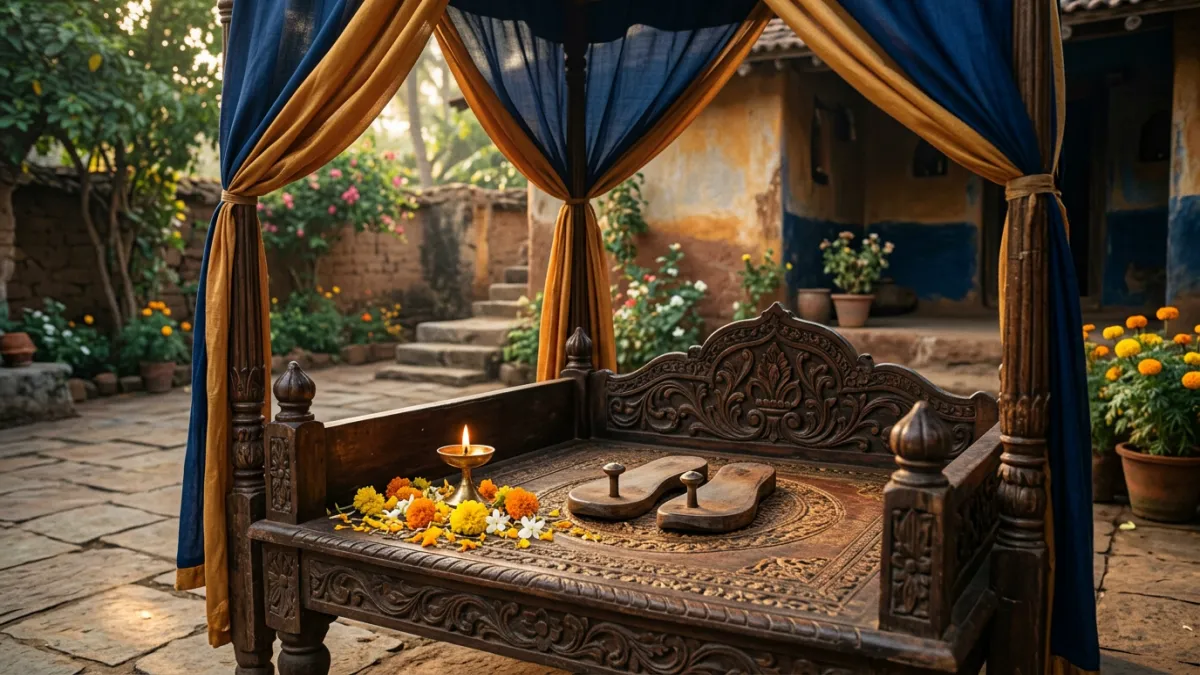
Sarga 112 closes it. Bharata takes Bhagwan Ram’s sandals, the padukas, and resolves to rule under them. A kingdom kept for someone else.
For the others in that forest scene, see the people of the Ramayana.
What Maricha told Ravana about him
Before the third test there is a scene in which Bhagwan Ram isn’t even present.
Aranya Kanda, sarga 37. Maricha, a rakshasa, warns Ravana against provoking Bhagwan Ram and urges him to give up his plan. He tells Ravana that Bhagwan Ram is dharma embodied, and king of all the worlds the way Indra is among the gods. The sarga’s own title says Maricha praises Bhagwan Ram and Maa Sita.
Close in spirit to the title we use for him now. And from a rakshasa.
I trust that more than praise from a friend. A friend has reasons to be kind.
The third test: would he take in Vibhishana?
Vibhishana comes over to Bhagwan Ram in Yuddha Kanda, sarga 17. He doesn’t decide alone. Consults his ministers first.
In sarga 18 he accepts Vibhishana’s friendship, and the reason he gives is a rule he keeps for himself. He will never refuse a person who comes to him as a friend.
He was at war with Ravana, Vibhishana was standing there asking to be his friend, and the limit he would not cross was still the one about how you treat a person who comes to you that way.
(The sarga numbers used all through this post are those of the IIT Kanpur edition of Valmiki’s Ramayana. The English translation by Hari Prasad Shastri numbers these sargas in the same way.)
Sarga 118 and Maa Sita, the scene people still ask about
This scene is a hard one to read.
Vibhishana brings Maa Sita to Bhagwan Ram in sarga 117. In sarga 118 Bhagwan Ram speaks harshly to her and tells her she is free to go wherever she wishes. That much is in the text, plainly.
A few paragraphs on a page about one title are not the place to settle it. The full scene and what follows it are in the agnipariksha scene explained, written with the care it needs.
A post on this title still has to name it. Sarga 118 is in the same Yuddha Kanda as the sargas where he accepts Vibhishana.
Read the five scenes before you settle on the word
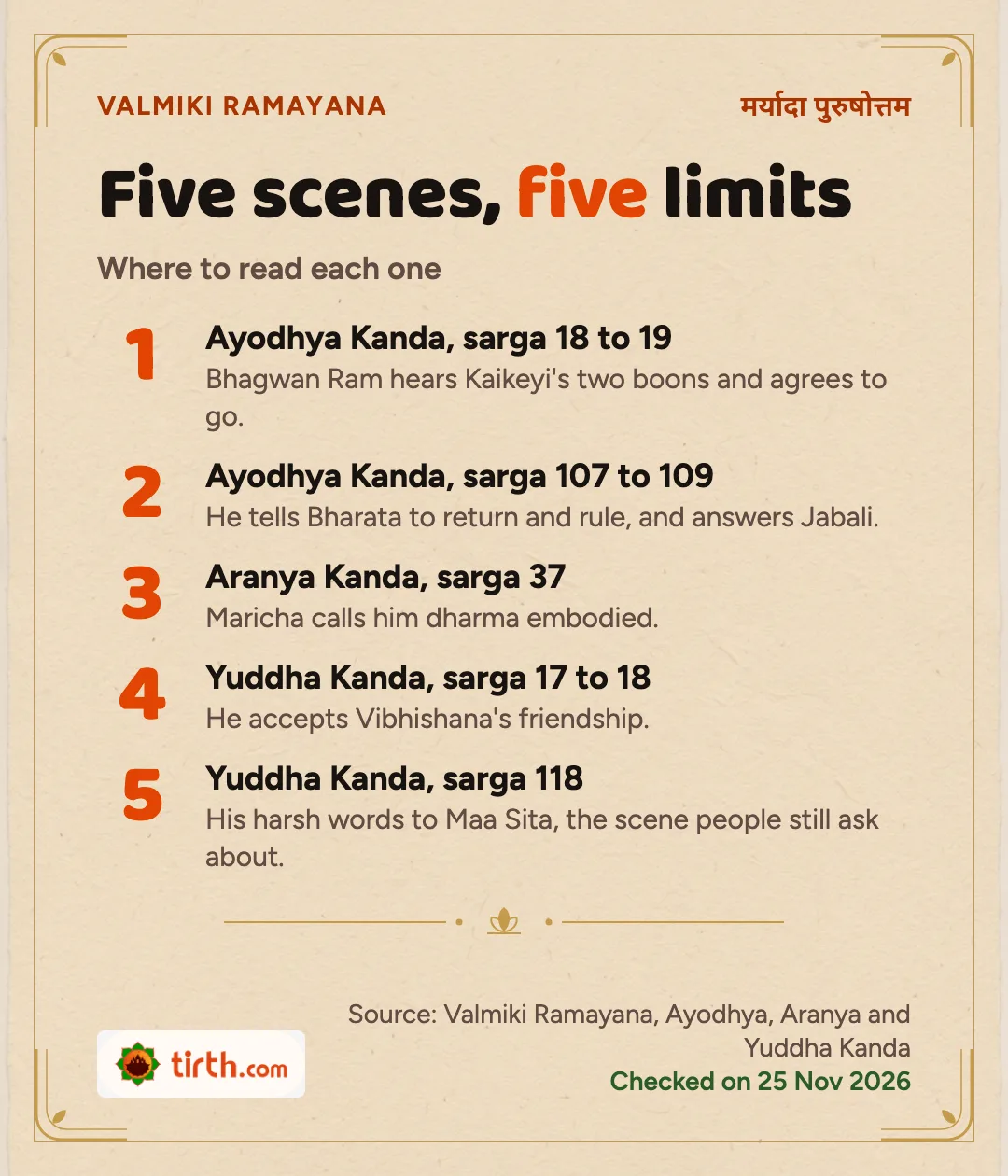
Kaikeyi’s boons, Bharata and Jabali, Maricha, Vibhishana and sarga 118 are all in Valmiki, and each one is worth reading in full before you decide what maryada means to you. The posts on Kaikeyi’s boons and the agnipariksha scene take two of them further. To book a puja for Bhagwan Ram, see puja booking on Tirth.
Frequently asked questions
What is the meaning of Maryada Purushottam?
The word maryada means a boundary or limit and Purushottam the best of men, so together they name Bhagwan Ram as the best of men who keeps to his limits.
Why is Bhagwan Ram called Maryada Purushottam?
In Valmiki’s Ramayana he keeps to a limit where crossing it would have been easier, when he agrees to Kaikeyi’s boons, tells Bharata to go back and rule and accepts Vibhishana’s friendship. The two words fit those scenes. Maryada is a boundary or limit, and Purushottam the best of men.
What are the 16 qualities of Bhagwan Ram?
Valmiki names them in the question he puts to Narada in Bala Kanda, sarga 1. Among them are virtuous, valorous, knows dharma, grateful, truthful in speech, firm in vows, of good conduct, kind to all beings, learned, has conquered anger and free of envy.
Why did Bhagwan Ram speak harshly to Maa Sita?
Yuddha Kanda, sarga 118, is the scene. His words to Maa Sita are harsh, and he tells her she may go where she will. For the whole of it, read the agnipariksha scene explained.
Continue on Tirth
- Bhagwan Rama page, his temples, stories and festivals in one place.
- The Vivah Panchami story on the Tirth blog.
- Ram aarti with meaning, for any evening at home.
- Tirth Spiritual Calendar, for the Ram Navami and Dussehra dates.
Leave a Reply