
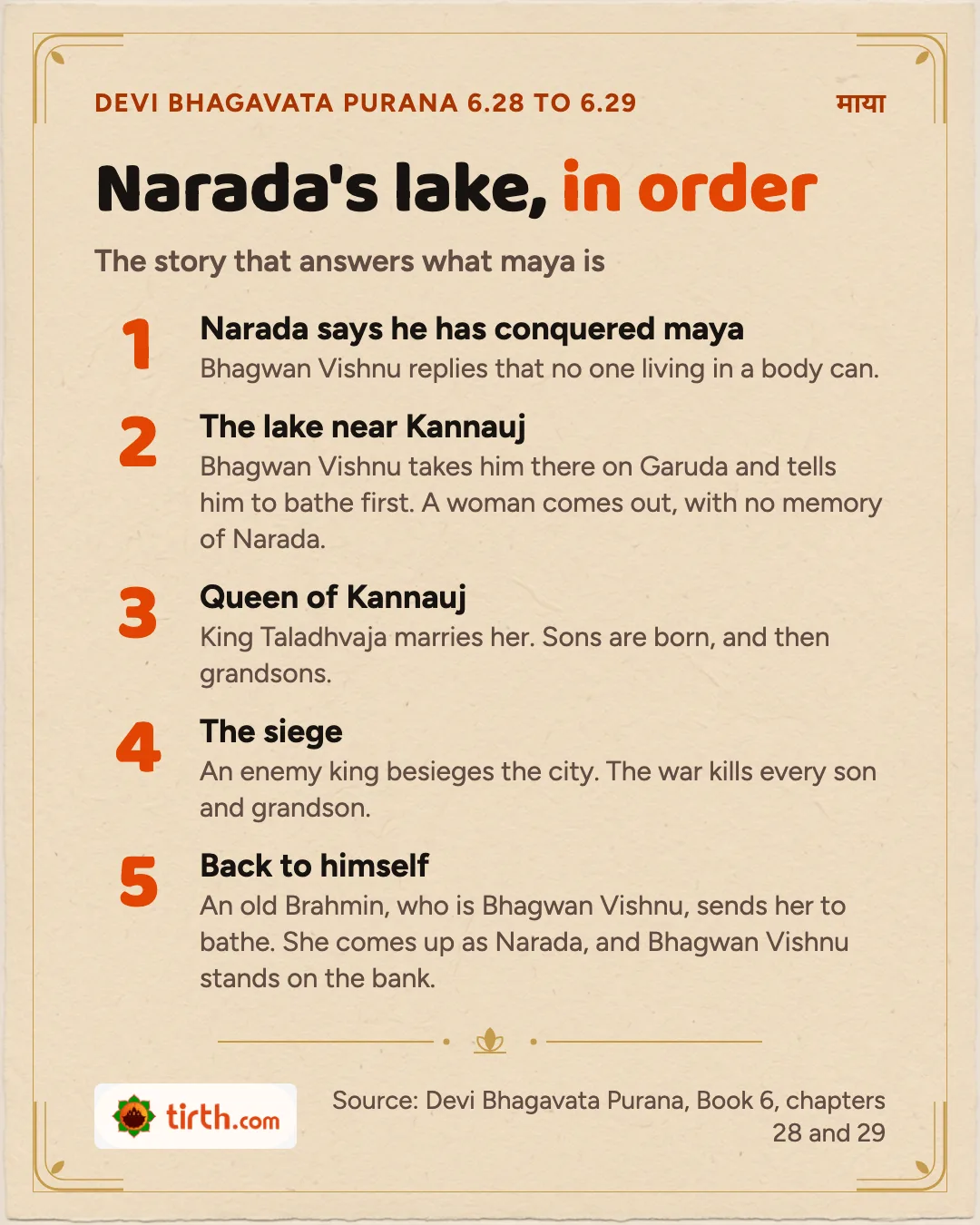
Narada was sure of himself. He had conquered maya, he told Bhagwan Vishnu.
Nobody living in a body has ever managed that, came the reply, and Bhagwan Vishnu seated him on Garuda and flew him to a lake near Kannauj. Bathe first. Into the water Narada went, and a woman came out, one who remembered nothing of having been Narada.
What maya means in Hinduism: the power Narada claimed he had beaten
In its simplest meaning, maya is a power. Through it the one shows up as many, and a mind mistakes what it sees for everything there is. When the Rig Veda says maya, it means a god’s creative or magical power. Shankara’s Advaita reads it as illusion.
Narada’s story comes from Book 6 of the Devi Bhagavata Purana.
Whose power is maya in the Rig Veda and the Gita?
Begin with Rig Veda 6.47.18. The verse has Indra Dev moving in many forms by means of his mayas. No one in that line is deceived by anything. The hymn is praising a god for being able to take many shapes.
Gaudapada cites the same line in his Karika (3.24), and Shankara cites it again in his commentary there, to show the Atman appearing as many through maya. So a verse sung in praise of Indra Dev now sits in the middle of an argument over whether the world is what it appears to be.
Move on to the Shvetashvatara Upanishad. At 4.10 it asks the reader to know prakriti, nature itself, as maya. The great Ishvara is the mayin. The one who wields it, in other words.
Bhagwan Krishna, in the Bhagavad Gita, calls it his own. Two verses carry the idea. In 7.14 he names this divine maya of his, made of the three gunas and hard to cross. And in 18.61 he says that Ishvara, dwelling in the heart of every being, turns them all about by maya like things mounted on a machine.
| Text | What maya is there | Who holds it |
|---|---|---|
| Rig Veda 6.47.18 | The many forms Indra Dev takes | Indra Dev |
| Shvetashvatara Upanishad 4.10 | Prakriti, nature itself | The great Ishvara, called the mayin |
| Bhagavad Gita 7.14 | A divine power made of the three gunas, hard to cross | Bhagwan Krishna, who calls it “my maya” |
| Bhagavad Gita 18.61 | What turns beings about as if on a machine | Ishvara, in the heart of every being |
| Gaudapada’s Karika on the Mandukya Upanishad 2.17, with Shankara’s commentary | The snake imagined in place of a rope | No holder is named. It comes from not knowing the rope |
| Devi Mahatmya, chapter 1 | The pull that draws even wise minds into delusion | Mahamaya, Maa Devi herself |
In the last column, five rows out of the six name somebody who holds the maya, so in those texts it is a power first and a mistake only afterwards.
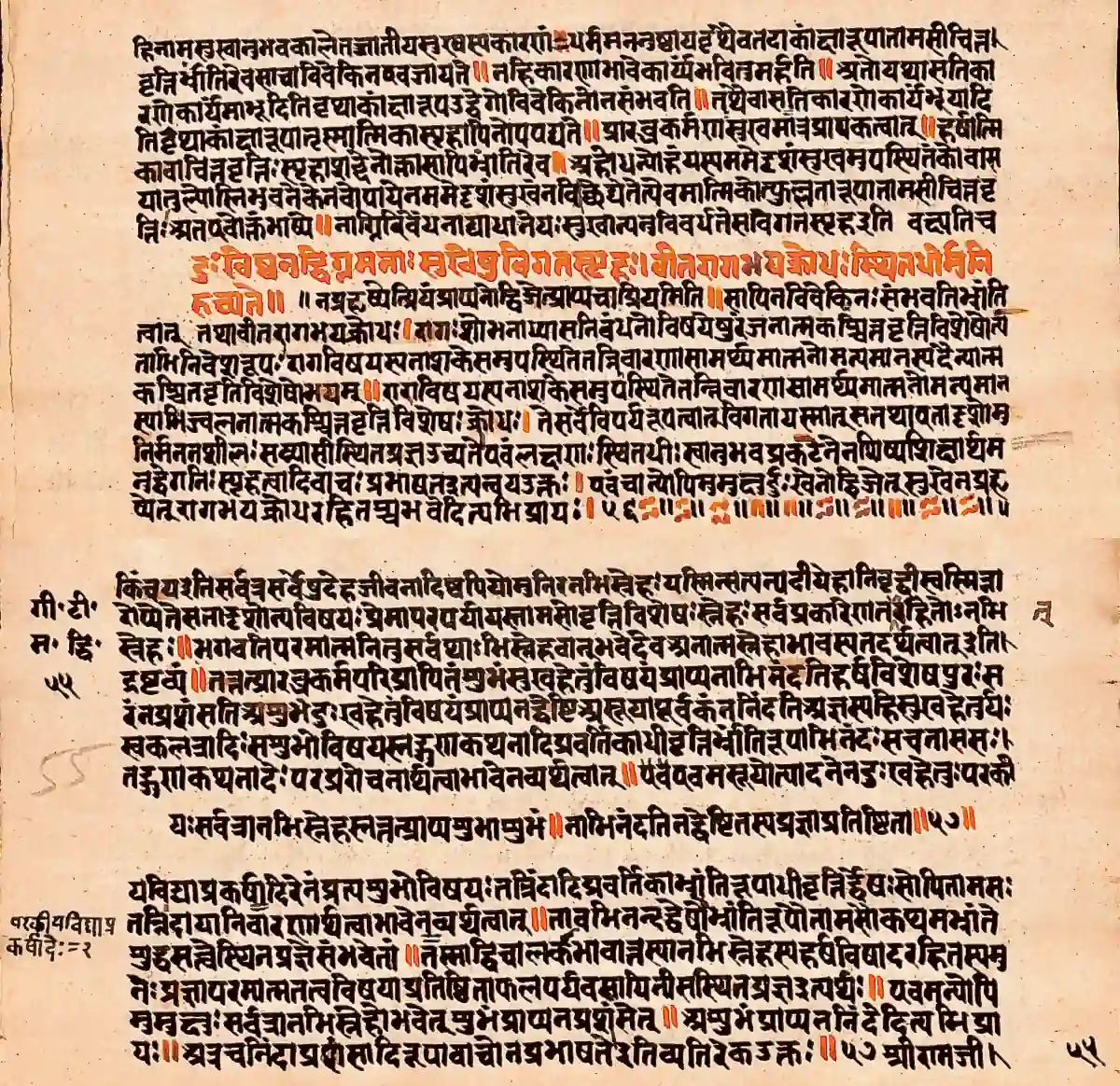
Where the illusion reading starts: a rope lying in the dark
One picture sits behind the whole illusion reading.
Think of a rope lying in the dark, which someone who cannot see it properly takes for a snake, or for one of the other things the verse names, and you have the image Gaudapada uses in his Karika on the Mandukya Upanishad (2.17). In his commentary Shankara puts the cause in the person. They do not know the rope for what it really is.
Verse 2.18 finishes the scene. The moment the rope is known for a rope, no snake is left.
The rope, in the Karika, is the Atman not known as it is, and the snake is everything imagined in its place. So maya, in this picture, is the darkness, the failure to see a rope that was lying there whole the entire time.

Does that make the world unreal? Advaita spends its whole length on that question, and a post about one word cannot give it the room it needs. For the full argument, school and teachers included, read our Advaita meaning post. Liberation, moksha, has its own post too.
What did Ramanuja say maya is?
Not an illusion. Ramanuja, the teacher of Vishishtadvaita, held maya to be a real power of Brahman, of Ishvara. Its effects are real too, even if they keep changing, and the Advaita account of maya was one he did not accept.
Look again at the two Gita rows in the table. Maya at 7.14 is “mine”, Bhagwan Krishna’s own. At 18.61 it is how Ishvara moves beings from inside their hearts. That is exactly how some modern Gita teachers read 7.14, as Bhagwan’s energy and not an illusion.
Tirth will not rank the two schools. Anyone told only that maya means illusion has heard one school’s answer, and the Gita’s own wording gives the other side plenty to stand on.
Mahamaya, the Maa Devi who clouds even the wise
Maya gets a face in the Devi Mahatmya. In the first chapter King Suratha and the merchant Samadhi hear it from the sage Medhas, who explains that Mahamaya, Maa Devi herself, draws even the minds of the wise into delusion.
The Devi texts turn maya back into a power held by a person, as in the Gita, and here that person is Maa Devi. For the festival itself, read our post on Navratri.
How Narada got back to himself, and the Gita’s word on crossing maya
The woman from the lake married King Taladhvaja of Kannauj, and sons came over the years, and then grandsons. Then an enemy king laid siege to the city, and in the war every son died, and every grandson with them.
She sat in her grief as queen until an old Brahmin, who was Bhagwan Vishnu in disguise, came to her and told her to bathe in a holy pool. She went into that water grieving. She came up as Narada again, and with that Book 6 brings him home.
Narada never thought his way free.
When he came up, Bhagwan Vishnu, who had brought him to that water, stood there on the bank.
The Gita puts the same thing in one verse at 7.14, “daivi hy esha guna-mayi mama maya duratyaya, mam eva ye prapadyante mayam etam taranti te”: this divine maya of mine, made of the gunas, is hard to cross; those who take refuge in me alone cross over it.
Nowhere does the verse say the crossing will be quick. Duratyaya, hard to cross, is the word it uses, and it lets that word stand.
The Gita’s teaching on action has a post of its own on Tirth: what the Gita and Upanishads say about action.
Frequently asked questions
What is the meaning of maya in Hinduism?
In the texts of Sanatan Dharma, the word points to a power through which the one is seen as many. The Rig Veda uses it for a god’s creative or magical power. The Gita gives it to Bhagwan Krishna as his own, and Shankara’s Advaita reads it as illusion.
Is the world an illusion according to Hinduism?
That depends on the school you ask. The rope and the snake are Advaita’s picture, after Gaudapada and Shankara, of a world that is misread. It was otherwise for Ramanuja, who held maya to be a real power of Ishvara, with effects that are real, though they change.
What does maya mean in the Bhagavad Gita?
His own maya, Bhagwan Krishna says at 7.14, is divine, made of the three gunas and hard to cross, and whoever takes refuge in him crosses it. Verse 18.61 has Ishvara dwelling in every heart and turning beings by maya, as if on a machine.
What is the rope and snake example?
A rope lies in the dark and is taken for a snake. That is the picture in Gaudapada’s Karika on the Mandukya Upanishad (2.17), and Shankara’s commentary puts the error down to not knowing the rope. Once the rope is known, the verse after it says, the snake disappears.
Who is Mahamaya?
Maa Devi, as the power of maya, is called Mahamaya. The sage Medhas tells King Suratha and the merchant Samadhi, in chapter 1 of the Devi Mahatmya, that she pulls even wise minds into delusion.
How do you overcome maya?
Maya is hard to cross, the Gita says at 7.14, and those who take refuge in Bhagwan alone cross it. Narada, in the Devi Bhagavata Purana story, does not find his own way back. Bhagwan Vishnu leads him there.
Continue on Tirth
- Advaita meaning on Tirth for the school that reads maya as the rope mistaken for a snake.
- What Sanatan Dharma means for the wider tradition these texts belong to.
- Navratri on Tirth for the nine nights kept for Maa Devi.
- The Tirth Spiritual Calendar for festival dates by city.
Leave a Reply