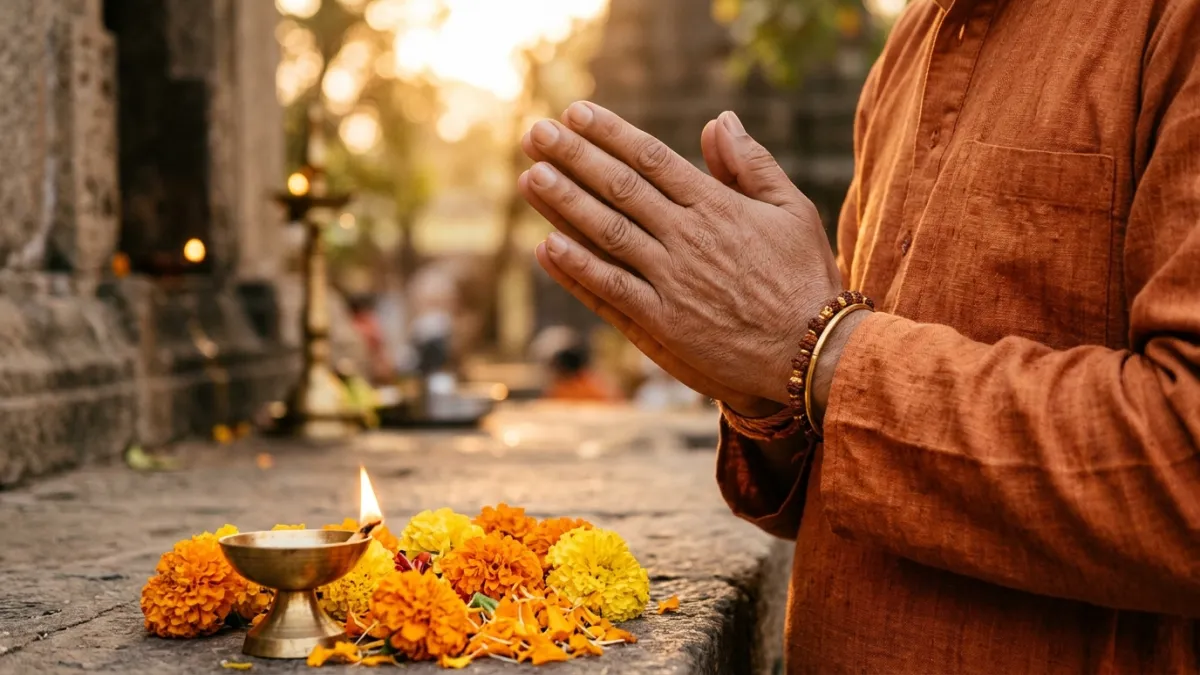
The namaste meaning fits in a line: you are saying “I bow to you”, or at greater length “salutations to you”. The phrase is Sanskrit, built from namas and te, and today it works as an ordinary polite greeting, said with the palms pressed together.
That is the dictionary answer, and it is plainer than the line you may have heard in a yoga class.
Three things sit under the word: its literal meaning, a Rig Veda verse where the same two words turn up, and the later devotional reading, “the divine in me bows to the divine in you”. They are easy to blur, so each gets its own section below.
The two small words inside namaste
Namas means a bow, an obeisance, a salutation, and Sanskrit dictionaries note that it is almost always used with the dative, the case that carries “to” or “for”. Te is the short dative of tvam, “to you”. The pair reads as “bowing to you” in the standard dictionaries. So “I bow to you”. Plain, and the right place to begin.
Spelling is the one wrinkle: on its own the word is namaḥ, and its final ḥ turns into an s before the t of te, giving the written form namaste.
| Word | Plain meaning (Tirth’s rendering) | Where you meet it |
|---|---|---|
| namas | a bow, homage, salutation | inside namaste |
| te | to you (the short, dative form of tvam) | inside namaste |
| namaste | bowing to you, salutations to you | the everyday greeting |
| namaḥ | a bow, homage | the word in Om Namah Shivaya |
| namo vām | namaste said to two people | the grammatical form for two |
| namo vaḥ | namaste said to three or more people | the grammatical form for a group |
Strictly, namaste is singular: one person, one “to you”. Two people call for namo vām and three or more for namo vaḥ, the forms in the last two rows, yet custom is looser than grammar and in India a whole group still hears namaste.
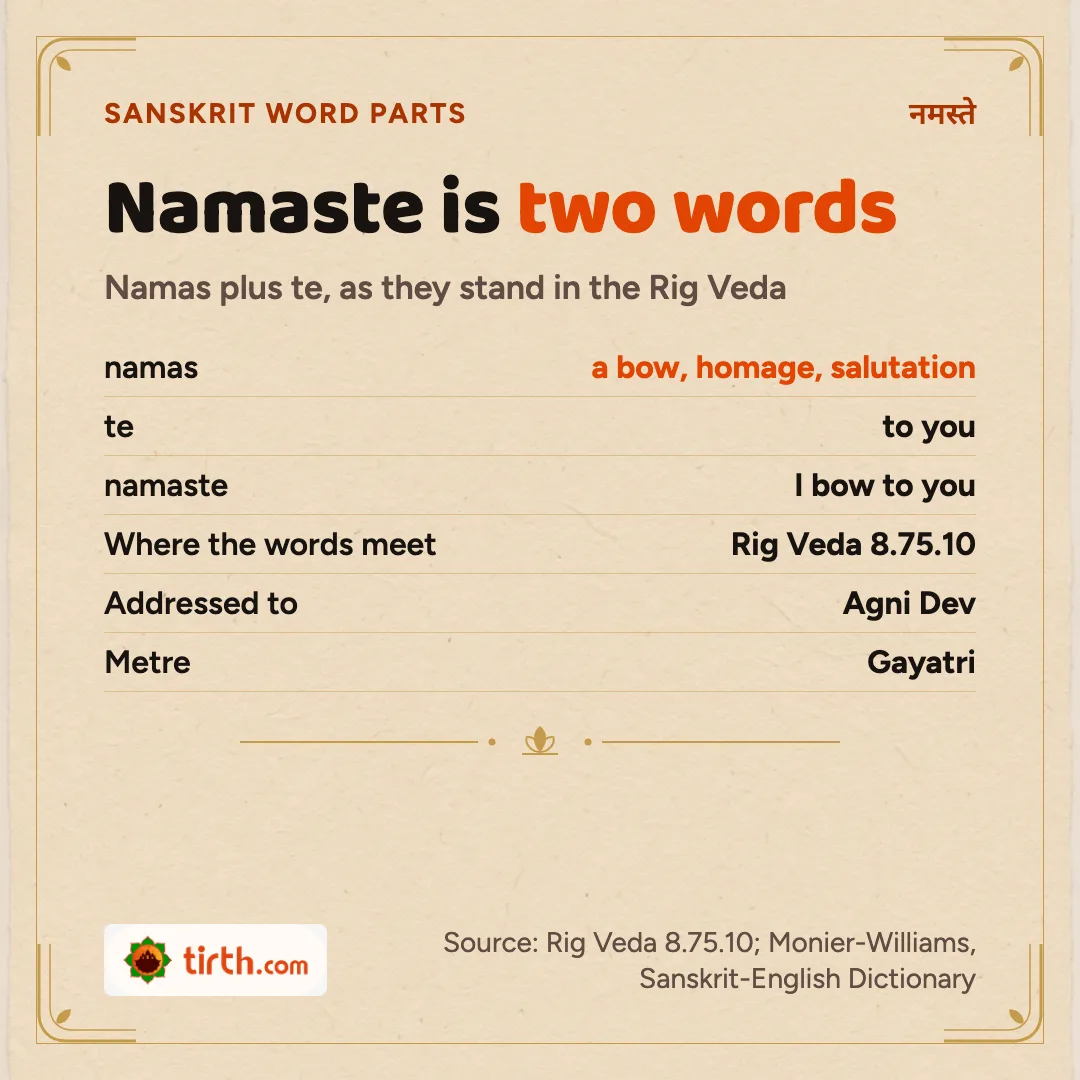
Namas te in the Rig Veda, a verse to Agni Dev
The two words stand side by side in Rig Veda 8.75.10, a short Gayatri-metre verse credited to the rishi Virupa and addressed to Agni Dev, the fire:
नमस्ते अग्न ओजसे गृणन्ति देव कृष्टयः । अमैरमित्रमर्दय ॥
namas te agna ojase gṛṇanti deva kṛṣṭayaḥ | amair amitram ardaya
An English translation from the nineteenth century gives the opening as “Divine Agni, men utter your praises for the attainment of strength”, after which the verse asks Agni Dev to destroy the enemy by that strength, and a more recent translation opens on homage too, homage to the power of Agni Dev.
No neighbour is being greeted here.
Here namas te is homage paid to a deity. Between people the same two words do a different job. More verses of this kind are collected in the post on Vedic mantras to Agni.
Where the folded hands come from
These days word and gesture arrive as a pair. Did they start that way? The verse says nothing about folded hands, so the safest thing to say is that the two came together over time.
Some terracotta figures from Harappan sites have their hands joined in a similar way. Do they show a greeting? That is open, so they cannot be offered as proof that namaste goes back to the Indus Valley.
The date is not known for when namaste became an everyday greeting either.
Is “the divine in me bows to the divine in you” a translation?
No. The Sanskrit gives “bowing to you”, and that is all it gives.
The longer line is a devotional reading. People added it later, hearing in the greeting a salutation to the atman, the self they believe lives in every person. Some scholars write about namaste that way; other writers answer that nothing in the Sanskrit itself supports it.
Both views can be held at once. Keep the reading if it moves you, and when you repeat it, call it a reading. We would always put the literal meaning first and the devotional reading second, because only the first is what the words say.
Namaste vs namaskar vs pranam across India
The greeting changes form as you cross India. The table gives common patterns, not a survey, and plenty of families say it another way.
| Greeting | Where it is commonly heard | A note |
|---|---|---|
| Namaskar | Hindi-speaking areas, Marathi | a close cousin of namaste |
| Namaskaram | Malayalam and other southern languages | a close cousin of namaste |
| Namaskaramu | Telugu | |
| Namaskara | Kannada | |
| Nomoshkar | West Bengal | |
| Vanakkam | Tamil | a different word |
| Sat Sri Akal | Sikh greeting, mostly Punjab | its own words and its own tradition |
| Pranam | used for parents, elders, teachers and deities | a deeper reverence, often with a touch of the feet |
Keep pranam apart. It is the word commonly chosen for parents, elders, teachers and deities, and a touch of the feet often goes with it. Namaste is lighter. Meeting someone new and unsure how formal to be, you can rely on namaste as the safe polite greeting.
Folded hands are not only Indian. Thailand has the wai, a related greeting. Want one more greeting to learn once namaste feels easy? Try the Ram Ram greeting.
Saying it yourself
Palms together, one person in front of you: namaste.
For a parent, an elder or a teacher, people commonly say pranam instead, often touching the feet.
Not sure which greeting to use in India? Namaste. It is the safe polite choice, and it needs no second word.
Frequently asked questions
What does namaste mean?
It means “I bow to you” or “salutations to you”. The Sanskrit behind it is namas, a bow or homage, followed by te, “to you”.
Is namaste religious?
The same two words occur in a Rig Veda verse to Agni Dev, so there is a devotional history behind them. As a greeting between people, namaste is a courteous sign of respect.
Is “the divine in me bows to the divine in you” a correct translation?
No. It is a later devotional reading and not a translation, because the Sanskrit literally says “bowing to you”. Some people hear the self in every person in the greeting, which is one way to read it.
What is the difference between namaste, namaskar and pranam?
Namaste and namaskar are close cousins. Pranam, by contrast, is the word commonly used for deeper reverence toward parents, elders, teachers and deities, with a touch of the feet in many cases.
Where does namaste come from?
Rig Veda 8.75.10, a verse to Agni Dev, holds namas te as two words together, and there they are homage to a deity. The greeting between people is another use, and the date for it is not known.
Why do Indians fold their hands?
Folded hands accompany namaste as a mark of respect. The date when the two joined is not known, so where the gesture began stays an open question.
Continue on Tirth
- Temples: find a temple page before you go.
- Destinations: where pilgrims go, and what to know first.
- Owl meaning in Hinduism: another meaning explained on the Tirth blog, a good next read if you enjoyed this one.
- Chappan Bhog meaning: the offering and what it stands for.
Leave a Reply