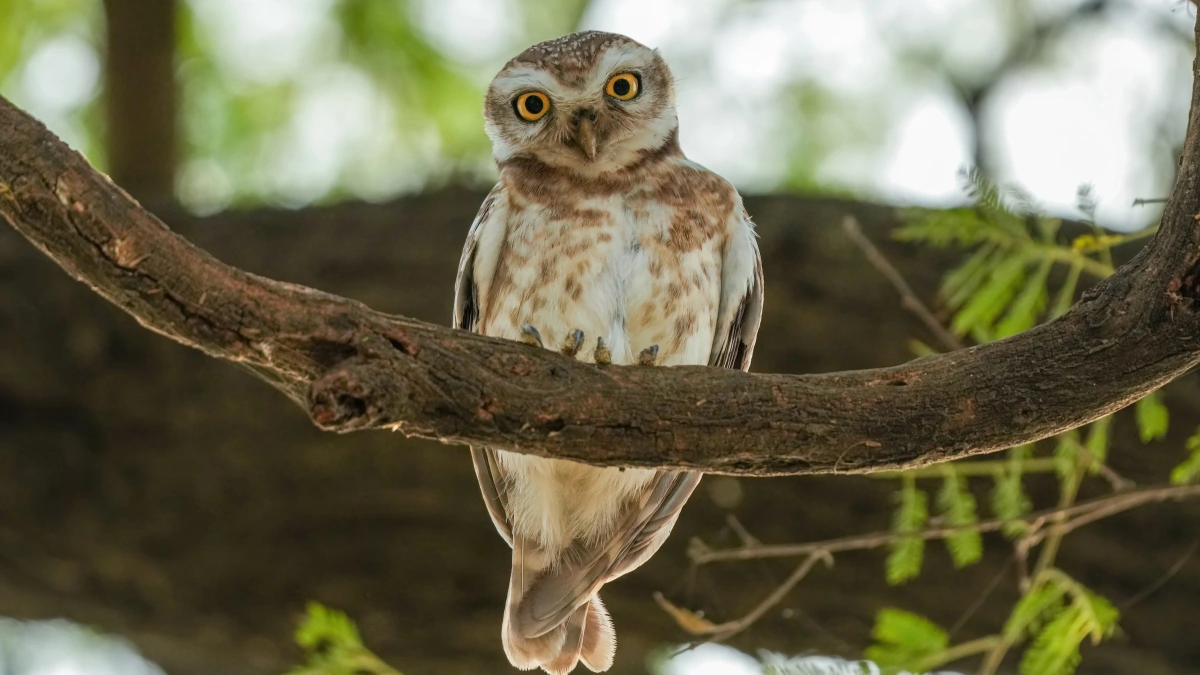
Why is there an owl at Maa Lakshmi’s feet in so many Diwali pictures? Devdutt Pattanaik, who has written on this very image, says the scriptures do not explain who the owl is, and no published source we found points to a text that does.
What exists instead is a set of readings. Each is held by someone you can name, from Pattanaik’s 2009 newspaper column to the art historians he quotes and the local belief of Bengal and Odisha, and none of them is the single answer to the owl meaning question.
Do the old texts say why Maa Lakshmi has an owl?
No published source checked for this page names one.
Pattanaik, writing in 2009, says plainly that the scriptures are silent on who the owl is. In temple art she is shown very often with elephants and only occasionally with an owl.
In the Gajalakshmi image (Maa Lakshmi with elephants on either side) she sits or stands on a lotus, and the same article reads the elephants as work, strength, water, rain and fertility. Gajalakshmi, and not the owl, is the more common image.
So if someone at the family puja tells you a particular Purana settles the matter, ask them which one and which chapter.
The white owl in Bengal and Odisha pictures
Pattanaik notes that in Orissa and Bengal, images of Maa Lakshmi include a white owl, and that local people see that bird as a sign of luck.
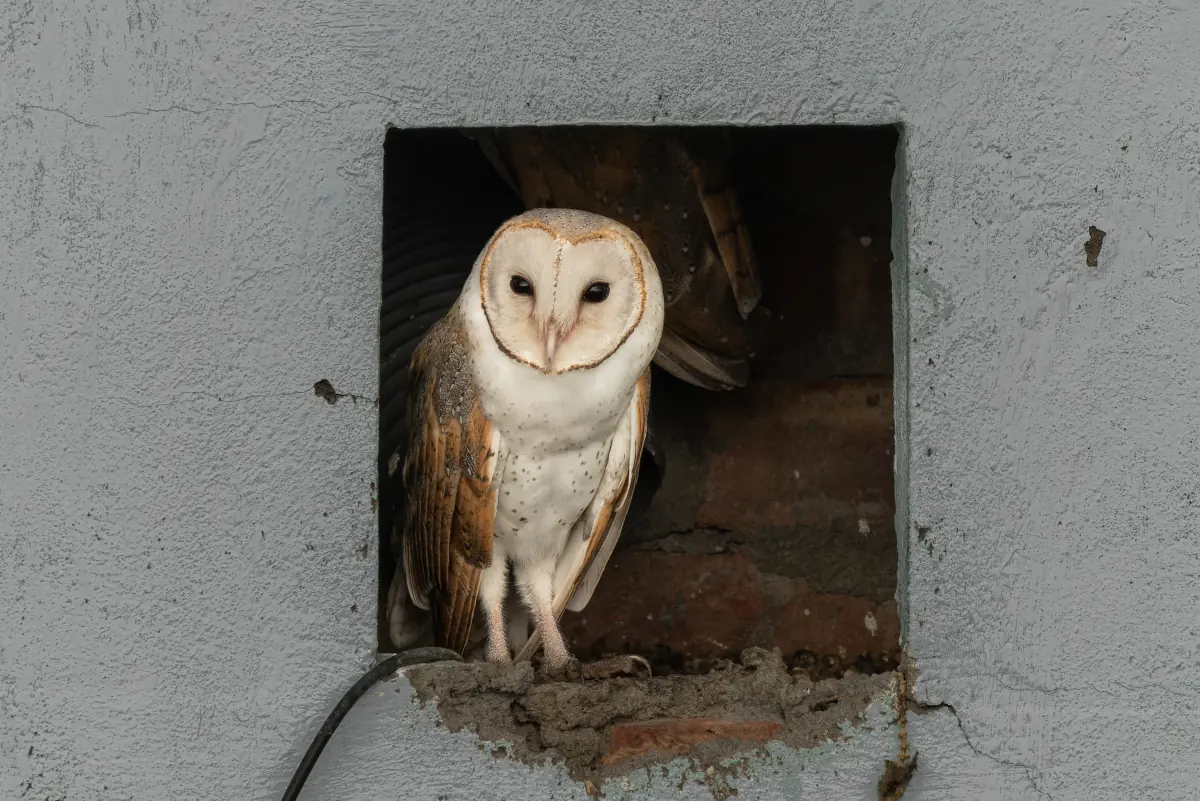
Is the owl her vahana (the animal a deity rides), or only her companion? Pattanaik records both views. Some say she rides it, while others say it only travels with her, since an elephant suits a deity of wealth and royalty better as a mount. Popular lists of vahanas do put the owl down as hers, and give it to Maa Chamunda too, so both answers are in circulation and neither comes with a verse attached.
For her forms and how she is worshipped, see Tirth’s page on Maa Lakshmi, her forms and her worship.
Owl meaning in Hinduism, read three ways
The first reading starts from the bird’s eyes.
The owl sees in the dark and is blinded by daylight. So it is read as patient effort to see and to know, and as a warning not to grow blind to truth, or greedy, once wealth and knowledge arrive.
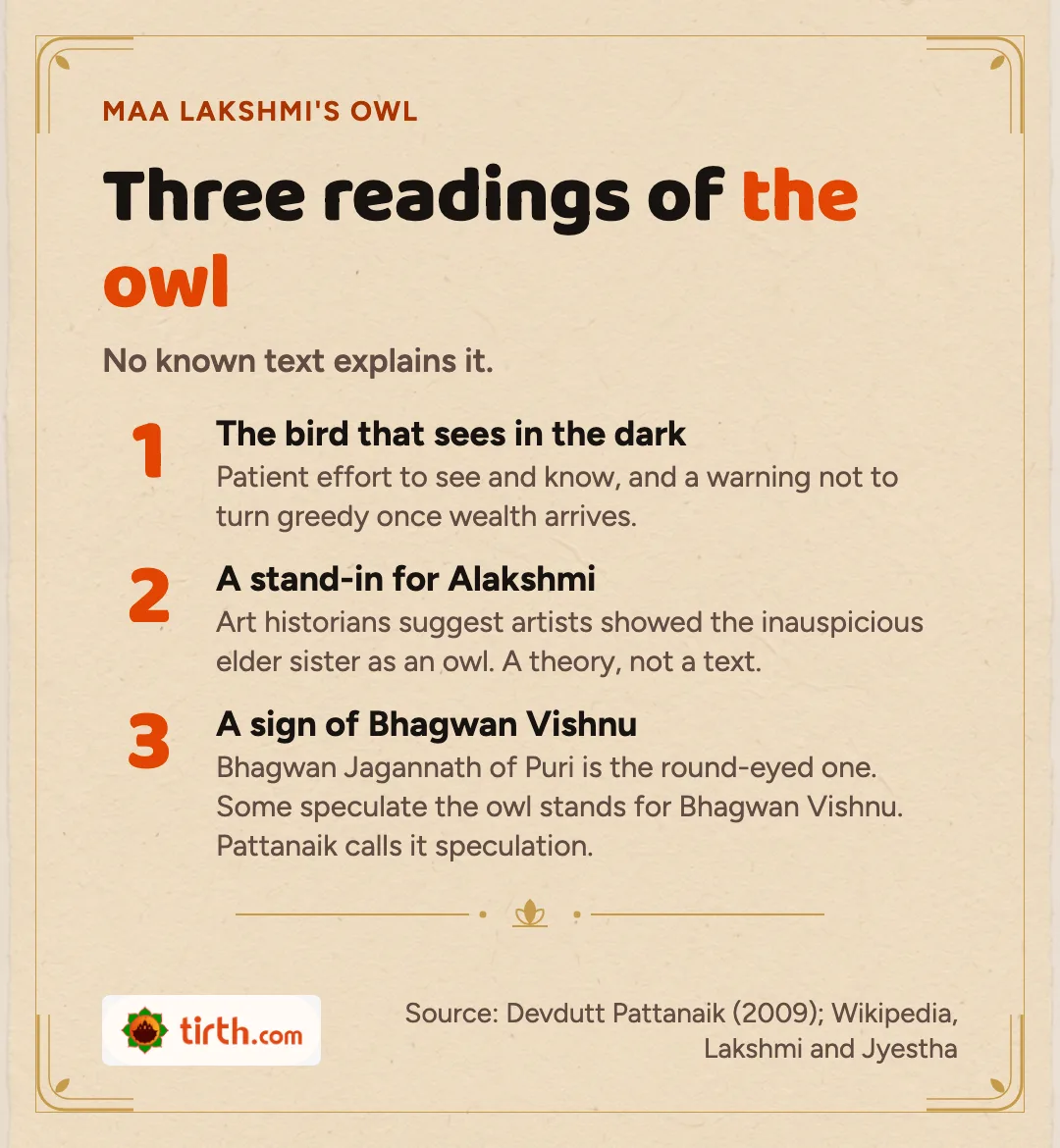
The second reading is darker, and it turns on Alakshmi, the elder sister of Maa Lakshmi who stands for misfortune, poverty and hunger. The Shri Sukta calls on Maa Lakshmi to drive Alakshmi away (we name the hymn only, and leave its text to the Lakshmi mantras page). Because owls are nocturnal, solitary and screech, they came to be tied with bad luck, and art historians quoted by Pattanaik suggest that artists, unwilling to draw Alakshmi, may have shown her as an owl instead.
The Puranas describe her differently. Jyestha, also called Alakshmi or Mudevi, is the sister who rose first at the churning of the ocean, and the Linga Purana gives her the name Alakshmi.
Her banner carries a crow. The article says nothing of an owl.
Pattanaik himself gives the owl-as-Alakshmi idea only as a theory, though it is the view he leans to in the end. We would rather families hold it that way too, as a writer’s best guess and never as something the scriptures say, because no text has been shown to back it.
The third reading comes from Puri. Bhagwan Jagannath is called Choka-dola, the one with round eyes, and some people speculate that the owl stands for Bhagwan Vishnu, consort of Maa Lakshmi. Pattanaik reports this and labels it speculation, preferring his own view that it is Alakshmi who walks beside her sister.
Lakshmi Puja on Sunday, 8 November 2026
Lakshmi Puja falls on Sunday, 8 November 2026, and the Lakshmi Puja muhurat for your city is on the festival page.
Should you feed or worship a real owl on Diwali?
No. Leave it alone.
Hunting and trading every Indian owl species is banned under the Wild Life (Protection) Act 1972, and in 2010 the wildlife trade monitor TRAFFIC warned that trade and sacrifice of owls could rise around Diwali. In 2021 Wildlife SOS reported a barn owl with a clipped wing found outside a temple in Vadodara, Gujarat, suspected of ritual use. If someone offers to sell you an owl for the puja, or promises luck from one, say no and walk away.
After the owl, the Diwali puja and the Chalisa
The steps and the samagri list are in Lakshmi Puja vidhi and samagri, and Lakshmi Puja timings explained covers the evening window in full. For the wider story of Diwali on 8 November 2026, read what Diwali means.
If your family sings after the puja, the Mahalakshmi Chalisa is there in full, and every festival date for the year is on the Tirth Spiritual Calendar. For another symbol read closely, see the sixteen adornments and what each one means, or browse more in Tirth Guides on devotional life and culture.
Frequently asked questions
Why does Maa Lakshmi ride an owl?
No scripture that published sources point to explains it. Writers offer readings instead, such as the owl as a bird that sees in the dark, the owl as a stand-in for Alakshmi, or the owl as a sign of Bhagwan Vishnu, and each is a view, not a verse.
Is the owl Maa Lakshmi’s vehicle or only her companion?
Both views exist. Devdutt Pattanaik records that some say she rides it and others say it only accompanies her, because an elephant suits a deity of wealth and royalty better. Popular lists of vahanas count the owl as hers.
Is the owl lucky or unlucky in Hinduism?
It depends on who you ask. In Orissa and Bengal, Pattanaik says, the white owl in images of Maa Lakshmi is tied to good luck in local belief, while the owl’s night habits and screech have also tied it with bad luck in other readings.
Is the owl linked with Alakshmi?
Only as a theory. Art historians quoted by Pattanaik suggest artists may have painted Alakshmi as an owl, but descriptions of Jyestha, another name for Alakshmi, give her a crow on her banner and do not mention an owl.
Why do some Maa Lakshmi pictures show elephants and no owl?
Because Gajalakshmi, Maa Lakshmi on a lotus with elephants beside her, is the more common image. She is very often shown with elephants and only occasionally with an owl.
Should owls be worshipped or fed on Diwali?
No. All Indian owls are protected, and hunting or trading them is banned under the Wild Life (Protection) Act 1972. TRAFFIC has warned that the trade in owls can rise around Diwali, and Wildlife SOS found a barn owl with a clipped wing outside a temple in Vadodara in 2021, so the kindest thing is to leave them be.
Continue on Tirth
- Tirth, Lakshmi Puja 2026, muhurat for your city.
- Tirth, Diwali 2026, date and Amavasya timing.
Leave a Reply