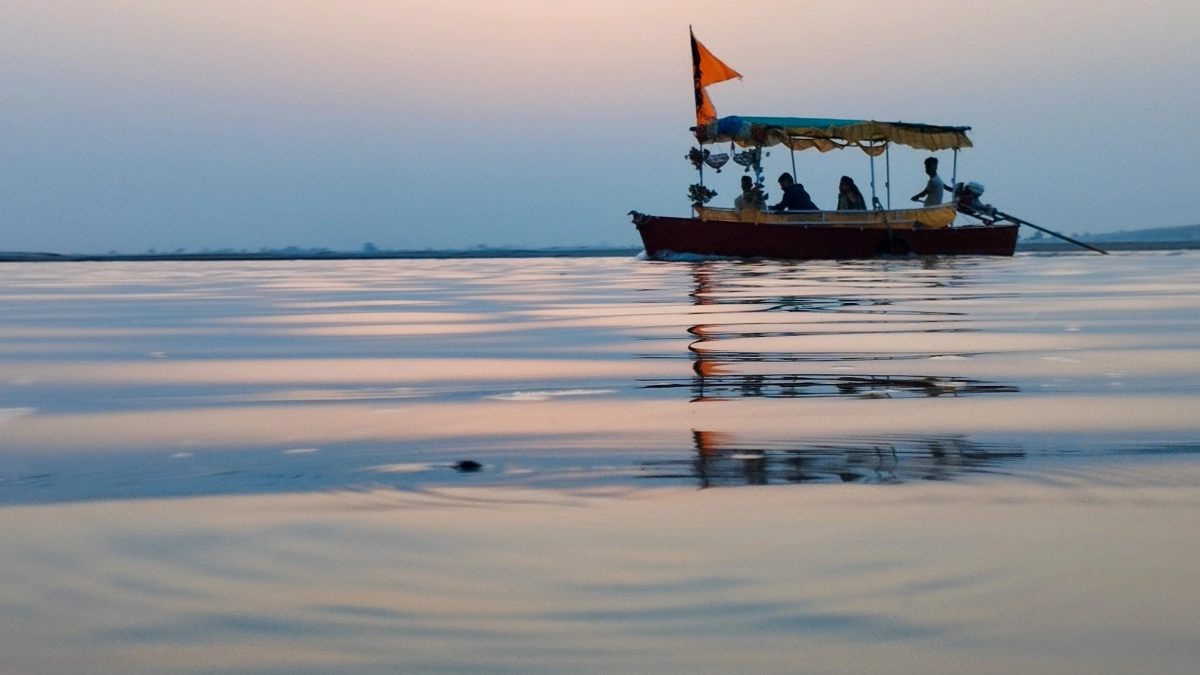
Ask about the Saryu river significance and the Valmiki Ramayana answers twice. In the Bala Kanda, a lake Bhagwan Brahma made on Mount Kailash by thought alone sends out a river, and that river is the one you see at Ayodhya.
The second answer waits for the last pages of the epic. In them, with his city’s people at his back, Bhagwan Ram walks into that same river.
Where does the Saryu come from in the Ramayana?
Turn to sarga 24 of the Bala Kanda. The speaker is Rishi Vishvamitra and the listener the young Bhagwan Ram, who hears that Bhagwan Brahma willed a great lake into being on Mount Kailash. It came from the mind. So the lake is called Manasa (of the mind).
Out of Manasa flows the Sarayu, the text’s spelling of Saryu, and the verse stops to explain the name from the lake itself (saras is Sanskrit for a lake, so a river born of a saras becomes the Sarayu). The name carries its source.
Further on in the same sarga, a great sound reaches the princes. Which is the Sarayu running into the Ganga, the sound of their waters colliding.
Put the two parts of the sarga together and see what the princes are given, a roar on the water and behind it a lake on Kailash that Bhagwan Brahma made by the mind.
The two translations differ on how the river meets Ayodhya. One has it surrounding the city; the Shastri translation has it flowing through.
Bhagwan Ram’s last walk, to Goprataraka ghat
The epic ends on this river too. Chapter 110 of the Uttara Kanda (the Shastri translation’s numbering) has Bhagwan Ram going with his subjects to the Goprataraka ghat on the Sarayu, where Bhagwan Brahma speaks to him from above. He steps into the water. And there he takes back his form as Bhagwan Vishnu, his brothers with him.
At the ghat, Bhagwan Brahma speaks to Bhagwan Ram from above.
The chapter does not stop at him. Those who entered the Sarayu’s waters, it says, gave up their bodies and rose to heaven. For Bhagwan Ram’s devoted followers Bhagwan Brahma set aside a realm of their own, and the text calls it Santanaka.
The Bala Kanda gives the river its source and the Uttara Kanda gives it this walk. For the life Bhagwan Ram lived in between, read who Bhagwan Ram was in Valmiki. The title he carried through all of it has a page of its own too, what Maryada Purushottam means.
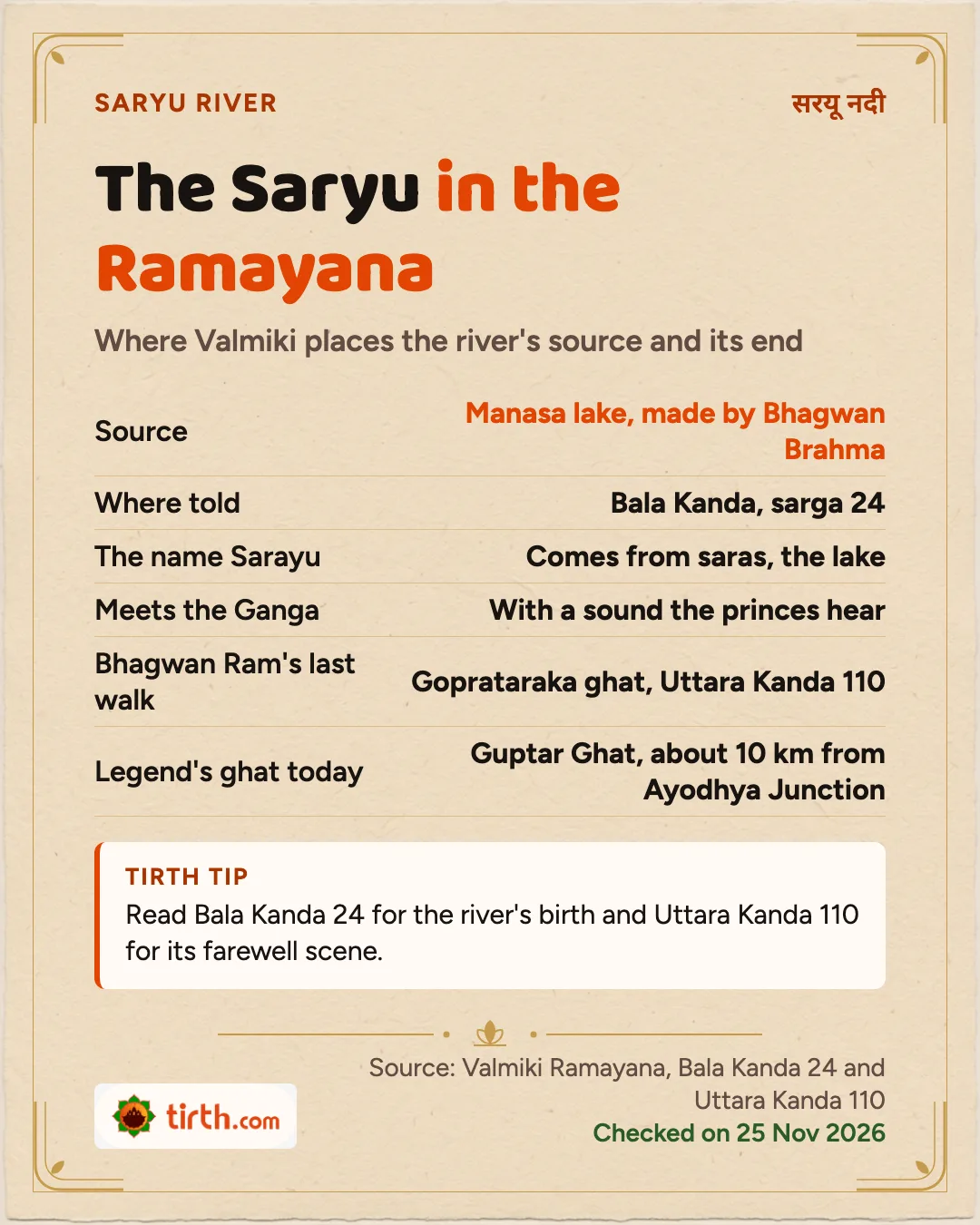
Is the Ramayana’s Saryu the Ghaghara on today’s map?
The water Bhagwan Ram walked into still runs past Ayodhya. A modern map labels it the Ghaghara, and popular usage calls the lower course of the Ghaghara the Sarayu or Sarju where it flows past Ayodhya, so largely, yes, they are the same river.
Some sources do not accept this. They treat the Sarayu as a stream of its own, and that argument is still open.
We would leave Bhagwan Brahma’s lake on Kailash exactly where the Ramayana puts it, as the text’s own account of where the river begins. That source is held in faith, and it is not something a map can check. More places like this are gathered in our sacred rivers, hills and places guides.
From the text to the town: Guptar Ghat
Text and ground part ways at the ghat as well. The Uttara Kanda names Goprataraka. Ayodhya points to a ghat of its own. In the legend India’s Ministry of Tourism has on record, Guptar Ghat is where Bhagwan Ram sat in meditation and then took jal samadhi (giving up the body in water), before ascending to Vaikuntha. It also records a belief of devotees, that a bath in the Saryu here washes away sins. The ancient Narsingh Temple is among the shrines nearby.
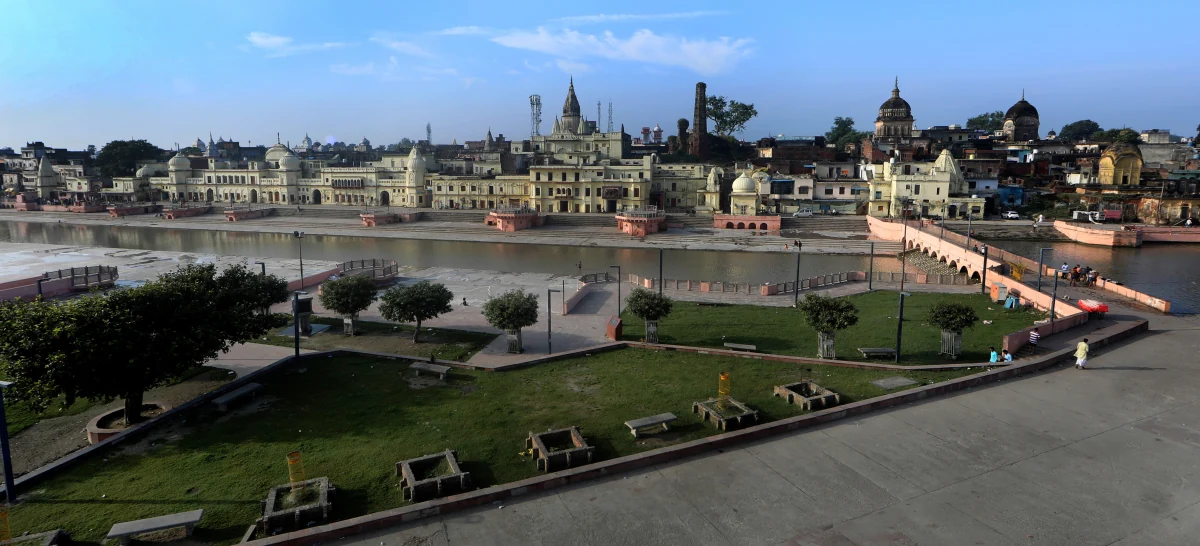
Ayodhya’s devotees have their own name for the river, Maa Saryu, which means mother Saryu. There is also our post on Ram Naam in Ayodhya.
Festival dates in Ayodhya move from year to year, so take them from the Tirth Spiritual Calendar. Planning a trip to Ayodhya has the practical side, and the Tirth yatra packages are there if you would rather travel with Tirth.
Frequently asked questions
Why is the Saryu sacred?
It leaves a lake Bhagwan Brahma made by thought, says the Valmiki Ramayana, and passes Ayodhya, Bhagwan Ram’s city. At the close of his life on earth, in the Uttara Kanda, he enters it. Devotees add a belief of their own, that bathing in it at Guptar Ghat washes away sins.
Where does the Saryu originate?
Manasa, says Bala Kanda sarga 24. Bhagwan Brahma made that lake by his will. It sits on Mount Kailash, and the river is named after it. The account is the Ramayana’s, held in faith.
Is Saryu the same as Ghaghara?
Largely. Where it flows past Ayodhya, the lower Ghaghara is popularly called the Saryu or Sarju. Some sources still treat the Sarayu as a separate river, so the question is not fully settled.
Where did Bhagwan Ram take jal samadhi?
The text gives one name and the town another. The Shastri translation of Uttara Kanda chapter 110 names the Goprataraka ghat on the Sarayu. Ayodhya’s legend puts the jal samadhi at Guptar Ghat.
What does the name Sarayu mean?
The Bala Kanda explains it from the lake. Saras is Sanskrit for a lake, and the river that flows out of Bhagwan Brahma’s lake on Mount Kailash is called the Sarayu (sarga 24). The lake is Manasa, of the mind, because Bhagwan Brahma made it by thought. Later in that sarga the princes hear a great roar, and it is this same river meeting the Ganga.
What happens to those who follow Bhagwan Ram into the Sarayu?
In Uttara Kanda chapter 110 he goes to the Goprataraka ghat with his subjects and returns to his Vishnu form with his brothers. Those who enter the water give up their bodies and rise to heaven, and Bhagwan Brahma gives his devoted followers a realm called Santanaka.
Continue on Tirth
- Ram Ki Paidi, a series of ghats on the bank of the Saryu.
- Ayodhya on Tirth, for the temples, ghats and sacred places of the city that sit beyond this one river’s story.
- How Ayodhya lives its faith each day.
- Tirth Spiritual Calendar, for each year’s festival dates in Ayodhya.
Leave a Reply